EUROPE
7236 articles
USA
10247 articles
DIGITAL
14857 articles (à imprimer)
Partitions Digitales
Partitions à imprimer
14857 partitions trouvées


Handbells handbell choir (3-6 octaves) with optional 3 octave handchimes & flute - Level 3 - Digital Download SKU: H1.2452DP Arranged by Cynthia Dobrinski. Hope's Recent Best Sellers Series. Christmas, Sacred. Handbell score. 12 pages. Hope Publishing - Digital #2452DP. Published by Hope Publishing - Digital (H1.2452DP). 1 Peter 1:10 - Genesis 11:9 - Isaiah 11:9 - Luke 2:8 - Luke 2:9 - Luke 2:10 - Luke 2:11 - Luke 2:12 - Luke 2:13 - Luke 2:14 - Luke 2:15.Familiar Carol Cynthia Dobrinski's elegant setting of this familiar carol provides sufficent contrast throughout by incorporating a variety of elements including a verse of Away in a Manger in the middle section. Optional 3 octave handchimes and a soaring flute part add special beauty and make this a lovely addition to both the concert and church repertoire.
It Came Upon the Midnight Clear
Cloches

$6.50 5.61 € Cloches PDF SheetMusicPlus

Piano and voice - Digital Download SKU: LV.23802 Arranged by Isidor Witmark. Entertainment, Alcoholic beverages, Intoxication, Courtship, Hangovers. Lester S. Levy Collection. 4 pages. Published by Johns Hopkins University Sheridan Libraries (LV.23802). The Great [Song] Success.What a Difference in the Morning! Or, At Night! At Night. Arranged by Isidor Witmark. Published 1891 by M. Witmark & Sons, 839 & 841 Broadway in New York. Composition of strophic with chorus with piano and voice instrumentation. Subject headings for this piece include Entertainment, Alcoholic beverages, Intoxication, Courtship, Hangovers. First line reads There's many a curious sight that we see, At night! at night!.. About The Lester S. Levy CollectionThe Lester S. Levy Collection of Sheet Music consists of over 29,000 pieces of American popular music. Donated to Johns Hopkins University Sheridan Libraries, the collection's strength is its thorough documentation of nineteenth-century American through popular music. This sheet music has been provided by Project Gado, a San Francisco Bay Area startup whose mission is to digitize and share the world's visual history.WARNING: These titles are provided as historical documents. Language and concepts within reflect the opinions and values of the time and may be offensive to some.
The Great (Song) Success. What a Difference in the Morning! Or, At Night! At Night
Piano, Voix

$5.99 5.17 € Piano, Voix PDF SheetMusicPlus

Brass Ensemble Trombone - Level 3 - Digital Download SKU: A0.813997 Composed by Franz Xaver Gruber. Arranged by Regis Bookshar. Christmas,Instructional,Multicultural,World. Score and parts. 11 pages. Regis Bookshar #6636659. Published by Regis Bookshar (A0.813997). Trombone Octet - Intermediate - Digital Download. This arrangement of Silent Night, or in German, Stille Nacht, would be a wonderful addition to any music library and could be performed for Christmas concerts, recitals, and, especially, church services. It is equally suitable for junior and senior high school students and even older musicians. Depending on their ability, younger musicians would also enjoy playing this selection. Included are a score and a complete set of parts (11 pages). This selection is one of the many arrangements from The Regis Bookshar Trumpet Ensemble's extensive music library which are being made available for the first time.Silent Night is probably the most popular Christmas carol ever written. It was composed in 1818 by Franz Xaver Gruber to lyrics by Joseph Mohr and was first performed on Christmas Eve at St. Nicholas parish church in Oberndorf, a small village in present-day Austria. A young Catholic priest, Father Joseph Mohr, had written the poem, Stille Nacht, in 1816 and had gone to Oberndorf in 1817. The melody was composed by Franz Xaver Gruber, schoolmaster and organist in the nearby village of Arnsdorf. On Christmas Eve, 1818, Mohr brought the words to Gruber and asked him to compose a melody and guitar accompaniment for that night's mass, after river flooding had possibly damaged the church organ. The church was eventually destroyed by repeated flooding and has since been replaced with the Silent-Night-Chapel.According to Gruber, Karl Mauracher, an organ builder who serviced the instrument at the Oberndorf church, was enamored with the song, and took the composition home with him to the Ziller Valley in Tyrol, Austria. From there, two traveling families of folk singers, the Strassers and the Rainers, included the tune in their shows. The Rainers were already singing it around Christmas, 1819, and once performed it for an audience that included Franz I of Austria and Alexander I of Russia. They also gave the first performance of the song in the United States in New York City in 1839. By the 1840's, the song was well known and was reported to be a favorite of Frederick William IV of Prussia. During this period, the melody changed slightly to become the version that is commonly heard today. The version of the melody that is generally used today is a slow, meditative lullaby, or pastoral, differing slightly from Gruber's original which has a moderate tempo. The song has been translated into about 140 languages and has been recorded by many singers across many music genres. The version sung by Bing Crosby in 1935, has sold over 10 million copies as a single.In this arrangement of Silent Night, Regis Bookshar has kept the basic form of this familiar Christmas carol, but has also included a descant during the third verse. Also, in addition to this version for a Trombone Octet, there are other arrangements of Silent Night available for a variety of instrumental ensembles. There are Quintets and Octets readily available for purchase. Please take the time to look for other versions of this composition. You may find something else that might also suit your needs.I would also encourage you to search for other arrangements by Regis Bookshar, as well, as there are numerous arrangements in a wide variety of styles, also available for purchase. You may find something else which might interest you. Please continue to check periodically because new arrangements are being added as often as possible. I'm certain that this wonderful arrangement of Silent Night will continue to entertain both performers and audiences alike for years to come.
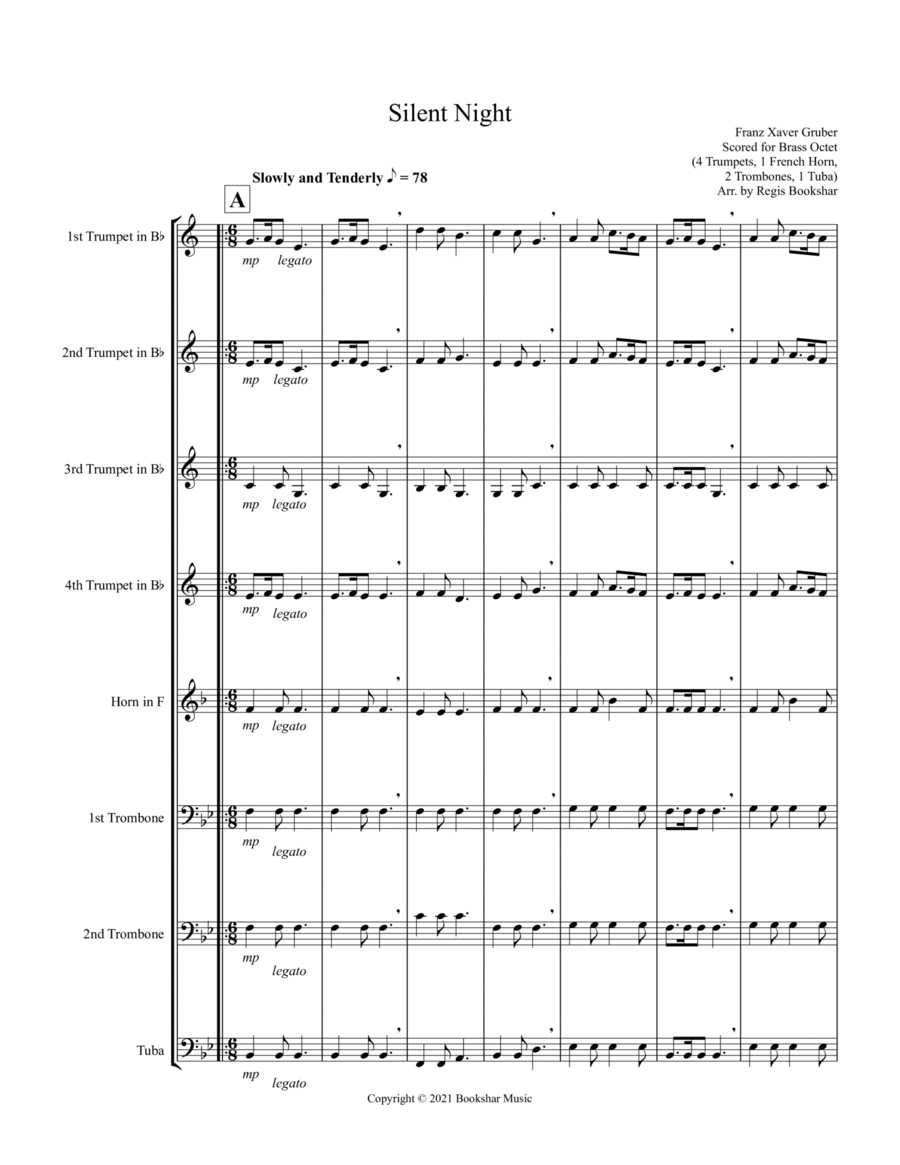
Silent Night (Bb) (Trombone Octet)
Ensemble de Trombones
the 1840's, the song was well known and was reported to be a favorite of Frederick William IV of Prussia During this period, the melody changed slightly to become the version that is commonly heard today
$8.00 6.9 € Ensemble de Trombones PDF SheetMusicPlus

Woodwind Ensemble Flute - Level 3 - Digital Download SKU: A0.813965 Composed by Franz Xaver Gruber. Arranged by Regis Bookshar. Christmas,Instructional,Multicultural,World. 7 pages. Regis Bookshar #6635849. Published by Regis Bookshar (A0.813965). Flute Quintet - Intermediate - Digital Download. This arrangement of Silent Night, or in German, Stille Nacht, would be a wonderful addition to any music library and could be performed for Christmas concerts, recitals, and, especially, church services. It is equally suitable for junior and senior high school students and even older musicians. Depending on their ability, younger musicians would also enjoy playing this selection. Included are a score and a complete set of parts (7 pages). This selection is one of the many arrangements from The Regis Bookshar Trumpet Ensemble's extensive music library which are being made available for the first time.Silent Night is probably the most popular Christmas carol ever written. It was composed in 1818 by Franz Xaver Gruber to lyrics by Joseph Mohr and was first performed on Christmas Eve at St. Nicholas parish church in Oberndorf, a small village in present-day Austria. A young Catholic priest, Father Joseph Mohr, had written the poem, Stille Nacht, in 1816 and had gone to Oberndorf in 1817. The melody was composed by Franz Xaver Gruber, schoolmaster and organist in the nearby village of Arnsdorf. On Christmas Eve, 1818, Mohr brought the words to Gruber and asked him to compose a melody and guitar accompaniment for that night's mass, after river flooding had possibly damaged the church organ. The church was eventually destroyed by repeated flooding and has since been replaced with the Silent-Night-Chapel.According to Gruber, Karl Mauracher, an organ builder who serviced the instrument at the Oberndorf church, was enamored with the song, and took the composition home with him to the Ziller Valley in Tyrol, Austria. From there, two traveling families of folk singers, the Strassers and the Rainers, included the tune in their shows. The Rainers were already singing it around Christmas, 1819, and once performed it for an audience that included Franz I of Austria and Alexander I of Russia. They also gave the first performance of the song in the United States in New York City in 1839. By the 1840's, the song was well known and was reported to be a favorite of Frederick William IV of Prussia. During this period, the melody changed slightly to become the version that is commonly heard today. The version of the melody that is generally used today is a slow, meditative lullaby, or pastoral, differing slightly from Gruber's original which has a moderate tempo. The song has been translated into about 140 languages and has been recorded by many singers across many music genres. The version sung by Bing Crosby in 1935, has sold over 10 million copies as a single.In this arrangement of Silent Night, Regis Bookshar has kept the basic form of this familiar Christmas carol, but has also included a descant during the third verse. Also, in addition to this version for a Flute Quintet, there are other arrangements of Silent Night available for a variety of instrumental ensembles. There are Quintets and Octets readily available for purchase. Please take the time to look for other versions of this composition. You may find something else that might also suit your needs.I would also encourage you to search for other arrangements by Regis Bookshar, as well, as there are numerous arrangements in a wide variety of styles, also available for purchase. You may find something else which might interest you. Please continue to check periodically because new arrangements are being added as often as possible. I'm certain that this wonderful arrangement of Silent Night will continue to entertain both performers and audiences alike for years to come.
Silent Night (Bb) (Flute Quintet)
Quintette de Flûte : 5 flûtes
the 1840's, the song was well known and was reported to be a favorite of Frederick William IV of Prussia During this period, the melody changed slightly to become the version that is commonly heard today
$5.00 4.31 € Quintette de Flûte : 5 flûtes PDF SheetMusicPlus

Brass Ensemble Horn,Trombone,Trumpet,Tuba - Level 3 - Digital Download SKU: A0.813980 Composed by Franz Xaver Gruber. Arranged by Regis Bookshar. Christmas,Instructional,Multicultural,World. Score and parts. 12 pages. Regis Bookshar #6636611. Published by Regis Bookshar (A0.813980). Brass Octet - Intermediate - Digital Download. This arrangement of Silent Night, or in German, Stille Nacht, would be a wonderful addition to any music library and could be performed for Christmas concerts, recitals, and, especially, church services. It is equally suitable for junior and senior high school students and even older musicians. Depending on their ability, younger musicians would also enjoy playing this selection. Included are a score and a complete set of parts (11 pages). This selection is one of the many arrangements from The Regis Bookshar Trumpet Ensemble's extensive music library which are being made available for the first time.Silent Night is probably the most popular Christmas carol ever written. It was composed in 1818 by Franz Xaver Gruber to lyrics by Joseph Mohr and was first performed on Christmas Eve at St. Nicholas parish church in Oberndorf, a small village in present-day Austria. A young Catholic priest, Father Joseph Mohr, had written the poem, Stille Nacht, in 1816 and had gone to Oberndorf in 1817. The melody was composed by Franz Xaver Gruber, schoolmaster and organist in the nearby village of Arnsdorf. On Christmas Eve, 1818, Mohr brought the words to Gruber and asked him to compose a melody and guitar accompaniment for that night's mass, after river flooding had possibly damaged the church organ. The church was eventually destroyed by repeated flooding and has since been replaced with the Silent-Night-Chapel.According to Gruber, Karl Mauracher, an organ builder who serviced the instrument at the Oberndorf church, was enamored with the song, and took the composition home with him to the Ziller Valley in Tyrol, Austria. From there, two traveling families of folk singers, the Strassers and the Rainers, included the tune in their shows. The Rainers were already singing it around Christmas, 1819, and once performed it for an audience that included Franz I of Austria and Alexander I of Russia. They also gave the first performance of the song in the United States in New York City in 1839. By the 1840's, the song was well known and was reported to be a favorite of Frederick William IV of Prussia. During this period, the melody changed slightly to become the version that is commonly heard today. The version of the melody that is generally used today is a slow, meditative lullaby, or pastoral, differing slightly from Gruber's original which has a moderate tempo. The song has been translated into about 140 languages and has been recorded by many singers across many music genres. The version sung by Bing Crosby in 1935, has sold over 10 million copies as a single.In this arrangement of Silent Night, Regis Bookshar has kept the basic form of this familiar Christmas carol, but has also included a descant during the third verse. Also, in addition to this version for a Brass Octet, consisting of 3 Trumpets, 2 French Horns, 2 Trombones and 1 Tuba, there are other arrangements of Silent Night available for a variety of instrumental ensembles. There are Quintets and Octets readily available for purchase. Please take the time to look for other versions of this composition. You may find something else that might also suit your needs.I would also encourage you to search for other arrangements by Regis Bookshar, as well, as there are numerous arrangements in a wide variety of styles, also available for purchase. You may find something else which might interest you. Please continue to check periodically because new arrangements are being added as often as possible. I'm certain that this wonderful arrangement of Silent Night will continue to entertain both performers and audiences alike for years to come.

Silent Night (Bb) (Brass Octet - 3 Trp, 2 Hrn, 2 Trb, 1 Tuba)
Quatuor de Cuivres : 2 trompettes, trombone, tuba
the 1840's, the song was well known and was reported to be a favorite of Frederick William IV of Prussia During this period, the melody changed slightly to become the version that is commonly heard today
$8.00 6.9 € Quatuor de Cuivres : 2 trompettes, trombone, tuba PDF SheetMusicPlus

Brass Ensemble Euphonium - Level 3 - Digital Download SKU: A0.813986 Composed by Franz Xaver Gruber. Arranged by Regis Bookshar. Christmas,Instructional,Multicultural,World. Score and parts. 12 pages. Regis Bookshar #6636629. Published by Regis Bookshar (A0.813986). Euphonium Octet - Intermediate - Digital Download. This arrangement of Silent Night, or in German, Stille Nacht, would be a wonderful addition to any music library and could be performed for Christmas concerts, recitals, and, especially, church services. It is equally suitable for junior and senior high school students and even older musicians. Depending on their ability, younger musicians would also enjoy playing this selection. Included are a score and a complete set of parts (12 pages). This selection is one of the many arrangements from The Regis Bookshar Trumpet Ensemble's extensive music library which are being made available for the first time.Silent Night is probably the most popular Christmas carol ever written. It was composed in 1818 by Franz Xaver Gruber to lyrics by Joseph Mohr and was first performed on Christmas Eve at St. Nicholas parish church in Oberndorf, a small village in present-day Austria. A young Catholic priest, Father Joseph Mohr, had written the poem, Stille Nacht, in 1816 and had gone to Oberndorf in 1817. The melody was composed by Franz Xaver Gruber, schoolmaster and organist in the nearby village of Arnsdorf. On Christmas Eve, 1818, Mohr brought the words to Gruber and asked him to compose a melody and guitar accompaniment for that night's mass, after river flooding had possibly damaged the church organ. The church was eventually destroyed by repeated flooding and has since been replaced with the Silent-Night-Chapel.According to Gruber, Karl Mauracher, an organ builder who serviced the instrument at the Oberndorf church, was enamored with the song, and took the composition home with him to the Ziller Valley in Tyrol, Austria. From there, two traveling families of folk singers, the Strassers and the Rainers, included the tune in their shows. The Rainers were already singing it around Christmas, 1819, and once performed it for an audience that included Franz I of Austria and Alexander I of Russia. They also gave the first performance of the song in the United States in New York City in 1839. By the 1840's, the song was well known and was reported to be a favorite of Frederick William IV of Prussia. During this period, the melody changed slightly to become the version that is commonly heard today. The version of the melody that is generally used today is a slow, meditative lullaby, or pastoral, differing slightly from Gruber's original which has a moderate tempo. The song has been translated into about 140 languages and has been recorded by many singers across many music genres. The version sung by Bing Crosby in 1935, has sold over 10 million copies as a single.In this arrangement of Silent Night, Regis Bookshar has kept the basic form of this familiar Christmas carol, but has also included a descant during the third verse. Also, in addition to this version for a Euphonium Octet, written in Treble Clef, there are other arrangements of Silent Night available for a variety of instrumental ensembles. There is also a version for a Euphonium Octet, written in Bass Clef, if you prefer. There are Quintets and Octets readily available for purchase. Please take the time to look for other versions of this composition. You may find something else that might also suit your needs.I would also encourage you to search for other arrangements by Regis Bookshar, as well, as there are numerous arrangements in a wide variety of styles, also available for purchase. You may find something else which might interest you. Please continue to check periodically because new arrangements are being added as often as possible. I'm certain that this wonderful arrangement of Silent Night will continue to entertain both performers and audiences alike for years to come.

Silent Night (Bb) (Euphonium Octet - Treble Clef)
the 1840's, the song was well known and was reported to be a favorite of Frederick William IV of Prussia During this period, the melody changed slightly to become the version that is commonly heard today
$8.00 6.9 € PDF SheetMusicPlus

Saxophone Ensemble,Woodwind Ensemble Alto Saxophone,Baritone Saxophone,Tenor Saxophone - Level 3 - Digital Download SKU: A0.813990 Composed by Franz Xaver Gruber. Arranged by Regis Bookshar. Christmas,Instructional,Multicultural,World. 11 pages. Regis Bookshar #6636637. Published by Regis Bookshar (A0.813990). Saxophone Octet - Intermediate - Digital Download. This arrangement of Silent Night, or in German, Stille Nacht, would be a wonderful addition to any music library and could be performed for Christmas concerts, recitals, and, especially, church services. It is equally suitable for junior and senior high school students and even older musicians. Depending on their ability, younger musicians would also enjoy playing this selection. Included are a score and a complete set of parts (11 pages). This selection is one of the many arrangements from The Regis Bookshar Trumpet Ensemble's extensive music library which are being made available for the first time.Silent Night is probably the most popular Christmas carol ever written. It was composed in 1818 by Franz Xaver Gruber to lyrics by Joseph Mohr and was first performed on Christmas Eve at St. Nicholas parish church in Oberndorf, a small village in present-day Austria. A young Catholic priest, Father Joseph Mohr, had written the poem, Stille Nacht, in 1816 and had gone to Oberndorf in 1817. The melody was composed by Franz Xaver Gruber, schoolmaster and organist in the nearby village of Arnsdorf. On Christmas Eve, 1818, Mohr brought the words to Gruber and asked him to compose a melody and guitar accompaniment for that night's mass, after river flooding had possibly damaged the church organ. The church was eventually destroyed by repeated flooding and has since been replaced with the Silent-Night-Chapel.According to Gruber, Karl Mauracher, an organ builder who serviced the instrument at the Oberndorf church, was enamored with the song, and took the composition home with him to the Ziller Valley in Tyrol, Austria. From there, two traveling families of folk singers, the Strassers and the Rainers, included the tune in their shows. The Rainers were already singing it around Christmas, 1819, and once performed it for an audience that included Franz I of Austria and Alexander I of Russia. They also gave the first performance of the song in the United States in New York City in 1839. By the 1840's, the song was well known and was reported to be a favorite of Frederick William IV of Prussia. During this period, the melody changed slightly to become the version that is commonly heard today. The version of the melody that is generally used today is a slow, meditative lullaby, or pastoral, differing slightly from Gruber's original which has a moderate tempo. The song has been translated into about 140 languages and has been recorded by many singers across many music genres. The version sung by Bing Crosby in 1935, has sold over 10 million copies as a single.In this arrangement of Silent Night, Regis Bookshar has kept the basic form of this familiar Christmas carol, but has also included a descant during the third verse. Also, in addition to this version for a Saxophone Octet, consisting of 3 Alto Saxophones, 4 Tenor Saxophones and 1 Baritone Saxophone, there are other arrangements of Silent Night available for a variety of instrumental ensembles. There are Quintets and Octets readily available for purchase. Please take the time to look for other versions of this composition. You may find something else that might also suit your needs.I would also encourage you to search for other arrangements by Regis Bookshar, as well, as there are numerous arrangements in a wide variety of styles, also available for purchase. You may find something else which might interest you. Please continue to check periodically because new arrangements are being added as often as possible. I'm certain that this wonderful arrangement of Silent Night will continue to entertain both performers and audiences alike for years to come.

Silent Night (Bb) (Saxophone Octet - 3 Alto, 4 Tenor, 1 Bari)
Ensemble de saxophones
the 1840's, the song was well known and was reported to be a favorite of Frederick William IV of Prussia During this period, the melody changed slightly to become the version that is commonly heard today
$8.00 6.9 € Ensemble de saxophones PDF SheetMusicPlus

Woodwind Ensemble,Woodwind Quintet Bassoon,Clarinet,Flute,Horn,Oboe - Level 3 - Digital Download SKU: A0.813981 Composed by Franz Xaver Gruber. Arranged by Regis Bookshar. Christmas,Instructional,Multicultural,World. 7 pages. Regis Bookshar #6635887. Published by Regis Bookshar (A0.813981). Woodwind Quintet - Intermediate - Digital Download. This arrangement of Silent Night, or in German, Stille Nacht, would be a wonderful addition to any music library and could be performed for Christmas concerts, recitals, and, especially, church services. It is equally suitable for junior and senior high school students and even older musicians. Depending on their ability, younger musicians would also enjoy playing this selection. Included are a score and a complete set of parts (7 pages). This selection is one of the many arrangements from The Regis Bookshar Trumpet Ensemble's extensive music library which are being made available for the first time.Silent Night is probably the most popular Christmas carol ever written. It was composed in 1818 by Franz Xaver Gruber to lyrics by Joseph Mohr and was first performed on Christmas Eve at St. Nicholas parish church in Oberndorf, a small village in present-day Austria. A young Catholic priest, Father Joseph Mohr, had written the poem, Stille Nacht, in 1816 and had gone to Oberndorf in 1817. The melody was composed by Franz Xaver Gruber, schoolmaster and organist in the nearby village of Arnsdorf. On Christmas Eve, 1818, Mohr brought the words to Gruber and asked him to compose a melody and guitar accompaniment for that night's mass, after river flooding had possibly damaged the church organ. The church was eventually destroyed by repeated flooding and has since been replaced with the Silent-Night-Chapel.According to Gruber, Karl Mauracher, an organ builder who serviced the instrument at the Oberndorf church, was enamored with the song, and took the composition home with him to the Ziller Valley in Tyrol, Austria. From there, two traveling families of folk singers, the Strassers and the Rainers, included the tune in their shows. The Rainers were already singing it around Christmas, 1819, and once performed it for an audience that included Franz I of Austria and Alexander I of Russia. They also gave the first performance of the song in the United States in New York City in 1839. By the 1840's, the song was well known and was reported to be a favorite of Frederick William IV of Prussia. During this period, the melody changed slightly to become the version that is commonly heard today. The version of the melody that is generally used today is a slow, meditative lullaby, or pastoral, differing slightly from Gruber's original which has a moderate tempo. The song has been translated into about 140 languages and has been recorded by many singers across many music genres. The version sung by Bing Crosby in 1935, has sold over 10 million copies as a single.In this arrangement of Silent Night, Regis Bookshar has kept the basic form of this familiar Christmas carol, but has also included a descant during the third verse. Also, in addition to this version for a Woodwind Quintet, consisting of 1 Flute, 1 Oboe, 1 Clarinet, 1 French Horn and 1 Bassoon, there are other arrangements of Silent Night available for a variety of instrumental ensembles. There are Quintets and Octets readily available for purchase. Please take the time to look for other versions of this composition. You may find something else that might also suit your needs.I would also encourage you to search for other arrangements by Regis Bookshar, as well, as there are numerous arrangements in a wide variety of styles, also available for purchase. You may find something else which might interest you. Please continue to check periodically because new arrangements are being added as often as possible. I'm certain that this wonderful arrangement of Silent Night will continue to entertain both performers and audiences alike for years to come.

Silent Night (Bb) (Woodwind Quintet - 1 Flute, 1 Oboe, 1 Clar, 1 Hrn, 1 Bassoon)
Quintette à Vent: flûte, Hautbois, basson, clarinette, Cor
the 1840's, the song was well known and was reported to be a favorite of Frederick William IV of Prussia During this period, the melody changed slightly to become the version that is commonly heard today
$5.00 4.31 € Quintette à Vent: flûte, Hautbois, basson, clarinette, Cor PDF SheetMusicPlus


Partitions Gratuites
Acheter des Partitions Musicales
Acheter des Partitions Digitales à Imprimer
Acheter des Instruments de Musique

© 2000 - 2025

Accueil - Version intégrale

