EUROPE
18046 articles
USA
50791 articles
DIGITAL
82503 articles (à imprimer)
Partitions Digitales
Partitions à imprimer
82503 partitions trouvées


Guitar,Piano,Vocal,Voice - Level 2 - Digital Download SKU: A0.564888 By Sharon Wilson. By Sharon Wilson. Arranged by Sharon Wilson. Children,Contemporary,Instructional,Praise & Worship,Sacred. Score. 35 pages. Sharon Wilson #3009845. Published by Sharon Wilson (A0.564888). This collection includes 10 easy-to-learn songs based on Bible verses. Two scores are provided for each song: a 3-staff voice with piano accompaniment score plus a separate lead sheet with only the melody, lyrics, and guitar chords. Scripture songs make learning Bible verses fun and are especially useful for children's ministries, home school, family worships, or Vacation Bible School. The ten titles in this collection are also available separately with accompanying preview pages and audio samples. Titles include:Always with Grace (Colossians 4:6)By His Grace (Romans 3:23-24)Commit to the Lord (Proverbs 16:3)Free Gift of God (Romans 6:23)He Is Faithful (1 John 1:9)If My People Pray (2 Chronicles 7:14)Rejoice, Pray, Give Thanks (1 Thessalonians 5:16-18)Rest for Your Souls (Matthew 11:28-30)The Law and Testimony (Isaiah 8:20)Trust in the Lord (Proverbs 3:5-6)Visit Sharon Wilson’s website: www.SharonWilsonMusic.comSubscribe to her YouTube Channel: www.youtube.com/user/SharonWilsonMusic
Scripture Songs (a collection of 10 Bible songs)
Piano, Voix et Guitare
Sharon Wilson
$10.00 8.61 € Piano, Voix et Guitare PDF SheetMusicPlus

Easy Piano - Level 2 - Digital Download SKU: A0.1413856 By Elton John. By Bernie Taupin and Elton John. Arranged by Bisdre Santus. Film/TV,Multicultural,Pop,Singer/Songwriter,Wedding,World. Score. 3 pages. Soul - Musical Creations #995642. Published by Soul - Musical Creations (A0.1413856). Explore the Magic of Elton John's Your Song - Easy Arrangement for Solo PianoAre you looking for a piece you can play and feel proud of? I present to you my simplified arrangement of Elton John's Your Song for solo piano.Why Your Song?Your Song is a song that touches everyone's heart. With its gentle melody, it is the perfect choice for piano students who want to move and connect with an audience.What makes this arrangement special?This arrangement has been carefully simplified to suit the skill level of developing pianists. Each note has been chosen with ease of playing in mind, allowing you to focus on expressing your own interpretation of the music.Why choose this arrangement?When you opt for this arrangement of Your Song, you are choosing a piece that challenges you in a comfortable and rewarding way. The simplicity of the notes doesn't compromise the beauty of the music, allowing you to immerse yourself in the magic of Elton John while developing your piano skills.Get it now and start playing!Don't pass up the opportunity to add this enchanting piece to your repertoire. Whether you're a beginner eager to impress your friends and family or a dedicated student looking for new challenges, this easy arrangement of Your Song is perfect for you. Buy now and embark on an exciting journey through music!
Your Song
Piano Facile
Elton John
$4.99 4.3 € Piano Facile PDF SheetMusicPlus

Saxophone Quartet,Woodwind Ensemble Alto Saxophone,Baritone Saxophone,Soprano Saxophone,Tenor Saxophone - Level 3 - Digital Download SKU: A0.1509854 By Francesco Leone. By Polish traditional. Arranged by Francesco Leone. Traditional. 25 pages. Glissato Edizioni Musicali #1085082. Published by Glissato Edizioni Musicali (A0.1509854). Step into the vibrant world of traditional Polish music with Grandpa's Polka, also celebrated as Polka Dziadek or The Clarinet Polka. This lively folksong, hailing from the late 19th century, has been a staple in folk celebrations and is now ingeniously arranged for Saxophone Quartet S.A.T.B. by Francesco Leone. This intermediate-level arrangement captures the energetic bounce and joyful spirit of the original melody while showcasing the versatility and rich tonality of the saxophone.This eBook provides both the full score and individual parts for the Soprano, Alto, Tenor, and Baritone saxophones, each meticulously arranged to ensure a rewarding and authentic polka experience. The arrangement pays homage to the piece’s folk roots while adapting it for the dynamic range of the saxophone ensemble, allowing each instrument to shine in both melody and harmony.An audio demonstration of this arrangement can be found at the provided link to www.glissato.it, offering an excellent opportunity for musicians to familiarize themselves with the pace and vivacity of the piece. The audio demo serves not only as a guide for interpretation but also as a source of inspiration, capturing the exuberance and communal joy that Grandpa's Polka evokes.Whether performed in a concert hall or at a community gathering, this eBook ensures that the rich cultural heritage of Grandpa's Polka is accessible to saxophonists eager to explore folk melodies in a classical setting. It's a delightful addition to any saxophone quartet's repertoire, promising to engage audiences with its infectious rhythm and nostalgic charm.
Saxophone Quartet: Grandpa's Polka (score & parts)
Quatuor de Saxophones: 4 saxophones
Francesco Leone
$14.99 12.91 € Quatuor de Saxophones: 4 saxophones PDF SheetMusicPlus

C Instrument - Level 3 - Digital Download SKU: A0.1012371 Composed by Tapio Sayppo. Pop. Lead Sheet / Fake Book. 5 pages. MSTS Music Studio #6024075. Published by MSTS Music Studio (A0.1012371). In January 2010, composer Tapio Sayppo was contacted by a 17-year-old schoolgirl named Sonia Zindoga in Helsinki, Finland. She had written two sets of lyrics, Unbroken Heart and Baby, That's Okay. She wanted Tapio to create the music for the two songs. After meeting her in Herttoniemi, Helsinki, Sayppo accepted the job. He then reviewed and edited the cute lyrics, wrote the music for the songs and played and recorded the instruments. Next, during several lengthy sessions, he taught Sonia to sings the songs. After all that, Tapio started recording her singing.
Baby, That's Okay (pop song)
Ligne De Mélodie, (Paroles) et Accords

$2.50 2.15 € Ligne De Mélodie, (Paroles) et Accords PDF SheetMusicPlus

Woodwind Ensemble,Woodwind Quintet Flute - Level 1 - Digital Download SKU: A0.957286 Composed by Bach, Martin Luther. Arranged by Ander. Baroque,Easter,Renaissance,Sacred,Wedding. 51 pages. Woods Only, Arrangements #6748223. Published by Woods Only, Arrangements (A0.957286). This album contains 5 of Johann Sebastian Bach's most famous and versatile pieces for flute choir quintet, all very well suited for the beginners who want to get to know the baroque repertoire. They are also suitable for performances at events such as: weddings, Christian and church ceremonies, Easter, and academic recitals or concerts. They can be used in music institutions and by teachers as repertoire material and study methods, either for performance or instrumental technique. This collection includes a totally free bonus for you to enjoy: Martin Luther's A Mighty Fortress is Our God, a Renaissance sacred song for choir, which has been adapted for this set. You can also buy each one individually by checking right at the end of each description of each work.1: Air on the G String - The original piece is part of Johann Sebastian Bach's Suite No. 3 for orchestra, in D Major, BWV 1068, written for Prince Leopold of Anhalt. The so-called Air on the G String dates from one of these latter employments. In the service of the Prince of Cöthen, Bach composed not only the famous Brandenburg Concertos, but also several orchestral suites, from the third of which comes the Air on the G String. This curious title derives from a later arrangement of this piece for violin solo, in which the melody is played entirely on the lower, higher string of the instrument. ID: S0.11897272: Arioso - The Cantata 156 (BWV 156) was written for the third Sunday after Epiphany in 1729, and was first performed on January 23 of that year. The text is by Picander, one of Bach's favorite librettists. Of the four cantatas written by Bach for the feast, it was the last and only one scored for solo voice. This is a choral cantata, employing a choral melody in several movements. Cantata 156, in fact, employs two different choral melodies and texts in the second and sixth movements. A cantata is a sung symphony consisting of several parts, one of which is the Arioso, which is the initial instrumental part. ID: S0.11899613: Jesu, joy of man's desiring - This is one of Bach's most beautiful cantatas, made famous by the Jesus the Joy of Men chorus. It was originally composed for Advent 1716 in Weimar. Years later, already in Leipzig, Advent was tempus clausum, there was no music in the churches. Bach then reworked it for the Feast of Mary's Visitation. It is the final chorale of the cantata Herz und Mund und Tat und Leben. Although it is the 32nd cantata composed by Bach, of those that have survived, it was given BWV 147 in the complete catalog of his works. ID: S0.11900114: O Jesulein süss, o Jesulein mild - The Jesulein süß, the Jesulein mild is an original traditional German choral melody for voice and continuous bass arranged by Johann Sebastian Bach around 1735. With lyrics by Valentin Thilo, O Jesulein süss is a sacred melody adapted and catalogued as BWV 493. The first translation is by Dirk van Hogendorp, who made it more of a song for the time of suffering. ID: S0.11901175: Minuet in G major - This famous piece has traditionally been attributed to Johann Sebastian Bach, as it appears in the Notebook for Anna Magdalena , a notebook that Bach gave to his wife Anna Magdalena in 1725 and which was to be filled with the favorite selections of Bach family members. However, recent research has concluded that this minuet, sometimes referred to as BWV Anhang 114. was probably composed by Christian Petzold, a German composer and organist contemporary with Bach. ID: S0.1190347Bonuses: A Mighty Fortress is Our God, by Martin Luther - Ein feste Burg ist unser Gott is a hymn written by Martin Luther probably before 1529. The melody was also considered his work for a long time, but it was created at least with the collaboration of Johann Walter. The song is of great symbolic power f.
5 Famous Songs by Bach for Flute Choir Quintet
Quintette de Flûte : 5 flûtes

$39.99 34.43 € Quintette de Flûte : 5 flûtes PDF SheetMusicPlus

Woodwind Ensemble,Woodwind Quintet Alto Saxophone,Baritone Saxophone,Soprano Saxophone,Tenor Saxophone - Level 1 - Digital Download SKU: A0.957297 Composed by Bach, Martin Luther. Arranged by Ander. Baroque,Easter,Renaissance,Sacred,Wedding. 51 pages. Woods Only, Arrangements #6748253. Published by Woods Only, Arrangements (A0.957297). This album contains 5 of Johann Sebastian Bach's most famous and versatile pieces for saxophone choir quintet, all very well suited for the beginners who want to get to know the baroque repertoire. They are also suitable for performances at events such as: weddings, Christian and church ceremonies, Easter, and academic recitals or concerts. They can be used in music institutions and by teachers as repertoire material and study methods, either for performance or instrumental technique. This collection includes a totally free bonus for you to enjoy: Martin Luther's A Mighty Fortress is Our God, a Renaissance sacred song for choir, which has been adapted for this set. You can also buy each one individually by checking right at the end of each description of each work.1: Air on the G String - The original piece is part of Johann Sebastian Bach's Suite No. 3 for orchestra, in D Major, BWV 1068, written for Prince Leopold of Anhalt. The so-called Air on the G String dates from one of these latter employments. In the service of the Prince of Cöthen, Bach composed not only the famous Brandenburg Concertos, but also several orchestral suites, from the third of which comes the Air on the G String. This curious title derives from a later arrangement of this piece for violin solo, in which the melody is played entirely on the lower, higher string of the instrument. ID: S0.11897852: Arioso - The Cantata 156 (BWV 156) was written for the third Sunday after Epiphany in 1729, and was first performed on January 23 of that year. The text is by Picander, one of Bach's favorite librettists. Of the four cantatas written by Bach for the feast, it was the last and only one scored for solo voice. This is a choral cantata, employing a choral melody in several movements. Cantata 156, in fact, employs two different choral melodies and texts in the second and sixth movements. A cantata is a sung symphony consisting of several parts, one of which is the Arioso, which is the initial instrumental part. ID: S0.11899873: Jesu, joy of man's desiring - This is one of Bach's most beautiful cantatas, made famous by the Jesus the Joy of Men chorus. It was originally composed for Advent 1716 in Weimar. Years later, already in Leipzig, Advent was tempus clausum, there was no music in the churches. Bach then reworked it for the Feast of Mary's Visitation. It is the final chorale of the cantata Herz und Mund und Tat und Leben. Although it is the 32nd cantata composed by Bach, of those that have survived, it was given BWV 147 in the complete catalog of his works. ID: S0.11900434: O Jesulein süss, o Jesulein mild - The Jesulein süß, the Jesulein mild is an original traditional German choral melody for voice and continuous bass arranged by Johann Sebastian Bach around 1735. With lyrics by Valentin Thilo, O Jesulein süss is a sacred melody adapted and catalogued as BWV 493. The first translation is by Dirk van Hogendorp, who made it more of a song for the time of suffering. ID: S0.11901835: Minuet in G major - This famous piece has traditionally been attributed to Johann Sebastian Bach, as it appears in the Notebook for Anna Magdalena , a notebook that Bach gave to his wife Anna Magdalena in 1725 and which was to be filled with the favorite selections of Bach family members. However, recent research has concluded that this minuet, sometimes referred to as BWV Anhang 114. was probably composed by Christian Petzold, a German composer and organist contemporary with Bach. ID: S0.1190379Bonuses: A Mighty Fortress is Our God, by Martin Luther - Ein feste Burg ist unser Gott is a hymn written by Martin Luther probably before 1529. The melody was also considered his work for a long time, but it was created at least with the collaboration of Johann Walter. The song is of great symbolic power for Protest.
5 Famous Songs by Bach for Saxophone Choir Quintet
Quintette de Saxophone: 5 saxophones

$39.99 34.43 € Quintette de Saxophone: 5 saxophones PDF SheetMusicPlus

Woodwind Ensemble,Woodwind Quintet Oboe - Level 1 - Digital Download SKU: A0.957289 Composed by Bach, Martin Luther. Arranged by Ander. Baroque,Easter,Renaissance,Sacred,Wedding. 51 pages. Woods Only, Arrangements #6748229. Published by Woods Only, Arrangements (A0.957289). This album contains 5 of Johann Sebastian Bach's most famous and versatile pieces for oboe quintet, all very well suited for the beginners who want to get to know the baroque repertoire. They are also suitable for performances at events such as: weddings, Christian and church ceremonies, Easter, and academic recitals or concerts. They can be used in music institutions and by teachers as repertoire material and study methods, either for performance or instrumental technique. This collection includes a totally free bonus for you to enjoy: Martin Luther's A Mighty Fortress is Our God, a Renaissance sacred song for choir, which has been adapted for this set. You can also buy each one individually by checking right at the end of each description of each work.1: Air on the G String - The original piece is part of Johann Sebastian Bach's Suite No. 3 for orchestra, in D Major, BWV 1068, written for Prince Leopold of Anhalt. The so-called Air on the G String dates from one of these latter employments. In the service of the Prince of Cöthen, Bach composed not only the famous Brandenburg Concertos, but also several orchestral suites, from the third of which comes the Air on the G String. This curious title derives from a later arrangement of this piece for violin solo, in which the melody is played entirely on the lower, higher string of the instrument. ID: S0.11897472: Arioso - The Cantata 156 (BWV 156) was written for the third Sunday after Epiphany in 1729, and was first performed on January 23 of that year. The text is by Picander, one of Bach's favorite librettists. Of the four cantatas written by Bach for the feast, it was the last and only one scored for solo voice. This is a choral cantata, employing a choral melody in several movements. Cantata 156, in fact, employs two different choral melodies and texts in the second and sixth movements. A cantata is a sung symphony consisting of several parts, one of which is the Arioso, which is the initial instrumental part. ID: S0.11899673: Jesu, joy of man's desiring - This is one of Bach's most beautiful cantatas, made famous by the Jesus the Joy of Men chorus. It was originally composed for Advent 1716 in Weimar. Years later, already in Leipzig, Advent was tempus clausum, there was no music in the churches. Bach then reworked it for the Feast of Mary's Visitation. It is the final chorale of the cantata Herz und Mund und Tat und Leben. Although it is the 32nd cantata composed by Bach, of those that have survived, it was given BWV 147 in the complete catalog of his works. ID: S0.11900194: O Jesulein süss, o Jesulein mild - The Jesulein süß, the Jesulein mild is an original traditional German choral melody for voice and continuous bass arranged by Johann Sebastian Bach around 1735. With lyrics by Valentin Thilo, O Jesulein süss is a sacred melody adapted and catalogued as BWV 493. The first translation is by Dirk van Hogendorp, who made it more of a song for the time of suffering. ID: S0.11901355: Minuet in G major - This famous piece has traditionally been attributed to Johann Sebastian Bach, as it appears in the Notebook for Anna Magdalena , a notebook that Bach gave to his wife Anna Magdalena in 1725 and which was to be filled with the favorite selections of Bach family members. However, recent research has concluded that this minuet, sometimes referred to as BWV Anhang 114. was probably composed by Christian Petzold, a German composer and organist contemporary with Bach. ID: S0.1190355Bonuses: A Mighty Fortress is Our God, by Martin Luther - Ein feste Burg ist unser Gott is a hymn written by Martin Luther probably before 1529. The melody was also considered his work for a long time, but it was created at least with the collaboration of Johann Walter. The song is of great symbolic power for Protestantism; whe.
5 Famous Songs by Bach for Oboe Quintet
Ensemble de Hautbois

$39.99 34.43 € Ensemble de Hautbois PDF SheetMusicPlus

Woodwind Ensemble,Woodwind Trio Clarinet,Flute,Oboe - Level 2 - Digital Download SKU: A0.1138509 Composed by Christian Petzold, Johann Sebastian Bach, and Martin Luther. Arranged by Ander. Baroque,Easter,Renaissance,Sacred,Wedding. 38 pages. Woods Only, Arrangements #738849. Published by Woods Only, Arrangements (A0.1138509). This album contains 5 of Johann Sebastian Bach's most famous and versatile pieces for woodwind trio, all very well suited for the beginners who want to get to know the baroque repertoire. They are also suitable for performances at events such as: weddings, Christian and church ceremonies, Easter, and academic recitals or concerts. They can be used in music institutions and by teachers as repertoire material and study methods, either for performance or instrumental technique. This collection includes a totally free bonus for you to enjoy: Martin Luther's A Mighty Fortress is Our God, a Renaissance sacred song for choir, which has been adapted for this set. 1: Air on the G String - The original piece is part of Johann Sebastian Bach's Suite No. 3 for orchestra, in D Major, BWV 1068, written for Prince Leopold of Anhalt. The so-called Air on the G String dates from one of these latter employments. In the service of the Prince of Cöthen, Bach composed not only the famous Brandenburg Concertos, but also several orchestral suites, from the third of which comes the Air on the G String. This curious title derives from a later arrangement of this piece for violin solo, in which the melody is played entirely on the lower, higher string of the instrument. 2: Arioso - The Cantata 156 (BWV 156) was written for the third Sunday after Epiphany in 1729, and was first performed on January 23 of that year. The text is by Picander, one of Bach's favorite librettists. Of the four cantatas written by Bach for the feast, it was the last and only one scored for solo voice. This is a choral cantata, employing a choral melody in several movements. Cantata 156, in fact, employs two different choral melodies and texts in the second and sixth movements. A cantata is a sung symphony consisting of several parts, one of which is the Arioso, which is the initial instrumental part. 3: Jesu, joy of man's desiring - This is one of Bach's most beautiful cantatas, made famous by the Jesus the Joy of Men chorus. It was originally composed for Advent 1716 in Weimar. Years later, already in Leipzig, Advent was tempus clausum, there was no music in the churches. Bach then reworked it for the Feast of Mary's Visitation. It is the final chorale of the cantata Herz und Mund und Tat und Leben. Although it is the 32nd cantata composed by Bach, of those that have survived, it was given BWV 147 in the complete catalog of his works. 4: O Jesulein süss, o Jesulein mild - The Jesulein süß, the Jesulein mild is an original traditional German choral melody for voice and continuous bass arranged by Johann Sebastian Bach around 1735. With lyrics by Valentin Thilo, O Jesulein süss is a sacred melody adapted and catalogued as BWV 493. The first translation is by Dirk van Hogendorp, who made it more of a song for the time of suffering. 5: Minuet in G major - This famous piece has traditionally been attributed to Johann Sebastian Bach, as it appears in the Notebook for Anna Magdalena , a notebook that Bach gave to his wife Anna Magdalena in 1725 and which was to be filled with the favorite selections of Bach family members. However, recent research has concluded that this minuet, sometimes referred to as BWV Anhang 114. was probably composed by Christian Petzold, a German composer and organist contemporary with Bach. Bonus: A Mighty Fortress is Our God, by Martin Luther - Ein feste Burg ist unser Gott is a hymn written by Martin Luther probably before 1529. The melody was also considered his work for a long time, but it was created at least with the collaboration of Johann Walter. The song is of great symbolic power for Protestantism, where it is also known as Deus noster refugium et virtus. Considered one of the most important hymns in the history of Christianity, it was considered by the Christian poet Johann Heirich Heine (1797-1856) to be the Marseillaise of the Reformation, in an allusion to the French national anthem.
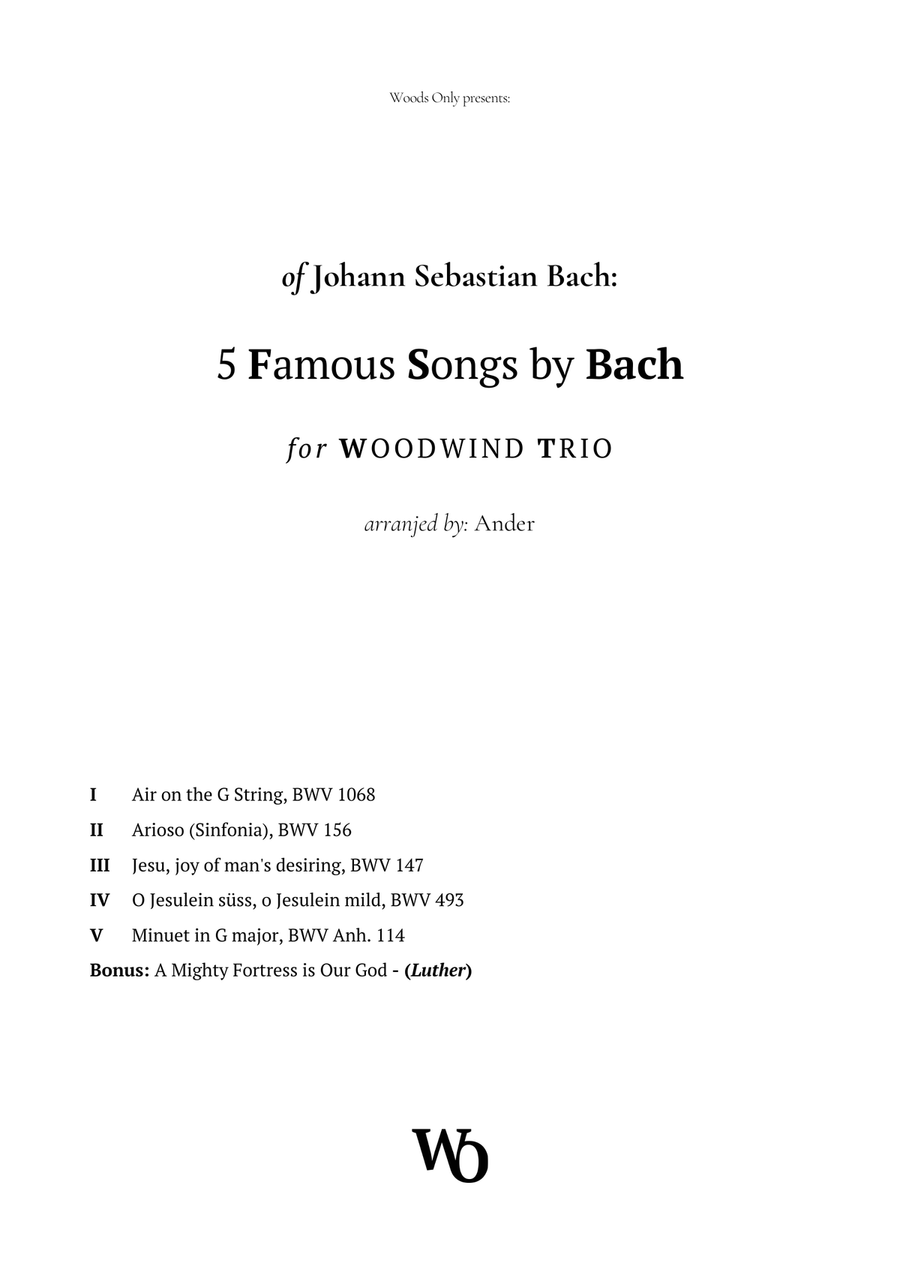
5 Famous Songs by Bach for Woodwind Trio
Flûte, Hautbois, Clarinette (trio)

$23.99 20.66 € Flûte, Hautbois, Clarinette (trio) PDF SheetMusicPlus

Woodwind Ensemble,Woodwind Quintet Soprano Saxophone - Level 1 - Digital Download SKU: A0.957293 Composed by Bach, Martin Luther. Arranged by Ander. Baroque,Easter,Renaissance,Sacred,Wedding. 51 pages. Woods Only, Arrangements #6748243. Published by Woods Only, Arrangements (A0.957293). This album contains 5 of Johann Sebastian Bach's most famous and versatile pieces for soprano sax quintet, all very well suited for the beginners who want to get to know the baroque repertoire. They are also suitable for performances at events such as: weddings, Christian and church ceremonies, Easter, and academic recitals or concerts. They can be used in music institutions and by teachers as repertoire material and study methods, either for performance or instrumental technique. This collection includes a totally free bonus for you to enjoy: Martin Luther's A Mighty Fortress is Our God, a Renaissance sacred song for choir, which has been adapted for this set. You can also buy each one individually by checking right at the end of each description of each work.1: Air on the G String - The original piece is part of Johann Sebastian Bach's Suite No. 3 for orchestra, in D Major, BWV 1068, written for Prince Leopold of Anhalt. The so-called Air on the G String dates from one of these latter employments. In the service of the Prince of Cöthen, Bach composed not only the famous Brandenburg Concertos, but also several orchestral suites, from the third of which comes the Air on the G String. This curious title derives from a later arrangement of this piece for violin solo, in which the melody is played entirely on the lower, higher string of the instrument. ID: S0.11897592: Arioso - The Cantata 156 (BWV 156) was written for the third Sunday after Epiphany in 1729, and was first performed on January 23 of that year. The text is by Picander, one of Bach's favorite librettists. Of the four cantatas written by Bach for the feast, it was the last and only one scored for solo voice. This is a choral cantata, employing a choral melody in several movements. Cantata 156, in fact, employs two different choral melodies and texts in the second and sixth movements. A cantata is a sung symphony consisting of several parts, one of which is the Arioso, which is the initial instrumental part. ID: S0.11899773: Jesu, joy of man's desiring - This is one of Bach's most beautiful cantatas, made famous by the Jesus the Joy of Men chorus. It was originally composed for Advent 1716 in Weimar. Years later, already in Leipzig, Advent was tempus clausum, there was no music in the churches. Bach then reworked it for the Feast of Mary's Visitation. It is the final chorale of the cantata Herz und Mund und Tat und Leben. Although it is the 32nd cantata composed by Bach, of those that have survived, it was given BWV 147 in the complete catalog of his works. ID: S0.11900274: O Jesulein süss, o Jesulein mild - The Jesulein süß, the Jesulein mild is an original traditional German choral melody for voice and continuous bass arranged by Johann Sebastian Bach around 1735. With lyrics by Valentin Thilo, O Jesulein süss is a sacred melody adapted and catalogued as BWV 493. The first translation is by Dirk van Hogendorp, who made it more of a song for the time of suffering. ID: S0.11901555: Minuet in G major - This famous piece has traditionally been attributed to Johann Sebastian Bach, as it appears in the Notebook for Anna Magdalena , a notebook that Bach gave to his wife Anna Magdalena in 1725 and which was to be filled with the favorite selections of Bach family members. However, recent research has concluded that this minuet, sometimes referred to as BWV Anhang 114. was probably composed by Christian Petzold, a German composer and organist contemporary with Bach. ID: S0.1190369Bonuses: A Mighty Fortress is Our God, by Martin Luther - Ein feste Burg ist unser Gott is a hymn written by Martin Luther probably before 1529. The melody was also considered his work for a long time, but it was created at least with the collaboration of Johann Walter. The song is of great symbolic power for Protestanti.
5 Famous Songs by Bach for Soprano Sax Quintet
Quintette de Saxophone: 5 saxophones

$39.99 34.43 € Quintette de Saxophone: 5 saxophones PDF SheetMusicPlus

Woodwind Ensemble,Woodwind Trio Clarinet - Level 2 - Digital Download SKU: A0.1138513 Composed by Christian Petzold, Johann Sebastian Bach, and Martin Luther. Arranged by Ander. Baroque,Easter,Renaissance,Sacred,Wedding. 38 pages. Woods Only, Arrangements #738853. Published by Woods Only, Arrangements (A0.1138513). This album contains 5 of Johann Sebastian Bach's most famous and versatile pieces for clarinet trio, all very well suited for the beginners who want to get to know the baroque repertoire. They are also suitable for performances at events such as: weddings, Christian and church ceremonies, Easter, and academic recitals or concerts. They can be used in music institutions and by teachers as repertoire material and study methods, either for performance or instrumental technique. This collection includes a totally free bonus for you to enjoy: Martin Luther's A Mighty Fortress is Our God, a Renaissance sacred song for choir, which has been adapted for this set. 1: Air on the G String - The original piece is part of Johann Sebastian Bach's Suite No. 3 for orchestra, in D Major, BWV 1068, written for Prince Leopold of Anhalt. The so-called Air on the G String dates from one of these latter employments. In the service of the Prince of Cöthen, Bach composed not only the famous Brandenburg Concertos, but also several orchestral suites, from the third of which comes the Air on the G String. This curious title derives from a later arrangement of this piece for violin solo, in which the melody is played entirely on the lower, higher string of the instrument. 2: Arioso - The Cantata 156 (BWV 156) was written for the third Sunday after Epiphany in 1729, and was first performed on January 23 of that year. The text is by Picander, one of Bach's favorite librettists. Of the four cantatas written by Bach for the feast, it was the last and only one scored for solo voice. This is a choral cantata, employing a choral melody in several movements. Cantata 156, in fact, employs two different choral melodies and texts in the second and sixth movements. A cantata is a sung symphony consisting of several parts, one of which is the Arioso, which is the initial instrumental part. 3: Jesu, joy of man's desiring - This is one of Bach's most beautiful cantatas, made famous by the Jesus the Joy of Men chorus. It was originally composed for Advent 1716 in Weimar. Years later, already in Leipzig, Advent was tempus clausum, there was no music in the churches. Bach then reworked it for the Feast of Mary's Visitation. It is the final chorale of the cantata Herz und Mund und Tat und Leben. Although it is the 32nd cantata composed by Bach, of those that have survived, it was given BWV 147 in the complete catalog of his works. 4: O Jesulein süss, o Jesulein mild - The Jesulein süß, the Jesulein mild is an original traditional German choral melody for voice and continuous bass arranged by Johann Sebastian Bach around 1735. With lyrics by Valentin Thilo, O Jesulein süss is a sacred melody adapted and catalogued as BWV 493. The first translation is by Dirk van Hogendorp, who made it more of a song for the time of suffering. 5: Minuet in G major - This famous piece has traditionally been attributed to Johann Sebastian Bach, as it appears in the Notebook for Anna Magdalena , a notebook that Bach gave to his wife Anna Magdalena in 1725 and which was to be filled with the favorite selections of Bach family members. However, recent research has concluded that this minuet, sometimes referred to as BWV Anhang 114. was probably composed by Christian Petzold, a German composer and organist contemporary with Bach. Bonus: A Mighty Fortress is Our God, by Martin Luther - Ein feste Burg ist unser Gott is a hymn written by Martin Luther probably before 1529. The melody was also considered his work for a long time, but it was created at least with the collaboration of Johann Walter. The song is of great symbolic power for Protestantism, where it is also known as Deus noster refugium et virtus. Considered one of the most important hymns in the history of Christianity, it was considered by the Christian poet Johann Heirich Heine (1797-1856) to be the Marseillaise of the Reformation, in an allusion to the French national anthem.
5 Famous Songs by Bach for Clarinet Trio
3 Clarinettes (trio)

$23.99 20.66 € 3 Clarinettes (trio) PDF SheetMusicPlus

Woodwind Ensemble,Woodwind Quartet - Level 2 - Digital Download SKU: A0.1137818 Composed by Christian Petzold, Johann Sebastian Bach, and Martin Luther. Arranged by Ander. Baroque,Easter,Renaissance,Sacred,Wedding. 44 pages. Woods Only, Arrangements #738076. Published by Woods Only, Arrangements (A0.1137818). This album contains 5 of Johann Sebastian Bach's most famous and versatile pieces for woodwind quartet, all very well suited for the beginners who want to get to know the baroque repertoire. They are also suitable for performances at events such as: weddings, Christian and church ceremonies, Easter, and academic recitals or concerts. They can be used in music institutions and by teachers as repertoire material and study methods, either for performance or instrumental technique. This collection includes a totally free bonus for you to enjoy: Martin Luther's A Mighty Fortress is Our God, a Renaissance sacred song for choir, which has been adapted for this set. 1: Air on the G String - The original piece is part of Johann Sebastian Bach's Suite No. 3 for orchestra, in D Major, BWV 1068, written for Prince Leopold of Anhalt. The so-called Air on the G String dates from one of these latter employments. In the service of the Prince of Cöthen, Bach composed not only the famous Brandenburg Concertos, but also several orchestral suites, from the third of which comes the Air on the G String. This curious title derives from a later arrangement of this piece for violin solo, in which the melody is played entirely on the lower, higher string of the instrument. 2: Arioso - The Cantata 156 (BWV 156) was written for the third Sunday after Epiphany in 1729, and was first performed on January 23 of that year. The text is by Picander, one of Bach's favorite librettists. Of the four cantatas written by Bach for the feast, it was the last and only one scored for solo voice. This is a choral cantata, employing a choral melody in several movements. Cantata 156, in fact, employs two different choral melodies and texts in the second and sixth movements. A cantata is a sung symphony consisting of several parts, one of which is the Arioso, which is the initial instrumental part. 3: Jesu, joy of man's desiring - This is one of Bach's most beautiful cantatas, made famous by the Jesus the Joy of Men chorus. It was originally composed for Advent 1716 in Weimar. Years later, already in Leipzig, Advent was tempus clausum, there was no music in the churches. Bach then reworked it for the Feast of Mary's Visitation. It is the final chorale of the cantata Herz und Mund und Tat und Leben. Although it is the 32nd cantata composed by Bach, of those that have survived, it was given BWV 147 in the complete catalog of his works. 4: O Jesulein süss, o Jesulein mild - The Jesulein süß, the Jesulein mild is an original traditional German choral melody for voice and continuous bass arranged by Johann Sebastian Bach around 1735. With lyrics by Valentin Thilo, O Jesulein süss is a sacred melody adapted and catalogued as BWV 493. The first translation is by Dirk van Hogendorp, who made it more of a song for the time of suffering. 5: Minuet in G major - This famous piece has traditionally been attributed to Johann Sebastian Bach, as it appears in the Notebook for Anna Magdalena , a notebook that Bach gave to his wife Anna Magdalena in 1725 and which was to be filled with the favorite selections of Bach family members. However, recent research has concluded that this minuet, sometimes referred to as BWV Anhang 114. was probably composed by Christian Petzold, a German composer and organist contemporary with Bach. Bonus: A Mighty Fortress is Our God, by Martin Luther - Ein feste Burg ist unser Gott is a hymn written by Martin Luther probably before 1529. The melody was also considered his work for a long time, but it was created at least with the collaboration of Johann Walter. The song is of great symbolic power for Protestantism, where it is also known as Deus noster refugium et virtus. Considered one of the most important hymns in the history of Christianity, it was considered by the Christian poet Johann Heirich Heine (1797-1856) to be the Marseillaise of the Reformation, in an allusion to the French national anthem.

5 Famous Songs by Bach for Woodwind Quartet
Flûte, Hautbois, Clarinette, Basson

$31.99 27.54 € Flûte, Hautbois, Clarinette, Basson PDF SheetMusicPlus

Saxophone Quartet,Woodwind Ensemble Alto Saxophone - Level 2 - Digital Download SKU: A0.1137872 Composed by Christian Petzold, Johann Sebastian Bach, and Martin Luther. Arranged by Ander. Baroque,Easter,Renaissance,Sacred,Wedding. 44 pages. Woods Only, Arrangements #738125. Published by Woods Only, Arrangements (A0.1137872). This album contains 5 of Johann Sebastian Bach's most famous and versatile pieces for alto sax quartet, all very well suited for the beginners who want to get to know the baroque repertoire. They are also suitable for performances at events such as: weddings, Christian and church ceremonies, Easter, and academic recitals or concerts. They can be used in music institutions and by teachers as repertoire material and study methods, either for performance or instrumental technique. This collection includes a totally free bonus for you to enjoy: Martin Luther's A Mighty Fortress is Our God, a Renaissance sacred song for choir, which has been adapted for this set. 1: Air on the G String - The original piece is part of Johann Sebastian Bach's Suite No. 3 for orchestra, in D Major, BWV 1068, written for Prince Leopold of Anhalt. The so-called Air on the G String dates from one of these latter employments. In the service of the Prince of Cöthen, Bach composed not only the famous Brandenburg Concertos, but also several orchestral suites, from the third of which comes the Air on the G String. This curious title derives from a later arrangement of this piece for violin solo, in which the melody is played entirely on the lower, higher string of the instrument. 2: Arioso - The Cantata 156 (BWV 156) was written for the third Sunday after Epiphany in 1729, and was first performed on January 23 of that year. The text is by Picander, one of Bach's favorite librettists. Of the four cantatas written by Bach for the feast, it was the last and only one scored for solo voice. This is a choral cantata, employing a choral melody in several movements. Cantata 156, in fact, employs two different choral melodies and texts in the second and sixth movements. A cantata is a sung symphony consisting of several parts, one of which is the Arioso, which is the initial instrumental part. 3: Jesu, joy of man's desiring - This is one of Bach's most beautiful cantatas, made famous by the Jesus the Joy of Men chorus. It was originally composed for Advent 1716 in Weimar. Years later, already in Leipzig, Advent was tempus clausum, there was no music in the churches. Bach then reworked it for the Feast of Mary's Visitation. It is the final chorale of the cantata Herz und Mund und Tat und Leben. Although it is the 32nd cantata composed by Bach, of those that have survived, it was given BWV 147 in the complete catalog of his works. 4: O Jesulein süss, o Jesulein mild - The Jesulein süß, the Jesulein mild is an original traditional German choral melody for voice and continuous bass arranged by Johann Sebastian Bach around 1735. With lyrics by Valentin Thilo, O Jesulein süss is a sacred melody adapted and catalogued as BWV 493. The first translation is by Dirk van Hogendorp, who made it more of a song for the time of suffering. 5: Minuet in G major - This famous piece has traditionally been attributed to Johann Sebastian Bach, as it appears in the Notebook for Anna Magdalena , a notebook that Bach gave to his wife Anna Magdalena in 1725 and which was to be filled with the favorite selections of Bach family members. However, recent research has concluded that this minuet, sometimes referred to as BWV Anhang 114. was probably composed by Christian Petzold, a German composer and organist contemporary with Bach. Bonus: A Mighty Fortress is Our God, by Martin Luther - Ein feste Burg ist unser Gott is a hymn written by Martin Luther probably before 1529. The melody was also considered his work for a long time, but it was created at least with the collaboration of Johann Walter. The song is of great symbolic power for Protestantism, where it is also known as Deus noster refugium et virtus. Considered one of the most important hymns in the history of Christianity, it was considered by the Christian poet Johann Heirich Heine (1797-1856) to be the Marseillaise of the Reformation, in an allusion to the French national anthem.

5 Famous Songs by Bach for Alto Sax Quartet
Quatuor de Saxophones: 4 saxophones

$31.99 27.54 € Quatuor de Saxophones: 4 saxophones PDF SheetMusicPlus

Woodwind Ensemble,Woodwind Quintet Alto Saxophone - Level 1 - Digital Download SKU: A0.957294 Composed by Bach, Martin Luther. Arranged by Ander. Baroque,Easter,Renaissance,Sacred,Wedding. 51 pages. Woods Only, Arrangements #6748245. Published by Woods Only, Arrangements (A0.957294). This album contains 5 of Johann Sebastian Bach's most famous and versatile pieces for alto sax quintet, all very well suited for the beginners who want to get to know the baroque repertoire. They are also suitable for performances at events such as: weddings, Christian and church ceremonies, Easter, and academic recitals or concerts. They can be used in music institutions and by teachers as repertoire material and study methods, either for performance or instrumental technique. This collection includes a totally free bonus for you to enjoy: Martin Luther's A Mighty Fortress is Our God, a Renaissance sacred song for choir, which has been adapted for this set. You can also buy each one individually by checking right at the end of each description of each work.1: Air on the G String - The original piece is part of Johann Sebastian Bach's Suite No. 3 for orchestra, in D Major, BWV 1068, written for Prince Leopold of Anhalt. The so-called Air on the G String dates from one of these latter employments. In the service of the Prince of Cöthen, Bach composed not only the famous Brandenburg Concertos, but also several orchestral suites, from the third of which comes the Air on the G String. This curious title derives from a later arrangement of this piece for violin solo, in which the melody is played entirely on the lower, higher string of the instrument. ID: S0.11897632: Arioso - The Cantata 156 (BWV 156) was written for the third Sunday after Epiphany in 1729, and was first performed on January 23 of that year. The text is by Picander, one of Bach's favorite librettists. Of the four cantatas written by Bach for the feast, it was the last and only one scored for solo voice. This is a choral cantata, employing a choral melody in several movements. Cantata 156, in fact, employs two different choral melodies and texts in the second and sixth movements. A cantata is a sung symphony consisting of several parts, one of which is the Arioso, which is the initial instrumental part. ID: S0.11899793: Jesu, joy of man's desiring - This is one of Bach's most beautiful cantatas, made famous by the Jesus the Joy of Men chorus. It was originally composed for Advent 1716 in Weimar. Years later, already in Leipzig, Advent was tempus clausum, there was no music in the churches. Bach then reworked it for the Feast of Mary's Visitation. It is the final chorale of the cantata Herz und Mund und Tat und Leben. Although it is the 32nd cantata composed by Bach, of those that have survived, it was given BWV 147 in the complete catalog of his works. ID: S0.11900294: O Jesulein süss, o Jesulein mild - The Jesulein süß, the Jesulein mild is an original traditional German choral melody for voice and continuous bass arranged by Johann Sebastian Bach around 1735. With lyrics by Valentin Thilo, O Jesulein süss is a sacred melody adapted and catalogued as BWV 493. The first translation is by Dirk van Hogendorp, who made it more of a song for the time of suffering. ID: S0.11901615: Minuet in G major - This famous piece has traditionally been attributed to Johann Sebastian Bach, as it appears in the Notebook for Anna Magdalena , a notebook that Bach gave to his wife Anna Magdalena in 1725 and which was to be filled with the favorite selections of Bach family members. However, recent research has concluded that this minuet, sometimes referred to as BWV Anhang 114. was probably composed by Christian Petzold, a German composer and organist contemporary with Bach. ID: S0.1190371Bonuses: A Mighty Fortress is Our God, by Martin Luther - Ein feste Burg ist unser Gott is a hymn written by Martin Luther probably before 1529. The melody was also considered his work for a long time, but it was created at least with the collaboration of Johann Walter. The song is of great symbolic power for Protestantism;.
5 Famous Songs by Bach for Alto Sax Quintet
Quintette de Saxophone: 5 saxophones

$39.99 34.43 € Quintette de Saxophone: 5 saxophones PDF SheetMusicPlus

Woodwind Ensemble,Woodwind Quartet Clarinet - Level 2 - Digital Download SKU: A0.1137849 Composed by Christian Petzold, Johann Sebastian Bach, and Martin Luther. Arranged by Ander. Baroque,Easter,Renaissance,Sacred,Wedding. 44 pages. Woods Only, Arrangements #738108. Published by Woods Only, Arrangements (A0.1137849). This album contains 5 of Johann Sebastian Bach's most famous and versatile pieces for clarinet quartet, all very well suited for the beginners who want to get to know the baroque repertoire. They are also suitable for performances at events such as: weddings, Christian and church ceremonies, Easter, and academic recitals or concerts. They can be used in music institutions and by teachers as repertoire material and study methods, either for performance or instrumental technique. This collection includes a totally free bonus for you to enjoy: Martin Luther's A Mighty Fortress is Our God, a Renaissance sacred song for choir, which has been adapted for this set. 1: Air on the G String - The original piece is part of Johann Sebastian Bach's Suite No. 3 for orchestra, in D Major, BWV 1068, written for Prince Leopold of Anhalt. The so-called Air on the G String dates from one of these latter employments. In the service of the Prince of Cöthen, Bach composed not only the famous Brandenburg Concertos, but also several orchestral suites, from the third of which comes the Air on the G String. This curious title derives from a later arrangement of this piece for violin solo, in which the melody is played entirely on the lower, higher string of the instrument. 2: Arioso - The Cantata 156 (BWV 156) was written for the third Sunday after Epiphany in 1729, and was first performed on January 23 of that year. The text is by Picander, one of Bach's favorite librettists. Of the four cantatas written by Bach for the feast, it was the last and only one scored for solo voice. This is a choral cantata, employing a choral melody in several movements. Cantata 156, in fact, employs two different choral melodies and texts in the second and sixth movements. A cantata is a sung symphony consisting of several parts, one of which is the Arioso, which is the initial instrumental part. 3: Jesu, joy of man's desiring - This is one of Bach's most beautiful cantatas, made famous by the Jesus the Joy of Men chorus. It was originally composed for Advent 1716 in Weimar. Years later, already in Leipzig, Advent was tempus clausum, there was no music in the churches. Bach then reworked it for the Feast of Mary's Visitation. It is the final chorale of the cantata Herz und Mund und Tat und Leben. Although it is the 32nd cantata composed by Bach, of those that have survived, it was given BWV 147 in the complete catalog of his works. 4: O Jesulein süss, o Jesulein mild - The Jesulein süß, the Jesulein mild is an original traditional German choral melody for voice and continuous bass arranged by Johann Sebastian Bach around 1735. With lyrics by Valentin Thilo, O Jesulein süss is a sacred melody adapted and catalogued as BWV 493. The first translation is by Dirk van Hogendorp, who made it more of a song for the time of suffering. 5: Minuet in G major - This famous piece has traditionally been attributed to Johann Sebastian Bach, as it appears in the Notebook for Anna Magdalena , a notebook that Bach gave to his wife Anna Magdalena in 1725 and which was to be filled with the favorite selections of Bach family members. However, recent research has concluded that this minuet, sometimes referred to as BWV Anhang 114. was probably composed by Christian Petzold, a German composer and organist contemporary with Bach. Bonus: A Mighty Fortress is Our God, by Martin Luther - Ein feste Burg ist unser Gott is a hymn written by Martin Luther probably before 1529. The melody was also considered his work for a long time, but it was created at least with the collaboration of Johann Walter. The song is of great symbolic power for Protestantism, where it is also known as Deus noster refugium et virtus. Considered one of the most important hymns in the history of Christianity, it was considered by the Christian poet Johann Heirich Heine (1797-1856) to be the Marseillaise of the Reformation, in an allusion to the French national anthem.

5 Famous Songs by Bach for Clarinet Quartet
Quatuor de Clarinettes: 4 clarinettes

$31.99 27.54 € Quatuor de Clarinettes: 4 clarinettes PDF SheetMusicPlus

Saxophone Quartet,Woodwind Ensemble - Level 2 - Digital Download SKU: A0.1137887 Composed by Christian Petzold, Johann Sebastian Bach, and Martin Luther. Arranged by Ander. Baroque,Easter,Renaissance,Sacred,Wedding. 44 pages. Woods Only, Arrangements #738143. Published by Woods Only, Arrangements (A0.1137887). This album contains 5 of Johann Sebastian Bach's most famous and versatile pieces for sax quartet, all very well suited for the beginners who want to get to know the baroque repertoire. They are also suitable for performances at events such as: weddings, Christian and church ceremonies, Easter, and academic recitals or concerts. They can be used in music institutions and by teachers as repertoire material and study methods, either for performance or instrumental technique. This collection includes a totally free bonus for you to enjoy: Martin Luther's A Mighty Fortress is Our God, a Renaissance sacred song for choir, which has been adapted for this set. 1: Air on the G String - The original piece is part of Johann Sebastian Bach's Suite No. 3 for orchestra, in D Major, BWV 1068, written for Prince Leopold of Anhalt. The so-called Air on the G String dates from one of these latter employments. In the service of the Prince of Cöthen, Bach composed not only the famous Brandenburg Concertos, but also several orchestral suites, from the third of which comes the Air on the G String. This curious title derives from a later arrangement of this piece for violin solo, in which the melody is played entirely on the lower, higher string of the instrument. 2: Arioso - The Cantata 156 (BWV 156) was written for the third Sunday after Epiphany in 1729, and was first performed on January 23 of that year. The text is by Picander, one of Bach's favorite librettists. Of the four cantatas written by Bach for the feast, it was the last and only one scored for solo voice. This is a choral cantata, employing a choral melody in several movements. Cantata 156, in fact, employs two different choral melodies and texts in the second and sixth movements. A cantata is a sung symphony consisting of several parts, one of which is the Arioso, which is the initial instrumental part. 3: Jesu, joy of man's desiring - This is one of Bach's most beautiful cantatas, made famous by the Jesus the Joy of Men chorus. It was originally composed for Advent 1716 in Weimar. Years later, already in Leipzig, Advent was tempus clausum, there was no music in the churches. Bach then reworked it for the Feast of Mary's Visitation. It is the final chorale of the cantata Herz und Mund und Tat und Leben. Although it is the 32nd cantata composed by Bach, of those that have survived, it was given BWV 147 in the complete catalog of his works. 4: O Jesulein süss, o Jesulein mild - The Jesulein süß, the Jesulein mild is an original traditional German choral melody for voice and continuous bass arranged by Johann Sebastian Bach around 1735. With lyrics by Valentin Thilo, O Jesulein süss is a sacred melody adapted and catalogued as BWV 493. The first translation is by Dirk van Hogendorp, who made it more of a song for the time of suffering. 5: Minuet in G major - This famous piece has traditionally been attributed to Johann Sebastian Bach, as it appears in the Notebook for Anna Magdalena , a notebook that Bach gave to his wife Anna Magdalena in 1725 and which was to be filled with the favorite selections of Bach family members. However, recent research has concluded that this minuet, sometimes referred to as BWV Anhang 114. was probably composed by Christian Petzold, a German composer and organist contemporary with Bach. Bonus: A Mighty Fortress is Our God, by Martin Luther - Ein feste Burg ist unser Gott is a hymn written by Martin Luther probably before 1529. The melody was also considered his work for a long time, but it was created at least with the collaboration of Johann Walter. The song is of great symbolic power for Protestantism, where it is also known as Deus noster refugium et virtus. Considered one of the most important hymns in the history of Christianity, it was considered by the Christian poet Johann Heirich Heine (1797-1856) to be the Marseillaise of the Reformation, in an allusion to the French national anthem.

5 Famous Songs by Bach for Saxophone Quartet
Quatuor de Saxophones: 4 saxophones

$31.99 27.54 € Quatuor de Saxophones: 4 saxophones PDF SheetMusicPlus


Partitions Gratuites
Acheter des Partitions Musicales
Acheter des Partitions Digitales à Imprimer
Acheter des Instruments de Musique

© 2000 - 2025

Accueil - Version intégrale

