EUROPE
210 articles
USA
0 articles
DIGITAL
963 articles (à imprimer)
Partitions Digitales
Partitions à imprimer
963 partitions trouvées

1 ....181 196 211 226 241 ....961

Small Ensemble Clarinet,Soprano Saxophone,Tenor Saxophone,Trumpet - Level 4 - Digital Download SKU: A0.948696 Composed by Mark S. Massey. Blues,Jazz. Score and parts. 3 pages. Geofonica Artistworks #6038041. Published by Geofonica Artistworks (A0.948696). Professor M & M's Jive Detector is a super cool, very bluesy instrumental jazz hit (in Bb lead-sheet format here, for tenor sax or other Bb instruments.) from pianist Mark Massey's breakthrough jazz LP: API: Acoustic Piano International. The piano and tenor sax interact, with sax and piano doubling the main melody (performed by guest saxophonist Plas Johnson--famed Wrecking Crew sax/woodwind player who was featured on The Pink Panther Theme), plus sax and piano in blues interplay and counterpoint. It's a great vehicle for musical interplay, blues/jazz improvisation, and laid-back bluesy rhythm section grooves. The API track featured Plas Johnson on sax backed by the Mark Massey trio, with Eric Stiller on acoustic bass and Aldo Bentivegna on drums.ABOUT MARK:In 2018, the California State Assembly and the Los Angeles County Board of Supervisors issued proclamations recognizing Mark Massey as a Jazz Living Legend. Jazz pianist-composer Mark Massey was born and raised in Lynwood, California, where he showed early talent on piano, trombone, and drums. During high school, he studied classical piano and played in the bands Synopsis (with future trumpet giant Wayne Bergeron), and Sabor (with Poncho Sanchez and the Banda Brothers). Mark played in the Pico Rivera Stage Band, which won First Place at the Hollywood Bowl Battle of the Bands. Mark graduated from California State University, Long Beach (with Bachelors and Masters degrees in Music), where he was recipient of the Carmen Dragon Fellowship for composition and he was dubbed A Young Giant by the National Association Of Jazz Educators. Mark has performed throughout the U.S., Europe, the former Soviet Union (in the 1980s), Russia (2001), the Far East and India. He has worked with Larry Carlton, David Benoit, Paul Horn, Hubert Laws, Louie Bellson, the Side Street Strutters, Phil Upchurch, L. Subramaniam, Freddie Hubbard, Maynard Ferguson, Yehudi Menuhin, Stéphane Grappelli, and Tony Williams. Mark was featured in The Four Pianos In Concert series along with pianists Paul Smith, Pete Jolly and Steve Allen. Mark Massey's debut CD, Acoustic Piano International, has received wide airplay on jazz radio. API featured nine of Mark's original jazz compositions--including Professor M&M's Jive Detector, offered here--inspired by his musical excursions around the globe, along with Eric Stiller (bass) and Aldo Bentivegna (drums), and guest artists Alex Acuña, percussion (Weather Report), Justo Almario, flute (Mongo Santamaria), Plas Johnson, tenor sax (The Pink Panther Theme), Bob Mintzer, soprano sax (The Yellow Jackets), and Ron Stout, flugelhorn, More recently, Mark has been recording his iconic Jazz Thoughts for the Day albums of original jazz improvisional compositions for each day of the year. Jazz Thoughts for the months of January through July have thus far been issued. COMMENTS FROM MAJOR CRITIC REVIEWS OF MARK MASSEY: Mark Massey is awfully good. His friendly, lyrical, melodic piano has a sound unto itself, API Coverbop and post-bop influenced, contemporarily informed, and languishing solidly in the modern mainstream. ...This is a very good trio that is together in many aspects of jazz expressionism. In larger, more interactive settings, Massey proves he has ideas that work well. ...Massey's talent being exposed is a breakthrough. A majority of jazz listeners should find this a worthwhile purchase, and a keeper. Recommended.----MICHAEL G. NASTOS, ALL MUSIC GUIDE (CD review of Acoustic Piano International) Mark Massey is an excellent straight-ahead pianist who often appears in the L.A. area. ...his playing is consistently appealing. Of the trio numbers, the often-introspective Flowers For Dorothy, the.
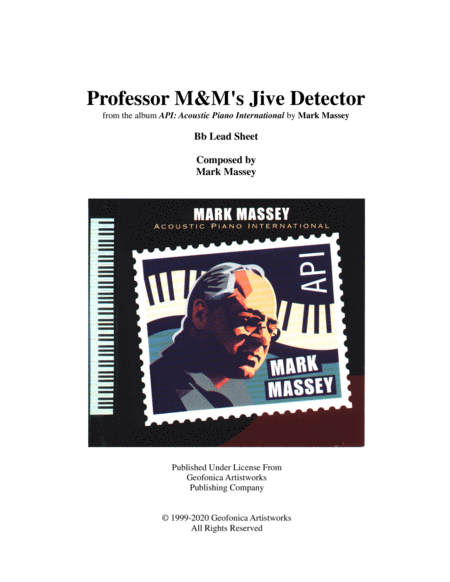
Professor M & M's Jive Detector (Bb leadsheet, with tenor sax & piano melody)

$3.99 3.46 € PDF SheetMusicPlus

Jazz Ensemble Jazz Ensemble - Level 4 - Digital Download SKU: A0.948697 Composed by Mark S. Massey. Blues,Jazz. Score and parts. 3 pages. Geofonica Artistworks #6038029. Published by Geofonica Artistworks (A0.948697). Professor M & M's Jive Detector is a super cool, very bluesy instrumental jazz hit (in lead sheet format here) from pianist Mark Massey's breakthrough jazz LP: API: Acoustic Piano International. (NOTE: A Bb leadsheet is also available.) The piano and tenor sax interact, with sax and piano doubling the main melody (performed by guest saxophonist Plas Johnson--famed Wrecking Crew sax/woodwind player who was featured on The Pink Panther Theme), plus sax and piano in blues interplay and counterpoint. It's a great vehicle for musical interplay, blues/jazz improvisation, and laid-back bluesy rhythm section grooves. The API track features Plas Johnson on sax backed by the Mark Massey trio, with Eric Stiller on acoustic bass and Aldo Bentivegna on drums.ABOUT MARK:In 2018, the California State Assembly and the Los Angeles County Board of Supervisors issued proclamations recognizing Mark Massey as a Jazz Living Legend. Jazz pianist-composer Mark Massey was born and raised in Lynwood, California, where he showed early talent on piano, trombone, and drums. During high school, he studied classical piano and played in the bands Synopsis (with future trumpet giant Wayne Bergeron), and Sabor (with Poncho Sanchez and the Banda Brothers). Mark played in the Pico Rivera Stage Band, which won First Place at the Hollywood Bowl Battle of the Bands. Mark graduated from California State University, Long Beach (with Bachelors and Masters degrees in Music), where he was recipient of the Carmen Dragon Fellowship for composition and he was dubbed A Young Giant by the National Association Of Jazz Educators. Mark has performed throughout the U.S., Europe, the former Soviet Union (in the 1980s), Russia (2001), the Far East and India. He has worked with Larry Carlton, David Benoit, Paul Horn, Hubert Laws, Louie Bellson, the Side Street Strutters, Phil Upchurch, L. Subramaniam, Freddie Hubbard, Maynard Ferguson, Yehudi Menuhin, Stéphane Grappelli, and Tony Williams. Mark was featured in The Four Pianos In Concert series along with pianists Paul Smith, Pete Jolly and Steve Allen. Mark Massey's debut CD, Acoustic Piano International, has received wide airplay on jazz radio. API featured nine of Mark's original jazz compositions--including Professor M&M's Jive Detector, offered here--inspired by his musical excursions around the globe, along with Eric Stiller (bass) and Aldo Bentivegna (drums), and guest artists Alex Acuña, percussion (Weather Report), Justo Almario, flute (Mongo Santamaria), Plas Johnson, tenor sax (The Pink Panther Theme), Bob Mintzer, soprano sax (The Yellow Jackets), and Ron Stout, flugelhorn, More recently, Mark has been recording his iconic Jazz Thoughts for the Day albums of original jazz improvisional compositions for each day of the year. Jazz Thoughts for the months of January through July have thus far been released. COMMENTS FROM MAJOR CRITIC REVIEWS OF MARK MASSEY: Mark Massey is awfully good. His friendly, lyrical, melodic piano has a sound unto itself, bop and post-bop influenced, contemporarily informed, and languishing solidly in the modern mainstream. ...This is a very good trio that is together in many aspects of jazz expressionism. In larger, more interactive settings, Massey proves he has ideas that work well. ...Massey's talent being exposed is a breakthrough. A majority of jazz listeners should find this a worthwhile purchase, and a keeper.  Recommended.----MICHAEL G. NASTOS, ALL MUSIC GUIDE (CD review of Acoustic Piano International) Mark Massey is an excellent straight-ahead pianist who often appears in the L.A. area. ...his playing is consistently appealing. Of the trio numbers, the often-introspective Flowers For Dorothy, the heated Limejuicer Blues, and .
Professor M & M's Jive Detector (C lead sheet, with piano & tenor sax melody)
Ensemble Jazz

$3.99 3.46 € Ensemble Jazz PDF SheetMusicPlus

Horn,Trombone,Tuba - Level 3 - Digital Download SKU: A0.1264810 Composed by Ludwig van Beethoven. Arranged by Ander. 19th Century,Classical,Romantic Period. 10 pages. Woods Only, Arrangements #857649. Published by Woods Only, Arrangements (A0.1264810). Adaptation of Ludwig van Beethoven’s Symphony No. 5 in C minor, Op. 67 for Low Brass Trio. Known as the Symphony of Destiny, this work is one of the most popular and well-known in the entire European repertoire. This adaptation retains the original essence but with a reduced duration, presenting only the main themes of the opening. Ideal for beginner instrumental music students who want to experience orchestral music in a simplified form. Can be used by music teachers in ensemble practices, academic recitals, didactic concerts or assessment tests. The four movements are characterized by orchestral homogeneity and alternation: the first movement presents great tension; the second, a solemn funeral march; the third, a vivacity; and the fourth, triumph and magnificence.
Symphony No. 5 by Beethoven for Low Brass Trio

$5.99 5.2 € PDF SheetMusicPlus

Bass Trombone,Cornet,Horn - Level 3 - Digital Download SKU: A0.1486246 Composed by Landini. Arranged by James M. Guthrie. Chamber,Early Music,Historic,Renaissance,Standards. 15 pages. Jmsgu3 #1063306. Published by jmsgu3 (A0.1486246). Francesco Landini's Ecco la Primavera is a significant work from the early Renaissance that exemplifies several essential aspects of 14th-century Italian music. The piece is a ballata, a popular form of Italian secular music during the Trecento period (14th century), also known as the Italian Ars Nova. This era marked the beginning of a new musical epoch. Ecco la Primavera is composed as an isorhythmic duet. Isorhythm was a crucial compositional technique in medieval and early Renaissance music, demonstrating Landini's mastery of complex musical structures.The work celebrates spring and love, reflecting the humanist ideals emerging during the early Renaissance. This focus on secular themes and natural beauty was a departure from the predominantly religious music of the medieval period. The piece provides insight into the cultural and social life of 14th-century Florence. It was likely performed at gatherings of intellectuals and artists, such as the one described at Villa del Paradiso near Florence in 1389.As the foremost composer of the Trecento period, Landini's works, including Ecco la Primavera, are crucial for understanding the musical developments of this era. The composition features flowing melodies that were characteristic of early Renaissance Italian music. This melodic style would influence the development of Renaissance music more broadly. The work has endured over centuries and continues to be performed and appreciated today, as evidenced by its inclusion in contemporary classical music rankings.Ecco la Primavera thus serves as an important example of the musical, cultural, and intellectual shifts occurring in Italy during the transition from the medieval period to the Renaissance.
Landini: Ecco la Primavera for Brass Trio

$34.95 30.35 € PDF SheetMusicPlus

Woodwind Ensemble Bass Clarinet - Level 3 - Digital Download SKU: A0.1486287 Composed by Landini. Arranged by James M. Guthrie. Chamber,Early Music,Historic,Medieval,Renaissance. 15 pages. Jmsgu3 #1063348. Published by jmsgu3 (A0.1486287). Francesco Landini's Ecco la Primavera is a significant work from the early Renaissance that exemplifies several essential aspects of 14th-century Italian music. The piece is a ballata, a popular form of Italian secular music during the Trecento period (14th century), also known as the Italian Ars Nova. This era marked the beginning of a new musical epoch. Ecco la Primavera is composed as an isorhythmic duet. Isorhythm was a crucial compositional technique in medieval and early Renaissance music, demonstrating Landini's mastery of complex musical structures. The work celebrates spring and love, reflecting the humanist ideals emerging during the early Renaissance. This focus on secular themes and natural beauty was a departure from the predominantly religious music of the medieval period. The piece provides insight into the cultural and social life of 14th-century Florence. It was likely performed at gatherings of intellectuals and artists, such as the one described at Villa del Paradiso near Florence in 1389. As the foremost composer of the Trecento period, Landini's works, including Ecco la Primavera, are crucial for understanding the musical developments of this era. The composition features flowing melodies that were characteristic of early Renaissance Italian music. This melodic style would influence the development of Renaissance music more broadly. The work has endured over centuries and continues to be performed and appreciated today, as evidenced by its inclusion in contemporary classical music rankings. Ecco la Primavera thus serves as an important example of the musical, cultural, and intellectual shifts occurring in Italy during the transition from the medieval period to the Renaissance.
Landini: Ecco la Primavera for Clarinet Trio

$34.95 30.35 € PDF SheetMusicPlus

Woodwind Ensemble Bassoon,Oboe - Level 3 - Digital Download SKU: A0.1486330 Composed by Landini. Arranged by James M. Guthrie. Chamber,Early Music,Historic,Medieval,Renaissance. 15 pages. Jmsgu3 #1063393. Published by jmsgu3 (A0.1486330). Francesco Landini's Ecco la Primavera is a significant work from the early Renaissance that exemplifies several essential aspects of 14th-century Italian music. The piece is a ballata, a popular form of Italian secular music during the Trecento period (14th century), also known as the Italian Ars Nova. This era marked the beginning of a new musical epoch. Ecco la Primavera is composed as an isorhythmic duet. Isorhythm was a crucial compositional technique in medieval and early Renaissance music, demonstrating Landini's mastery of complex musical structures. The work celebrates spring and love, reflecting the humanist ideals emerging during the early Renaissance. This focus on secular themes and natural beauty was a departure from the predominantly religious music of the medieval period. The piece provides insight into the cultural and social life of 14th-century Florence. It was likely performed at gatherings of intellectuals and artists, such as the one described at Villa del Paradiso near Florence in 1389. As the foremost composer of the Trecento period, Landini's works, including Ecco la Primavera, are crucial for understanding the musical developments of this era. The composition features flowing melodies that were characteristic of early Renaissance Italian music. This melodic style would influence the development of Renaissance music more broadly. The work has endured over centuries and continues to be performed and appreciated today, as evidenced by its inclusion in contemporary classical music rankings. Ecco la Primavera thus serves as an important example of the musical, cultural, and intellectual shifts occurring in Italy during the transition from the medieval period to the Renaissance.
Landini: Ecco la Primavera for Double Reed Trio

$34.95 30.35 € PDF SheetMusicPlus

Horn,Trombone,Trumpet - Level 3 - Digital Download SKU: A0.1264875 Composed by Ludwig van Beethoven. Arranged by Ander. 19th Century,Classical,Folk,March,Romantic Period. 7 pages. Woods Only, Arrangements #857713. Published by Woods Only, Arrangements (A0.1264875). This brass trio arrangement of Beethoven’s Turkish March Op. 113 is perfect for young music students and professional musicians alike. Adapted from the original work, it remains faithful to the structure while changing the tone for comfortable playing. Use it for recitals, repertoire, academic presentations, and didactic material. The Turkish March is the 4th movement of operatic work by Beethoven, The Ruins of Athens. Originally written in 1809 as Theme with Six Variations for Piano, Op. 76, it was later used to accompany August von Kotzebue’s play for the dedication of a new theater in Pest. In Latin America, this movement became known as “The Elephant Never Forgets†in Jean-Jacques Perrey’s version and was used as the opening theme for the Mexican TV comedy El Chavo del Ocho. Experience Beethoven’s Turkish March with this brass trio arrangement, perfect for ensemble practice among musicians of different traditions.
Turkish March by Beethoven for Brass Trio

$5.99 5.2 € PDF SheetMusicPlus

Trumpet - Level 3 - Digital Download SKU: A0.1264881 Composed by Ludwig van Beethoven. Arranged by Ander. 19th Century,Classical,Folk,March,Romantic Period. 7 pages. Woods Only, Arrangements #857719. Published by Woods Only, Arrangements (A0.1264881). This trumpet trio arrangement of Beethoven’s Turkish March Op. 113 is perfect for young music students and professional musicians alike. Adapted from the original work, it remains faithful to the structure while changing the tone for comfortable playing. Use it for recitals, repertoire, academic presentations, and didactic material. The Turkish March is the 4th movement of operatic work by Beethoven, The Ruins of Athens. Originally written in 1809 as Theme with Six Variations for Piano, Op. 76, it was later used to accompany August von Kotzebue’s play for the dedication of a new theater in Pest. In Latin America, this movement became known as “The Elephant Never Forgets†in Jean-Jacques Perrey’s version and was used as the opening theme for the Mexican TV comedy El Chavo del Ocho. Experience Beethoven’s Turkish March with this trumpet trio arrangement, perfect for ensemble practice among musicians of different traditions.
Turkish March by Beethoven for Trumpet Trio
Trompette

$5.99 5.2 € Trompette PDF SheetMusicPlus

Horn,Trombone,Tuba - Level 3 - Digital Download SKU: A0.1264878 Composed by Ludwig van Beethoven. Arranged by Ander. 19th Century,Classical,Folk,March,Romantic Period. 7 pages. Woods Only, Arrangements #857716. Published by Woods Only, Arrangements (A0.1264878). This low brass trio arrangement of Beethoven’s Turkish March Op. 113 is perfect for young music students and professional musicians alike. Adapted from the original work, it remains faithful to the structure while changing the tone for comfortable playing. Use it for recitals, repertoire, academic presentations, and didactic material. The Turkish March is the 4th movement of operatic work by Beethoven, The Ruins of Athens. Originally written in 1809 as Theme with Six Variations for Piano, Op. 76, it was later used to accompany August von Kotzebue’s play for the dedication of a new theater in Pest. In Latin America, this movement became known as “The Elephant Never Forgets†in Jean-Jacques Perrey’s version and was used as the opening theme for the Mexican TV comedy El Chavo del Ocho. Experience Beethoven’s Turkish March with this low brass trio arrangement, perfect for ensemble practice among musicians of different traditions.
Turkish March by Beethoven for Low Brass Trio

$5.99 5.2 € PDF SheetMusicPlus


1 ....181 196 211 226 241 ....961


Partitions Gratuites
Acheter des Partitions Musicales
Acheter des Partitions Digitales à Imprimer
Acheter des Instruments de Musique

© 2000 - 2026

Accueil - Version intégrale





