EUROPE
2083 articles
USA
6891 articles
DIGITAL
54355 articles (à imprimer)
Partitions Digitales
Partitions à imprimer
54355 partitions trouvées

1 ....61 76 91 106 121 ....9991

E-Flat Tenor Horn,Instrumental Solo,Piano - Level 2 - Digital Download SKU: A0.592569 Composed by Various. Arranged by David McKeown. Praise & Worship,Sacred,Spiritual. Score and individual part. 50 pages. David McKeown #6404067. Published by David McKeown (A0.592569). 18 Easy Gospel Hymns Vol.1 for Solo Tenor Horn in E Flat and Piano is a beautiful collection of your best-loved Gospel Hymns and Spirituals. They are arranged simply in the most suitable range and key for the solo instrument. The preview only shows a few pages of the piano score, but this is followed by a separate solo instrumental part, adding up to 49 pages of quality music.The standard is early intermediate. Players with a year or two’s experience will enjoy playing these Gospel hymns, with plenty of interest in both the solo and the piano parts. These hymns are ideal for use in concerts or worship, formal or informal. The hymns are in alphabetical order and are as follows·    Abide with Me, Â·    Amazing Grace, Â·    Blessed Assurance, Â·    Deep River, Â·    Down by the Riverside, Â·    Go Down Moses, Â·    Go Tell It on the Mountain, Â·    He’s Got the Whole World in HIs Hands, Â·    Higher Ground, Â·    Jesus on the Mainline, Â·    Joshua Fought the Battle of Jericho, Â·    Just a Closer Walk with Thee, Â·    Just as I Am, Â·    Just Over in the Glory Land, Â·    Kumbaya My Lord, Â·    Love Lifted Me, Â·    Nobody Knows the Trouble I’ve Seen, Â·    Nothing but the Blood of Jesus. If you like these Gospel Hymns, then there are another eighteen just like them in Volume 2. To find them copy and paste 18 Easy Gospel Hymns Vol.2 for Solo Tenor Horn in E Flat and Piano in the Search Bar above. There are also duet versions of these Gospel hymns available on Sheet Music Plus, and more advanced duet arrangements of your Gospel favourites in the 10 Gospel Duets series.To keep up with new titles, search for Dave McKeown Sheet Music Downloads on Facebook.There are many more top quality arrangements and compositions by David McKeown for you to browse at http://www.sheetmusicplus.com/publishers/david-mckeown/6203
18 Gospel Hymns Vol.1 for Solo Tenor Horn and Piano

$8.49 7.24 € PDF SheetMusicPlus

Alto Flute,Instrumental Solo,Piano - Level 2 - Digital Download SKU: A0.592566 Composed by Various. Arranged by David McKeown. Praise & Worship,Sacred,Spiritual. Score and individual part. 50 pages. David McKeown #6404061. Published by David McKeown (A0.592566). 18 Easy Gospel Hymns Vol.1 for Solo Alto Flute and Piano is a beautiful collection of your best-loved Gospel Hymns and Spirituals. They are arranged simply in the most suitable range and key for the solo instrument. The preview only shows a few pages of the piano score, but this is followed by a separate solo instrumental part, adding up to 49 pages of quality music.The standard is early intermediate. Players with a year or two’s experience will enjoy playing these Gospel hymns, with plenty of interest in both the solo and the piano parts. These hymns are ideal for use in concerts or worship, formal or informal. The hymns are in alphabetical order and are as follows·    Abide with Me, Â·    Amazing Grace, Â·    Blessed Assurance, Â·    Deep River, Â·    Down by the Riverside, Â·    Go Down Moses, Â·    Go Tell It on the Mountain, Â·    He’s Got the Whole World in HIs Hands, Â·    Higher Ground, Â·    Jesus on the Mainline, Â·    Joshua Fought the Battle of Jericho, Â·    Just a Closer Walk with Thee, Â·    Just as I Am, Â·    Just Over in the Glory Land, Â·    Kumbaya My Lord, Â·    Love Lifted Me, Â·    Nobody Knows the Trouble I’ve Seen, Â·    Nothing but the Blood of Jesus. If you like these Gospel Hymns, then there are another eighteen just like them in Volume 2. To find them copy and paste 18 Easy Gospel Hymns Vol.2 for Solo Alto Flute and Piano in the Search Bar above. There are also duet versions of these Gospel hymns available on Sheet Music Plus, and more advanced duet arrangements of your Gospel favourites in the 10 Gospel Duets series.To keep up with new titles, search for Dave McKeown Sheet Music Downloads on Facebook.There are many more top quality arrangements and compositions by David McKeown for you to browse at http://www.sheetmusicplus.com/publishers/david-mckeown/6203
18 Gospel Hymns Vol.1 for Solo Alto Flute and Piano

$8.49 7.24 € PDF SheetMusicPlus

Small Ensemble Instrumental Solo,Piano,Treble Recorder - Level 2 - Digital Download SKU: A0.592574 Composed by Various. Arranged by David McKeown. Praise & Worship,Sacred,Spiritual. Score and individual part. 50 pages. David McKeown #6404077. Published by David McKeown (A0.592574). 18 Easy Gospel Hymns Vol.1 for Solo Treble Recorder and Piano is a beautiful collection of your best-loved Gospel Hymns and Spirituals. They are arranged simply in the most suitable range and key for the solo instrument. The preview only shows a few pages of the piano score, but this is followed by a separate solo instrumental part, adding up to 49 pages of quality music.The standard is early intermediate. Players with a year or two’s experience will enjoy playing these Gospel hymns, with plenty of interest in both the solo and the piano parts. These hymns are ideal for use in concerts or worship, formal or informal. The hymns are in alphabetical order and are as follows·    Abide with Me, ·    Amazing Grace, ·    Blessed Assurance, ·    Deep River, ·    Down by the Riverside, ·    Go Down Moses, ·    Go Tell It on the Mountain, ·    He’s Got the Whole World in HIs Hands, ·    Higher Ground, ·    Jesus on the Mainline, ·    Joshua Fought the Battle of Jericho, ·    Just a Closer Walk with Thee, ·    Just as I Am, ·    Just Over in the Glory Land, ·    Kumbaya My Lord, ·    Love Lifted Me, ·    Nobody Knows the Trouble I’ve Seen, ·    Nothing but the Blood of Jesus. If you like these Gospel Hymns, then there are another eighteen just like them in Volume 2. To find them copy and paste 18 Easy Gospel Hymns Vol.2 for Solo Treble Recorder and Piano in the Search Bar above. There are also duet versions of these Gospel hymns available on Sheet Music Plus, and more advanced duet arrangements of your Gospel favourites in the 10 Gospel Duets series.To keep up with new titles, search for Dave McKeown Sheet Music Downloads on Facebook.There are many more top quality arrangements and compositions by David McKeown for you to browse at http://www.sheetmusicplus.com/publishers/david-mckeown/6203
18 Gospel Hymns Vol.1 for Solo Treble Recorder and Piano

$8.49 7.24 € PDF SheetMusicPlus

Guitar,Piano,Vocal,Voice - Level 2 - Digital Download SKU: A0.801677 Composed by Connie Boss. Celtic,Christmas,Irish,Sacred. Score. 120 pages. Connie Boss #6414353. Published by Connie Boss (A0.801677). This lovely cantata is about how we gather together in song to celebrate the birth of Jesus. It has a Celtic feel and the songs are from several different countries - United States, Ireland, England, France, Germany, Scotland, Italy. There are 8 songs included, 2 originals, 2 medleys and 4 songs that you know and love included also. All of the songs are in SATB with an (optional) accent instrument part (choice of flute, violin or cello - parts included at the end of each score) - the score has the flute part so you can see where the accent instrument fits into the score. A simple piano part is included in each score. The voices and accent instruments help to complete the entire piece. You can also purchase individual songs on here separately if you choose to not purchase the whole cantata. However, it is a bargain to purchase the cantata. There are narration parts before each song that give a little history of the song. You can opt out of using them if desired. The titles of the songs are: 1. Baby, Jesus, Was Born Unto This Earth. (original)  2. Christ Child's Lullaby. 3. Bring a Torch Jeanette, Isabella. 4. Christmas Carols - Coventry and Wexford. 5. Good Christian Men Rejoice. 6. O Come Let Us Adore Him, Christ the Lord - (In the Bleak Midwinter, Gesu Bambino, The Snow Lay on the Ground) 7. Peace on Earth (original) 8. Sing We Now of Christmas. Take a little time to listen to the mp3 attached. It has computer voices, but you can get an idea of what it is supposed to sound like. It also has one of the instrument parts as a sample and then the piano on each one. Any questions, please email me at cdboss@cvalley.net. I'm glad to work with you. This is my 5th cantata and most recent one. You can purchase the other 4 on here - check them out. You can also purchase in book form any of these on Amazon. I have background accompaniment to these songs. If you purchase a book and would like them, please email me with proof of purchase and I will email them back to you. .
O Come Let Us Adore Him Christmas Cantata - SATB optional instruments and Piano - parts included
Piano, Voix et Guitare

$7.00 5.97 € Piano, Voix et Guitare PDF SheetMusicPlus

Piano,Soprano Saxophone - Level 1 - Digital Download SKU: A0.548720 Composed by Martin Luther. Arranged by James M. Guthrie, ASCAP. Easter,Instructional,Standards. Score and part. 4 pages. Jmsgu3 #3411755. Published by jmsgu3 (A0.548720). Out of the Depths I Cry to You by Martin Luther. The first verses feature modified counterpoint and harmony proceeding at quarter = 82. The final verse is reharmonized for maximum dramatic effect at a more contemplative tempo such as quarter = 64. Features the entire range of the instrument. Very powerful selection for Lent or Easter. Duration (3 verses) 3:05, 36 ms. Score: 3 pg. Solo part: 1 pg. The piano reads from the score. Out of the Depths Aus tiefer Not schrei ich zu dir (From deep affliction I cry out to you), is, of course, a hymn composed by Martin Luther. Moreover, Luther also wrote the lyrics, essentially a paraphrase of Psalm 130. First published in 1524, it is also one of eight songs in the original Lutheran hymnal. It appears likewise in many hymnals and in different translations. The lyrics furthermore stimulated compositions from the Renaissance to the contemporary. Consequently, composers such as Johann Sebastian Bach built an entire chorale cantata on it. Other composers similarly contributed pieces, such as Felix Mendelssohn and Max Reger. Luther Background Martin Luther, (1483 –1546) was a German professor of theology, composer, priest, and moreover, an influential character in the Protestant Reformation. Luther had a momentous impact on church and society due to his contributions to the musical arts. He wanted to disseminate the gospel among mankind and with this intention thought that the best way to do that was through music. Influence It is important to realize that other musicians, and their descendants, were encouraged by Luther’s songs and wrote their own hymns. Luther, to be sure, had a thorough musical education. For example, he knew secular and sacred songs from an early age. He, in particular, played the lute well and sang in the monastery when he was a monk. That is to say, music was an essential part of his life. He in fact first began writing songs in 1523, sometimes writing the melody as well as the lyrics. Luther was certainly able to evaluate the composers of his time. He thought especially highly of Josquin des and Ludwig Senfl. He was also acquainted, with this in mind, with other composers and their works. Legacy The Lutheran musical ethos soon covered all of Germany and later significantly fashioned Protestant musical culture. Heinrich Schütz and Johann Sebastian Bach are the most compelling evidence of this Protestant musical culture. Additionally, as a point often overlooked, the pedal organ, first refined in northern Germany, became universally prevalent. As a matter of fact, Dieterich Buxtehude established a regular evening organ concert series in Lübeck. Another key point is that this concert series, in turn, spread North German Musical ideas worldwide. Luther was especially convinced that music is a beautiful and exclusive offering of the divine.
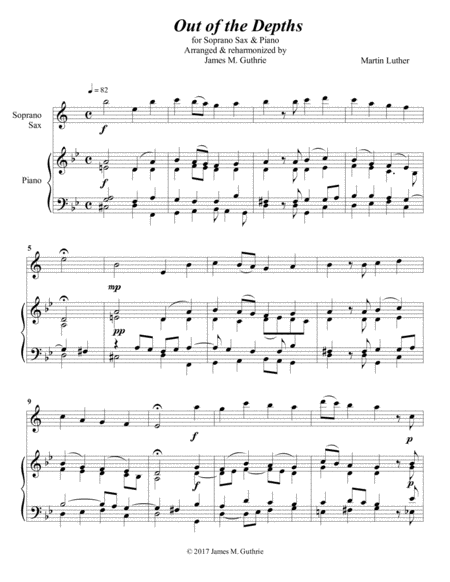
Luther: Out of the Depths for Soprano Sax & Piano
Saxophone Soprano et Piano

$24.95 21.27 € Saxophone Soprano et Piano PDF SheetMusicPlus

French Horn,Piano - Level 1 - Digital Download SKU: A0.548717 Composed by Martin Luther. Arranged by James M. Guthrie, ASCAP. Easter,Instructional,Standards. Score and part. 4 pages. Jmsgu3 #3411743. Published by jmsgu3 (A0.548717). Out of the Depths I Cry to You by Martin Luther arranged for French horn & piano. The first verses feature modified counterpoint and harmony proceeding at quarter = 82. The final verse is reharmonized for maximum dramatic effect at a more contemplative tempo such as quarter = 64. Features the entire range of the instrument. Very powerful selection for Lent or Easter. Duration (3 verses) 3:05, 36 ms. Score: 3 pg. Solo part: 1 pg. The piano reads from the score. Out of the Depths Aus tiefer Not schrei ich zu dir (From deep affliction I cry out to you), is, of course, a hymn composed by Martin Luther. Moreover, Luther also wrote the lyrics, essentially a paraphrase of Psalm 130. First published in 1524, it is also one of eight songs in the original Lutheran hymnal. It appears likewise in many hymnals and in different translations. The lyrics furthermore stimulated compositions from the Renaissance to the contemporary. Consequently, composers such as Johann Sebastian Bach built an entire chorale cantata on it. Other composers similarly contributed pieces, such as Felix Mendelssohn and Max Reger. Luther Background Martin Luther, (1483 –1546) was a German professor of theology, composer, priest, and moreover, an influential character in the Protestant Reformation. Luther had a momentous impact on church and society due to his contributions to the musical arts. He wanted to disseminate the gospel among mankind and with this intention thought that the best way to do that was through music. Influence It is important to realize that other musicians, and their descendants, were encouraged by Luther’s songs and wrote their own hymns. Luther, to be sure, had a thorough musical education. For example, he knew secular and sacred songs from an early age. He, in particular, played the lute well and sang in the monastery when he was a monk. That is to say, music was an essential part of his life. He in fact first began writing songs in 1523, sometimes writing the melody as well as the lyrics. Luther was certainly able to evaluate the composers of his time. He thought especially highly of Josquin des and Ludwig Senfl. He was also acquainted, with this in mind, with other composers and their works. Legacy The Lutheran musical ethos soon covered all of Germany and later significantly fashioned Protestant musical culture. Heinrich Schütz and Johann Sebastian Bach are the most compelling evidence of this Protestant musical culture. Additionally, as a point often overlooked, the pedal organ, first refined in northern Germany, became universally prevalent. As a matter of fact, Dieterich Buxtehude established a regular evening organ concert series in Lübeck. Another key point is that this concert series, in turn, spread North German Musical ideas worldwide. Luther was especially convinced that music is a beautiful and exclusive offering of the divine.
Luther: Out of the Depths for French Horn & Piano
Cor et Piano

$24.95 21.27 € Cor et Piano PDF SheetMusicPlus

Oboe,Piano - Level 1 - Digital Download SKU: A0.548719 Composed by Martin Luther. Arranged by James M. Guthrie, ASCAP. Easter,Instructional,Standards. Score and part. 4 pages. Jmsgu3 #3411753. Published by jmsgu3 (A0.548719). Out of the Depths I Cry to You by Martin Luther. The first verses feature modified counterpoint and harmony proceeding at quarter = 82. The final verse is reharmonized for maximum dramatic effect at a more contemplative tempo such as quarter = 64. Features the entire range of the instrument. Very powerful selection for Lent or Easter. Duration (3 verses) 3:05, 36 ms. Score: 3 pg. Solo part: 1 pg. The piano reads from the score. Out of the Depths Aus tiefer Not schrei ich zu dir (From deep affliction I cry out to you), is, of course, a hymn composed by Martin Luther. Moreover, Luther also wrote the lyrics, essentially a paraphrase of Psalm 130. First published in 1524, it is also one of eight songs in the original Lutheran hymnal. It appears likewise in many hymnals and in different translations. The lyrics furthermore stimulated compositions from the Renaissance to the contemporary. Consequently, composers such as Johann Sebastian Bach built an entire chorale cantata on it. Other composers similarly contributed pieces, such as Felix Mendelssohn and Max Reger. Luther Background Martin Luther, (1483 –1546) was a German professor of theology, composer, priest, and moreover, an influential character in the Protestant Reformation. Luther had a momentous impact on church and society due to his contributions to the musical arts. He wanted to disseminate the gospel among mankind and with this intention thought that the best way to do that was through music. Influence It is important to realize that other musicians, and their descendants, were encouraged by Luther’s songs and wrote their own hymns. Luther, to be sure, had a thorough musical education. For example, he knew secular and sacred songs from an early age. He, in particular, played the lute well and sang in the monastery when he was a monk. That is to say, music was an essential part of his life. He in fact first began writing songs in 1523, sometimes writing the melody as well as the lyrics. Luther was certainly able to evaluate the composers of his time. He thought especially highly of Josquin des and Ludwig Senfl. He was also acquainted, with this in mind, with other composers and their works. Legacy The Lutheran musical ethos soon covered all of Germany and later significantly fashioned Protestant musical culture. Heinrich Schütz and Johann Sebastian Bach are the most compelling evidence of this Protestant musical culture. Additionally, as a point often overlooked, the pedal organ, first refined in northern Germany, became universally prevalent. As a matter of fact, Dieterich Buxtehude established a regular evening organ concert series in Lübeck. Another key point is that this concert series, in turn, spread North German Musical ideas worldwide. Luther was especially convinced that music is a beautiful and exclusive offering of the divine.

Luther: Out of the Depths for Oboe & Piano
Hautbois, Piano (duo)

$24.95 21.27 € Hautbois, Piano (duo) PDF SheetMusicPlus

Baritone Saxophone,Piano - Level 1 - Digital Download SKU: A0.548713 Composed by Martin Luther. Arranged by James M. Guthrie, ASCAP. Easter,Instructional,Standards. Score and part. 4 pages. Jmsgu3 #3411737. Published by jmsgu3 (A0.548713). Out of the Depths I Cry to You by Martin Luther. The first verses feature modified counterpoint and harmony proceeding at quarter = 82. The final verse is reharmonized for maximum dramatic effect at a more contemplative tempo such as quarter = 64. Features the entire range of the instrument. Very powerful selection for Lent or Easter. Duration (3 verses) 3:05, 36 ms. Score: 3 pg. Solo part: 1 pg. The piano reads from the score. Out of the Depths Aus tiefer Not schrei ich zu dir (From deep affliction I cry out to you), is, of course, a hymn composed by Martin Luther. Moreover, Luther also wrote the lyrics, essentially a paraphrase of Psalm 130. First published in 1524, it is also one of eight songs in the original Lutheran hymnal. It appears likewise in many hymnals and in different translations. The lyrics furthermore stimulated compositions from the Renaissance to the contemporary. Consequently, composers such as Johann Sebastian Bach built an entire chorale cantata on it. Other composers similarly contributed pieces, such as Felix Mendelssohn and Max Reger. Luther Background Martin Luther, (1483 –1546) was a German professor of theology, composer, priest, and moreover, an influential character in the Protestant Reformation. Luther had a momentous impact on church and society due to his contributions to the musical arts. He wanted to disseminate the gospel among mankind and with this intention thought that the best way to do that was through music. Influence It is important to realize that other musicians, and their descendants, were encouraged by Luther’s songs and wrote their own hymns. Luther, to be sure, had a thorough musical education. For example, he knew secular and sacred songs from an early age. He, in particular, played the lute well and sang in the monastery when he was a monk. That is to say, music was an essential part of his life. He in fact first began writing songs in 1523, sometimes writing the melody as well as the lyrics. Luther was certainly able to evaluate the composers of his time. He thought especially highly of Josquin des and Ludwig Senfl. He was also acquainted, with this in mind, with other composers and their works. Legacy The Lutheran musical ethos soon covered all of Germany and later significantly fashioned Protestant musical culture. Heinrich Schütz and Johann Sebastian Bach are the most compelling evidence of this Protestant musical culture. Additionally, as a point often overlooked, the pedal organ, first refined in northern Germany, became universally prevalent. As a matter of fact, Dieterich Buxtehude established a regular evening organ concert series in Lübeck. Another key point is that this concert series, in turn, spread North German Musical ideas worldwide. Luther was especially convinced that music is a beautiful and exclusive offering of the divine.

Luther: Out of the Depths for Baritone Sax & Piano
Saxophone Baryton, Piano

$24.95 21.27 € Saxophone Baryton, Piano PDF SheetMusicPlus

B-Flat Trumpet,Piano - Level 1 - Digital Download SKU: A0.548721 Composed by Martin Luther. Arranged by James M. Guthrie, ASCAP. Easter,Instructional,Standards. Score and part. 4 pages. Jmsgu3 #3411757. Published by jmsgu3 (A0.548721). Out of the Depths I Cry to You by Martin Luther. The first verses feature modified counterpoint and harmony proceeding at quarter = 82. The final verse is reharmonized for maximum dramatic effect at a more contemplative tempo such as quarter = 64. Features the entire range of the instrument. Very powerful selection for Lent or Easter. Duration (3 verses) 3:05, 36 ms. Score: 3 pg. Solo part: 1 pg. The piano reads from the score. Out of the Depths Aus tiefer Not schrei ich zu dir (From deep affliction I cry out to you), is, of course, a hymn composed by Martin Luther. Moreover, Luther also wrote the lyrics, essentially a paraphrase of Psalm 130. First published in 1524, it is also one of eight songs in the original Lutheran hymnal. It appears likewise in many hymnals and in different translations. The lyrics furthermore stimulated compositions from the Renaissance to the contemporary. Consequently, composers such as Johann Sebastian Bach built an entire chorale cantata on it. Other composers similarly contributed pieces, such as Felix Mendelssohn and Max Reger. Luther Background Martin Luther, (1483 –1546) was a German professor of theology, composer, priest, and moreover, an influential character in the Protestant Reformation. Luther had a momentous impact on church and society due to his contributions to the musical arts. He wanted to disseminate the gospel among mankind and with this intention thought that the best way to do that was through music. Influence It is important to realize that other musicians, and their descendants, were encouraged by Luther’s songs and wrote their own hymns. Luther, to be sure, had a thorough musical education. For example, he knew secular and sacred songs from an early age. He, in particular, played the lute well and sang in the monastery when he was a monk. That is to say, music was an essential part of his life. He in fact first began writing songs in 1523, sometimes writing the melody as well as the lyrics. Luther was certainly able to evaluate the composers of his time. He thought especially highly of Josquin des and Ludwig Senfl. He was also acquainted, with this in mind, with other composers and their works. Legacy The Lutheran musical ethos soon covered all of Germany and later significantly fashioned Protestant musical culture. Heinrich Schütz and Johann Sebastian Bach are the most compelling evidence of this Protestant musical culture. Additionally, as a point often overlooked, the pedal organ, first refined in northern Germany, became universally prevalent. As a matter of fact, Dieterich Buxtehude established a regular evening organ concert series in Lübeck. Another key point is that this concert series, in turn, spread North German Musical ideas worldwide. Luther was especially convinced that music is a beautiful and exclusive offering of the divine.

Luther: Out of the Depths for Trumpet & Piano
Trompette

$24.95 21.27 € Trompette PDF SheetMusicPlus

English Horn,Piano - Level 1 - Digital Download SKU: A0.548716 Composed by Martin Luther. Arranged by James M. Guthrie, ASCAP. Easter,Instructional,Standards. Score and part. 4 pages. Jmsgu3 #3411745. Published by jmsgu3 (A0.548716). Out of the Depths I Cry to You by Martin Luther. The first verses feature modified counterpoint and harmony proceeding at quarter = 82. The final verse is reharmonized for maximum dramatic effect at a more contemplative tempo such as quarter = 64. Features the entire range of the instrument. Very powerful selection for Lent or Easter. Duration (3 verses) 3:05, 36 ms. Score: 3 pg. Solo part: 1 pg. The piano reads from the score. Out of the Depths Aus tiefer Not schrei ich zu dir (From deep affliction I cry out to you), is, of course, a hymn composed by Martin Luther. Moreover, Luther also wrote the lyrics, essentially a paraphrase of Psalm 130. First published in 1524, it is also one of eight songs in the original Lutheran hymnal. It appears likewise in many hymnals and in different translations. The lyrics furthermore stimulated compositions from the Renaissance to the contemporary. Consequently, composers such as Johann Sebastian Bach built an entire chorale cantata on it. Other composers similarly contributed pieces, such as Felix Mendelssohn and Max Reger. Luther Background Martin Luther, (1483 –1546) was a German professor of theology, composer, priest, and moreover, an influential character in the Protestant Reformation. Luther had a momentous impact on church and society due to his contributions to the musical arts. He wanted to disseminate the gospel among mankind and with this intention thought that the best way to do that was through music. Influence It is important to realize that other musicians, and their descendants, were encouraged by Luther’s songs and wrote their own hymns. Luther, to be sure, had a thorough musical education. For example, he knew secular and sacred songs from an early age. He, in particular, played the lute well and sang in the monastery when he was a monk. That is to say, music was an essential part of his life. He in fact first began writing songs in 1523, sometimes writing the melody as well as the lyrics. Luther was certainly able to evaluate the composers of his time. He thought especially highly of Josquin des and Ludwig Senfl. He was also acquainted, with this in mind, with other composers and their works. Legacy The Lutheran musical ethos soon covered all of Germany and later significantly fashioned Protestant musical culture. Heinrich Schütz and Johann Sebastian Bach are the most compelling evidence of this Protestant musical culture. Additionally, as a point often overlooked, the pedal organ, first refined in northern Germany, became universally prevalent. As a matter of fact, Dieterich Buxtehude established a regular evening organ concert series in Lübeck. Another key point is that this concert series, in turn, spread North German Musical ideas worldwide. Luther was especially convinced that music is a beautiful and exclusive offering of the divine.

Luther: Out of the Depths for English Horn & Piano
Cor anglais, Piano

$24.95 21.27 € Cor anglais, Piano PDF SheetMusicPlus


1 ....61 76 91 106 121 ....9991


Partitions Gratuites
Acheter des Partitions Musicales
Acheter des Partitions Digitales à Imprimer
Acheter des Instruments de Musique

© 2000 - 2025

Accueil - Version intégrale

