EUROPE
3453 articles
USA
6296 articles
DIGITAL
10245 articles (à imprimer)
Partitions Digitales
Partitions à imprimer
10245 partitions trouvées


Piano Solo - Level 2 - Digital Download SKU: A0.1091187 Composed by Sibylle Kuder. Baroque,Classical,Contest,Festival,Instructional,Traditional. Score. 3 pages. Sibylle Kuder #695343. Published by Sibylle Kuder (A0.1091187). Early Intermediate. Other than reading and playing in the key of A major, there are few challenges in this piece: the rhythm consists of quarter, eighth, and half notes, the only accidental is D sharp. Eighth note patterns are scale fragments, ascending in the left hand, descending in the right hand. When the hands move, it is along with the melodic pattern. While most measures have eighth notes, they never happen in both hands at the same time. The most difficult aspect is counterpoint in Baroque style: quarter notes are to be played staccato, eight notes legato, usually both at the same time. An excellent preparation for this Gavotte would be the Gavotte in D major by James Hook: it trains counterpoint playing but the hands never move. One page, Level 3 ~ I frequently make changes to my compositions. If you would like to make sure that you have the latest edition, please send an email to sibyllekuder@gmail.com ~ If there is a newer edition I will gladly send you the updated PDF file! ~.
Gavotte in A for Early Intermediate Solo Piano
Piano seul

$1.99 1.68 € Piano seul PDF SheetMusicPlus

Voice, recorder and percussion - Digital Download SKU: S9.Q47388 Major: Drone Bass-Triads. Arranged by Margaret Murray. This edition: score for voice and/or instruments. Songs - Orff Schulwerk - pieces. Orff-Schulwerk. Downloadable, Vocal and performing score. Op. 2. Schott Music - Digital #Q47388. Published by Schott Music - Digital (S9.Q47388). English.Carl Orff devoted much of his life to the development of a philosophy of Music for Children, based on his belief that music is the natural outcome of speech, rhythm and movement. His ideas and pioneering work have had a major influence on music and dance education throughout the world and today that work continues under the guidance of leading teachers and educators in many countries. The five basic German volumes of Music for Children by Carl Orff and Gunild Keetman were published between 1950 and 1954. Editions have since been published in Bolivia, Brazil, Canada, Czechoslovakia, Denmark, Estonia, France, Ghana, Great Britain (including a special Welsh edition), Greece, Italy, Japan, Korea, Latin-America, the Netherlands, Portugal, Spain, Sweden, Taiwan and the USA. In 1952 the first edition in translation appeared an English language adaptation by Doreen Hall and Arnold Walter for their Canadian and American students. A few years later, Margaret Murray independently developed a version (1957-1966), essentially to fulfil the needs of United Kingdom teachers. Inevitably the considerable growth of Orff-Schulwerk in the United States led to the publication of the American Edition (1977) to satisfy the requirements of a different educational system and national heritage. Orff-Schulwerk: Music for Children has proved itself to be a stimulating source of material for music teaching. Carl Orff's fundamental educational ideas have revitalized music education in nursery schools, at all levels of primary and secondary education and in special music schools, based on the concepts that: - music, dance and language are inter-related and animated through rhythm. - when children discover, invent, improvise and compose, their experience of music is intensified. These creative activities are complementary to those of interpreting and listening to music. - all who take part are encouraged to contribute, not only vocally but also instrumentally. - the Orff approach to music education is many sided; it is concerned with practical music-making, it provides fundamental experiences and it lays the foundation for a comprehensive musical training. - movement games and activities for body awareness in space, time and flow, lead to movement improvisation and dance forms. - music and dance have been notated in many different ways in history. Various ways of writing down sounds and music, as well as playing from and interpreting different kinds of sources are being explored. Today, countless teachers and institutions are using these ideas. More and more teachers look for ways of involving their students in active music making. In particular, they seek to challenge their pupils' creativity by the use of music, dance and speech - as media of human expression - as a foundation of all education. A prerequisite for work in Orff-Schulwerk is the artistic and pedagogical training of teachers. The Orff Institute was founded in 1961 as a Department of the 'Mozarteum', in Salzburg, Austria. Training offered includes a four-year diploma course, a two-year post-graduate course, and a one-year-course in English. At the opening of the Orff Institute in Salzburg in 1963, Carl Orff ended his speech with a quotation from Schiller: 'I have done my part, now do yours.' That challenge has been taken up by teachers worldwide. Murray Edition English adaption, with additional material, by Margaret Murray. Besed on, and containing all the rhythmic and instrumental material from the main five volumes of the original German edition. Contents of this second volume: Songs and pieces using the full major scale. Accompaniments are founded on drone bass with the later addition of simple chords.
Music for Children

$21.99 18.54 € PDF SheetMusicPlus

Voice, recorder and percussion - Digital Download SKU: S9.Q23985 Pentatonig. Composed by Carl Orff and Gunild Keetman. This edition: score for voice and/or instruments. Orff-Schulwerk. Downloadable, Vocal and performing score. Op. 1. Schott Music - Digital #Q23985. Published by Schott Music - Digital (S9.Q23985). Welsh.Carl Orff devoted much of his life to the development of a philosophy of Music for Children, based on his belief that music is the natural outcome of speech, rhythm and movement. His ideas and pioneering work have had a major influence on music and dance education throughout the world and today that work continues under the guidance of leading teachers and educators in many countries. The five basic German volumes of Music for Children by Carl Orff and Gunild Keetman were published between 1950 and 1954. Edition have since been published in Bolivia, Brazil, Canada, Czechoslovakia, Denmark, Estonia, France, Ghana, Great Britain (including a special Welsh edition), Greece, Italy, Japan, Korea, Latin-America, the Netherlands, Portugal, Spain, Sweden, Taiwan and the USA. In 1952 the first edition in translation appeared, an English language adaptation by Doreen Hall and Arnold Walter for their Canadian and American students. A few years later, Margaret Murray independently developed a version (1957-1966), essentially to fulfil the needs of United Kingdom teachers. Inevitably the considerable growth of Orff-Schulwerk in the United States led to the publication of the American Edition (1977) to satisfy the requirements of a different educational system and national heritage. Orff-Schulwerk: Music for Children has proved itself to be a stimulating source of material for music teaching. Carl Orff's fundamental educational ideas have revitalized music education in nursery schools, at all levels of primary and secondary education and in special music schools, based on the concepts that: - music, dance and language are inter-related and animated through rhythm. - when children discover, invent, improvise and compose, their experience of music is intensified. These creative activities are complementary to those of interpreting and listening to music. - all who take part are encouraged to contribute, not only vocally but also instrumentally. - the Orff approach to music education is many sided; it is concerned with practical music-making, it provides fundamental experiences and it lays the foundation for a comprehensive musical training. - movement games and activities for body awareness in space, time and flow, lead to movement improvisation and dance forms. - music and dance have been notated in many different ways in history. Various ways of writing down sounds and music, as well as playing from and interpreting different kinds of sources are being explored. Today, countless teachers and institutions are using these ideas. More and more teachers look for ways of invovling their students in active music making. In particular, they seek to challenge their pupils' creativity by the use of music, dance and speech - as media of human expression - as a foundation of all education. A prerequisite for work in Orff-Schulwerk is the artistic and pedagogical training of teachers. The Orff Institute was founded in 1961 as a Department of the 'Mozarteum', in Salzburg, Austria. Training offered includes a four-year diploma course, a two-year post-graduate course, and a one-year-course in English. At the opening of the Orff Institute in Salzburg in 1963, Carl Orff ended his speech with a quotation from Schiller: 'I have done my part, now do yours.' That challenge has been taken up by teachers worldwide. Welsh Edition This volume closely follows the English Volume 1, substituting Welsh for English wherever words are used in speech or song. It should be used in conjunction with the English version, since only the sung and spoken parts are provided.
Argraffiad Cymraeg

$10.99 9.26 € PDF SheetMusicPlus

Voice, recorder and percussion - Digital Download SKU: S9.Q2433 Minor: Bordun. Composed by Carl Orff and Gunild Keetman. Arranged by Arnold Walter and Doreen Hall. This edition: score for voice and/or instruments. Orff-Schulwerk. Downloadable, Vocal and performing score. Op. 4. Schott Music - Digital #Q2433. Published by Schott Music - Digital (S9.Q2433). English.Carl Orff devoted much of his life to the development of a philosophy of Music for Children, based on his belief that music is the natural outcome of speech, rhythm and movement. His ideas and pioneering work have had a major influence on music and dance education throughout the world and today that work continues under the guidance of leading teachers and educators in many countries. The five basic German volumes of Music for Children by Carl Orff and Gunild Keetman were published between 1950 and 1954. Edition have since been published in Bolivia, Brazil, Canada, Czechoslovakia, Denmark, Estonia, France, Ghana, Great Britain (including a special Welsh edition), Greece, Italy, Japan, Korea, Latin-America, the Netherlands, Portugal, Spain, Sweden, Taiwan and the USA. In 1952 the first edition in translation appeared, an English language adaptation by Doreen Hall and Arnold Walter for their Canadian and American students. A few years later, Margaret Murray independently developed a version (1957-1966), essentially to fulfil the needs of United Kingdom teachers. Inevitably the considerable growth of Orff-Schulwerk in the United States led to the publication of the American Edition (1977) to satisfy the requirements of a different educational system and national heritage. Orff-Schulwerk: Music for Children has proved itself to be a stimulating source of material for music teaching. Carl Orff's fundamental educational ideas have revitalized music education in nursery schools, at all levels of primary and secondary education and in special music schools, based on the concepts that: - music, dance and language are inter-related and animated through rhythm. - when children discover, invent, improvise and compose, their experience of music is intensified. These creative activities are complementary to those of interpreting and listening to music. - all who take part are encouraged to contribute, not only vocally but also instrumentally. - the Orff approach to music education is many sided; it is concerned with practical music-making, it provides fundamental experiences and it lays the foundation for a comprehensive musical training. - movement games and activities for body awareness in space, time and flow, lead to movement improvisation and dance forms. - music and dance have been notated in many different ways in history. Various ways of writing down sounds and music, as well as playing from and interpreting different kinds of sources are being explored. Today, countless teachers and institutions are using these ideas. More and more teachers look for ways of invovling their students in active music making. In particular, they seek to challenge their pupils' creativity by the use of music, dance and speech - as media of human expression - as a foundation of all education. A prerequisite for work in Orff-Schulwerk is the artistic and pedagogical training of teachers. The Orff Institute was founded in 1961 as a Department of the 'Mozarteum', in Salzburg, Austria. Training offered includes a four-year diploma course, a two-year post-graduate course, and a one-year-course in English. At the opening of the Orff Institute in Salzburg in 1963, Carl Orff ended his speech with a quotation from Schiller: 'I have done my part, now do yours.' That challenge has been taken up by teachers worldwide. Hall/Walter Edition Based on Volumes 1, 2 and 4 of the original German Edition musik für Kinder, english adaption with additional material by Doreen Hall and Arnold Walter.
Music for Children

$11.99 10.11 € PDF SheetMusicPlus

Voice, recorder and percussion - Digital Download SKU: S9.Q53825 Major: Dominant and Subdominant Triads. Arranged by Margaret Murray. This edition: score for voice and/or instruments. Orchestration - Orff Schulwerk - keys. Orff-Schulwerk. Downloadable, Vocal and performing score. Op. 3. Schott Music - Digital #Q53825. Published by Schott Music - Digital (S9.Q53825). English.Carl Orff devoted much of his life to the development of a philosophy of Music for Children, based on his belief that music is the natural outcome of speech, rhythm and movement. His ideas and pioneering work have had a major influence on music and dance education throughout the world and today that work continues under the guidance of leading teachers and educators in many countries. The five basic German volumes of Music for Children by Carl Orff and Gunild Keetman were published between 1950 and 1954. Editions have since been published in Bolivia, Brazil, Canada, Czechoslovakia, Denmark, Estonia, France, Ghana, Great Britain (including a special Welsh edition), Greece, Italy, Japan, Korea, Latin-America, the Netherlands, Portugal, Spain, Sweden, Taiwan and the USA. In 1952 the first edition in translation appeared an English language adaptation by Doreen Hall and Arnold Walter for their Canadian and American students. A few years later, Margaret Murray independently developed a version (1957-1966), essentially to fulfil the needs of United Kingdom teachers. Inevitably the considerable growth of Orff-Schulwerk in the United States led to the publication of the American Edition (1977) to satisfy the requirements of a different educational system and national heritage. Orff-Schulwerk: Music for Children has proved itself to be a stimulating source of material for music teaching. Carl Orff's fundamental educational ideas have revitalized music education in nursery schools, at all levels of primary and secondary education and in special music schools, based on the concepts that: - music, dance and language are inter-related and animated through rhythm. - when children discover, invent, improvise and compose, their experience of music is intensified. These creative activities are complementary to those of interpreting and listening to music. - all who take part are encouraged to contribute, not only vocally but also instrumentally. - the Orff approach to music education is many sided; it is concerned with practical music-making, it provides fundamental experiences and it lays the foundation for a comprehensive musical training. - movement games and activities for body awareness in space, time and flow, lead to movement improvisation and dance forms. - music and dance have been notated in many different ways in history. Various ways of writing down sounds and music, as well as playing from and interpreting different kinds of sources are being explored. Today, countless teachers and institutions are using these ideas. More and more teachers look for ways of involving their students in active music making. In particular, they seek to challenge their pupils' creativity by the use of music, dance and speech - as media of human expression - as a foundation of all education. A prerequisite for work in Orff-Schulwerk is the artistic and pedagogical training of teachers. The Orff Institute was founded in 1961 as a Department of the 'Mozarteum', in Salzburg, Austria. Training offered includes a four-year diploma course, a two-year post-graduate course, and a one-year-course in English. At the opening of the Orff Institute in Salzburg in 1963, Carl Orff ended his speech with a quotation from Schiller: 'I have done my part, now do yours.' That challenge has been taken up by teachers worldwide. Murray Edition English adaption, with additional material, by Margaret Murray. Besed on, and containing all the rhythmic and instrumental material from the main five volumes of the original German edition. Contents of this third volume: The instrumentation and range of keys are inceased. The settings include the chords on the fourth and fifth notes of the major scale.
Music for Children

$21.99 18.54 € PDF SheetMusicPlus

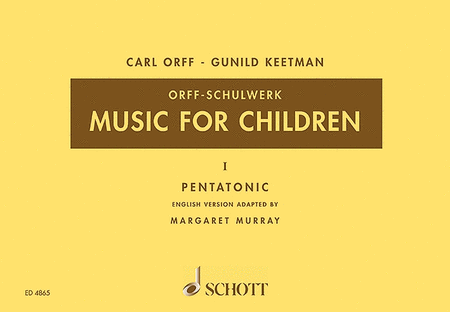
Voice, recorder and percussion - Digital Download SKU: S9.Q42466 Pentatonic. Arranged by Margaret Murray. This edition: score for voice and/or instruments. Orff-Schulwerk - Rhythmusübungen - Kinderreime. Orff-Schulwerk. Downloadable, Vocal and performing score. Op. 1. Schott Music - Digital #Q42466. Published by Schott Music - Digital (S9.Q42466). English.Carl Orff devoted much of his life to the development of a philosophy of Music for Children, based on his belief that music is the natural outcome of speech, rhythm and movement. His ideas and pioneering work have had a major influence on music and dance education throughout the world and today that work continues under the guidance of leading teachers and educators in many countries. The five basic German volumes of Music for Children by Carl Orff and Gunild Keetman were published between 1950 and 1954. Editions have since been published in Bolivia, Brazil, Canada, Czechoslovakia, Denmark, Estonia, France, Ghana, Great Britain (including a special Welsh edition), Greece, Italy, Japan, Korea, Latin-America, the Netherlands, Portugal, Spain, Sweden, Taiwan and the USA. In 1952 the first edition in translation appeared an English language adaptation by Doreen Hall and Arnold Walter for their Canadian and American students. A few years later, Margaret Murray independently developed a version (1957-1966), essentially to fulfil the needs of United Kingdom teachers. Inevitably the considerable growth of Orff-Schulwerk in the United States led to the publication of the American Edition (1977) to satisfy the requirements of a different educational system and national heritage. Orff-Schulwerk: Music for Children has proved itself to be a stimulating source of material for music teaching. Carl Orff's fundamental educational ideas have revitalized music education in nursery schools, at all levels of primary and secondary education and in special music schools, based on the concepts that: - music, dance and language are inter-related and animated through rhythm. - when children discover, invent, improvise and compose, their experience of music is intensified. These creative activities are complementary to those of interpreting and listening to music. - all who take part are encouraged to contribute, not only vocally but also instrumentally. - the Orff approach to music education is many sided; it is concerned with practical music-making, it provides fundamental experiences and it lays the foundation for a comprehensive musical training. - movement games and activities for body awareness in space, time and flow, lead to movement improvisation and dance forms. - music and dance have been notated in many different ways in history. Various ways of writing down sounds and music, as well as playing from and interpreting different kinds of sources are being explored. Today, countless teachers and institutions are using these ideas. More and more teachers look for ways of involving their students in active music making. In particular, they seek to challenge their pupils' creativity by the use of music, dance and speech - as media of human expression - as a foundation of all education. A prerequisite for work in Orff-Schulwerk is the artistic and pedagogical training of teachers. The Orff Institute was founded in 1961 as a Department of the 'Mozarteum', in Salzburg, Austria. Training offered includes a four-year diploma course, a two-year post-graduate course, and a one-year-course in English. At the opening of the Orff Institute in Salzburg in 1963, Carl Orff ended his speech with a quotation from Schiller: 'I have done my part, now do yours.' That challenge has been taken up by teachers worldwide. Murray Edition English adaption, with additional material, by Margaret Murray. Besed on, and containing all the rhythmic and instrumental material from the main five volumes of the original German edition. Contents of this first volume: speech and rhythmic exercises, nursery rhymes, songs, instrumental pieces and melodic exercises using only the five note scale, with instructions and notes. Illustrated.
Music for Children

$21.99 18.54 € PDF SheetMusicPlus

Voice, recorder and percussion - Digital Download SKU: S9.Q47192 Minor: Drone Bass-Triads. Arranged by Margaret Murray. This edition: score for voice and/or instruments. Songs - Orff Schulwerk - pieces. Orff-Schulwerk. Downloadable, Vocal and performing score. Op. 4. Schott Music - Digital #Q47192. Published by Schott Music - Digital (S9.Q47192). English.Carl Orff devoted much of his life to the development of a philosophy of Music for Children, based on his belief that music is the natural outcome of speech, rhythm and movement. His ideas and pioneering work have had a major influence on music and dance education throughout the world and today that work continues under the guidance of leading teachers and educators in many countries. The five basic German volumes of Music for Children by Carl Orff and Gunild Keetman were published between 1950 and 1954. Editions have since been published in Bolivia, Brazil, Canada, Czechoslovakia, Denmark, Estonia, France, Ghana, Great Britain (including a special Welsh edition), Greece, Italy, Japan, Korea, Latin-America, the Netherlands, Portugal, Spain, Sweden, Taiwan and the USA. In 1952 the first edition in translation appeared an English language adaptation by Doreen Hall and Arnold Walter for their Canadian and American students. A few years later, Margaret Murray independently developed a version (1957-1966), essentially to fulfil the needs of United Kingdom teachers. Inevitably the considerable growth of Orff-Schulwerk in the United States led to the publication of the American Edition (1977) to satisfy the requirements of a different educational system and national heritage. Orff-Schulwerk: Music for Children has proved itself to be a stimulating source of material for music teaching. Carl Orff's fundamental educational ideas have revitalized music education in nursery schools, at all levels of primary and secondary education and in special music schools, based on the concepts that: - music, dance and language are inter-related and animated through rhythm. - when children discover, invent, improvise and compose, their experience of music is intensified. These creative activities are complementary to those of interpreting and listening to music. - all who take part are encouraged to contribute, not only vocally but also instrumentally. - the Orff approach to music education is many sided; it is concerned with practical music-making, it provides fundamental experiences and it lays the foundation for a comprehensive musical training. - movement games and activities for body awareness in space, time and flow, lead to movement improvisation and dance forms. - music and dance have been notated in many different ways in history. Various ways of writing down sounds and music, as well as playing from and interpreting different kinds of sources are being explored. Today, countless teachers and institutions are using these ideas. More and more teachers look for ways of involving their students in active music making. In particular, they seek to challenge their pupils' creativity by the use of music, dance and speech - as media of human expression - as a foundation of all education. A prerequisite for work in Orff-Schulwerk is the artistic and pedagogical training of teachers. The Orff Institute was founded in 1961 as a Department of the 'Mozarteum', in Salzburg, Austria. Training offered includes a four-year diploma course, a two-year post-graduate course, and a one-year-course in English. At the opening of the Orff Institute in Salzburg in 1963, Carl Orff ended his speech with a quotation from Schiller: 'I have done my part, now do yours.' That challenge has been taken up by teachers worldwide. Murray Edition English adaption, with additional material, by Margaret Murray. Besed on, and containing all the rhythmic and instrumental material from the main five volumes of the original German edition. Contents of this fourth volume: Songs and pieces using the full range of the aeolian, dorian and phrygian modes. Accompaniements are founded on drone bass with the later addition of simple chords.
Music for Children

$21.99 18.54 € PDF SheetMusicPlus

Piano Solo - Level 3 - Digital Download SKU: A0.1284524 Composed by Ylan Chu. Classical,Instructional. Score. 54 pages. Ylan Chu #875697. Published by Ylan Chu (A0.1284524). These exercises were originally used for ear training purposes (students would listen to the exercise twice and write and/or name the chord progression). They were also used as sight reading exercises (as regular playing through and as playing with naming the chords). Every example has the Roman numeral analysis written underneath each chord. This first book containing 150 exercises is the companion to videos 1-30 of the Chord Progressions with Melodies ear training series. This PDF is for personal use only.• Playlist for Book 1: https://youtube.com/playlist?list=PLBjX9Vsck-AC2R9d3SzxW8jNYp7Ib-72B&si=_329F0qnuXM9xBym• Playlist for Chord Progressions Ear Training: https://youtube.com/playlist?list=PLBjX9Vsck-AD1U3fAsRHhFEVBfNiZW6zO&si=02WWov4CcpFjbDWT• Playlist for Sight Reading: https://www.youtube.com/playlist?list=PLBjX9Vsck-ABLcGTqn6S4OEhcLSS5BNxCLinks to other sight reading books: C major Pentascale - Book 1: https://www.sheetmusicplus.com/title/beginner-piano-exercises-sight-reading-c-major-pentascale-digital-pdf-download-digital-sheet-music/22365196 Sight Reading - Level 1: https://www.sheetmusicplus.com/title/sight-reading-level-1-piano-digital-pdf-download-digital-sheet-music/22364469 Sight Reading - Level 2: https://www.sheetmusicplus.com/title/sight-reading-level-2-piano-digital-pdf-download-digital-sheet-music/22364472 -For more information about the composer, Dr. Ylan Chu, please visit her website: www.ylanchu.com.More resource links can be found here: www.ylanchu.com/resources.Socials / Links: YouTube: https://youtube.com/@ClassicalSqueak Bandcamp: https://ylanchu.bandcamp.com/ Lessons (online): https://www.ylanchu.com/teaching For more sheet music or to leave a tip, please visit: https://ko-fi.com/classicalsqueak/shop Video index: https://www.ylanchu.com/videoindex
Sight Reading Chord Progressions with Melodies Book 1 | Intermediate-Advanced Exercises 1-150
Piano seul

$8.00 6.74 € Piano seul PDF SheetMusicPlus

Voice, recorder and percussion - Digital Download SKU: S9.Q25928 Pentatonic. Composed by Carl Orff and Gunild Keetman. Arranged by Arnold Walter and Doreen Hall. This edition: score for voice and/or instruments. Orff-Schulwerk. Downloadable, Vocal and performing score. Op. 1. Schott Music - Digital #Q25928. Published by Schott Music - Digital (S9.Q25928). English.Carl Orff devoted much of his life to the development of a philosophy of Music for Children, based on his belief that music is the natural outcome of speech, rhythm and movement. His ideas and pioneering work have had a major influence on music and dance education throughout the world and today that work continues under the guidance of leading teachers and educators in many countries. The five basic German volumes of Music for Children by Carl Orff and Gunild Keetman were published between 1950 and 1954. Edition have since been published in Bolivia, Brazil, Canada, Czechoslovakia, Denmark, Estonia, France, Ghana, Great Britain (including a special Welsh edition), Greece, Italy, Japan, Korea, Latin-America, the Netherlands, Portugal, Spain, Sweden, Taiwan and the USA. In 1952 the first edition in translation appeared, an English language adaptation by Doreen Hall and Arnold Walter for their Canadian and American students. A few years later, Margaret Murray independently developed a version (1957-1966), essentially to fulfil the needs of United Kingdom teachers. Inevitably the considerable growth of Orff-Schulwerk in the United States led to the publication of the American Edition (1977) to satisfy the requirements of a different educational system and national heritage. Orff-Schulwerk: Music for Children has proved itself to be a stimulating source of material for music teaching. Carl Orff's fundamental educational ideas have revitalized music education in nursery schools, at all levels of primary and secondary education and in special music schools, based on the concepts that: - music, dance and language are inter-related and animated through rhythm. - when children discover, invent, improvise and compose, their experience of music is intensified. These creative activities are complementary to those of interpreting and listening to music. - all who take part are encouraged to contribute, not only vocally but also instrumentally. - the Orff approach to music education is many sided; it is concerned with practical music-making, it provides fundamental experiences and it lays the foundation for a comprehensive musical training. - movement games and activities for body awareness in space, time and flow, lead to movement improvisation and dance forms. - music and dance have been notated in many different ways in history. Various ways of writing down sounds and music, as well as playing from and interpreting different kinds of sources are being explored. Today, countless teachers and institutions are using these ideas. More and more teachers look for ways of invovling their students in active music making. In particular, they seek to challenge their pupils' creativity by the use of music, dance and speech - as media of human expression - as a foundation of all education. A prerequisite for work in Orff-Schulwerk is the artistic and pedagogical training of teachers. The Orff Institute was founded in 1961 as a Department of the 'Mozarteum', in Salzburg, Austria. Training offered includes a four-year diploma course, a two-year post-graduate course, and a one-year-course in English. At the opening of the Orff Institute in Salzburg in 1963, Carl Orff ended his speech with a quotation from Schiller: 'I have done my part, now do yours.' That challenge has been taken up by teachers worldwide. Hall/Walter Edition Based on Volumes 1, 2 and 4 of the original German Edition musik für Kinder, english adaption with additional material by Doreen Hall and Arnold Walter.
Music for Children

$10.99 9.26 € PDF SheetMusicPlus

Brass Quintet Euphonium,Horn,Trombone,Trumpet,Tuba - Level 5 - Digital Download SKU: A0.1457458 Composed by John Philip Sousa. Arranged by Matthew Nunes. Chamber,Classical,Historic,March,Patriotic. 22 pages. Matthew Nunes Music #1036483. Published by Matthew Nunes Music (A0.1457458). Named and written in honor of a New York summer resort. This Brass Quintet arrangement was made using “The President’s Own” United States Marine Band’s The Complete Marches of John Philip Sousa score as found at https://www.marineband.marines.mil/Audio-Resources/The-Complete-Marches-of-John-Philip-Sousa/. Manhattan Beach was composed in 1893, and the referenced edition was made Public Domain in 2016. The piece is catalogued as Volume 3, No. 49.Section titles (such as “First Strain” and “Trio”) follow the measure numbers provided by that edition. Each instrument follows its full-band part as often as possible, the only exception being Trombone covering the Euphonium/Baritone part. Because of this, Euphonium/Baritone would make a suitable substitute.
Manhattan Beach
Quintette de Cuivres: 2 trompettes, Cor, trombone, tuba

$1.99 1.68 € Quintette de Cuivres: 2 trompettes, Cor, trombone, tuba PDF SheetMusicPlus

Brass Quintet Euphonium,Horn,Trombone,Trumpet,Tuba - Level 5 - Digital Download SKU: A0.1454833 Composed by John Philip Sousa. Arranged by Matthew Nunes. Chamber,Classical,Historic,March,Patriotic. 28 pages. Matthew Nunes Music #1033901. Published by Matthew Nunes Music (A0.1454833). Written for the University of Minnesota, and uses some Indian themes. This Brass Quintet arrangement was made using “The President’s Own” United States Marine Band’s The Complete Marches of John Philip Sousa score as found at https://www.marineband.marines.mil/Audio-Resources/The-Complete-Marches-of-John-Philip-Sousa/. The Minnesota March was composed in 1927, and the referenced edition was made Public Domain in 2023. The piece is catalogued as Volume 6, No. 109.Section titles (such as “First Strain” and “Trio”) follow the measure numbers provided by that edition. Each instrument follows its full-band part as often as possible, the only exception being Trombone covering the Euphonium/Baritone part. Because of this, Euphonium/Baritone would make a suitable substitute.
The Minnesota March
Quintette de Cuivres: 2 trompettes, Cor, trombone, tuba

$1.99 1.68 € Quintette de Cuivres: 2 trompettes, Cor, trombone, tuba PDF SheetMusicPlus

Concert Band - Level 3 - Digital Download SKU: A0.1425731 Composed by Nathaniel Hontz. 21st Century,Contemporary,Contest,Festival,March,Ragtime. 58 pages. TigerSong LLC #1006490. Published by TigerSong LLC (A0.1425731). “‘Beacon Street March’ was born from the experience of being a Boston University pedestrian: students are adept at Dodging crowds, bikes, cars, tour groups, and green line trams. The march’s ragtime-like rhythms, percussive punctuation, and bouncy tone all reflect the syncopated gaits, quick stops, and half runs that get Beacon Street pedestrians where they need to go. It all culminates in a festive final strain, mirroring the Boston Marathon which runs down Beacon Street every year.Premiered by the Boston University Concert Band, April 2024.
Beacon Street March (for Concert Band)
Orchestre d'harmonie

$39.99 33.71 € Orchestre d'harmonie PDF SheetMusicPlus


Partitions Gratuites
Acheter des Partitions Musicales
Acheter des Partitions Digitales à Imprimer
Acheter des Instruments de Musique

© 2000 - 2026

Accueil - Version intégrale





