EUROPE
6706 articles
USA
0 articles
DIGITAL
13177 articles (à imprimer)
Partitions Digitales
Partitions à imprimer
13177 partitions trouvées


Cello Duet Cello - Level 3 - Digital Download SKU: A0.1117313 By Osvaldo Farrés. By Osvaldo Farrés. Arranged by Vanessa Baez Menendez. 20th Century,Jazz,Latin,Multicultural,Traditional,World. Score. 3 pages. Madeleine Duba / Watusi Dance co ltd #718896. Published by Madeleine Duba / Watusi Dance co ltd (A0.1117313). Music notes featuring Cuban 20th century Cello Duets available to print and play instantly. A wide range from 1900's - 1960's of Cuban genres like Bolero's, Cha Cha's, Danzon's and Son's, shop our newest and most popular two cellos sheet music such as Besame Mucho (1941) - Cello Duet, QuizaÌs, QuizaÌs, QuizaÌs (1947) - Cello Duet and Frenesi (1939) - Cello Duet, Con tigo Aprendi (1967) - Cello Duet, Besame Mucho (1941) - Cello Duet, Sabor a Mi (1959) - Cello Duet and others. . . . . . . . . . . . . . . . . . . . . . . . . . . . . . . . . . . . . . . . . . . . . . . . . . . . . . . . . . . . . . . . . . . . . . . . . . . . . . . . . . . . . . . . . . . . . . . . . . . . . . . . . . . . . . . . . . . . . . . . . . . . . . . . . . . . . . . . . . . . . . . . . . Farrés was born in 1903 in the small city of Quemado de Güines, Las Villas, Cuba. Although unable to read or write music, he became a prolific and world-renowned composer. His songs include Quizás, Quizás, Quizás, Acércate Más, Tres Palabras, Toda Una Vida and his own favorite Madrecita written in honor of his mother and sung to this day in Latin America on Mother's Day. His songs have been performed and recorded by stars such as Doris Day, Nat King Cole, Natalie Cole, Eydie Gorme, Pedro Vargas, Raquel Bitton, Charles Aznavour, Luis Miguel, Maurice Chevalier, Sara Montiel, Olga Guillot, John Serry Sr., Cake[1][2] and many others. Charlie Haden included Tres Palabras on his Grammy-winning 2001 album Nocturne. In 1962, Farrés and his wife, Fina del Peso Farrés, left Cuba. They never returned. He died in West New York, New Jersey, in 1985.
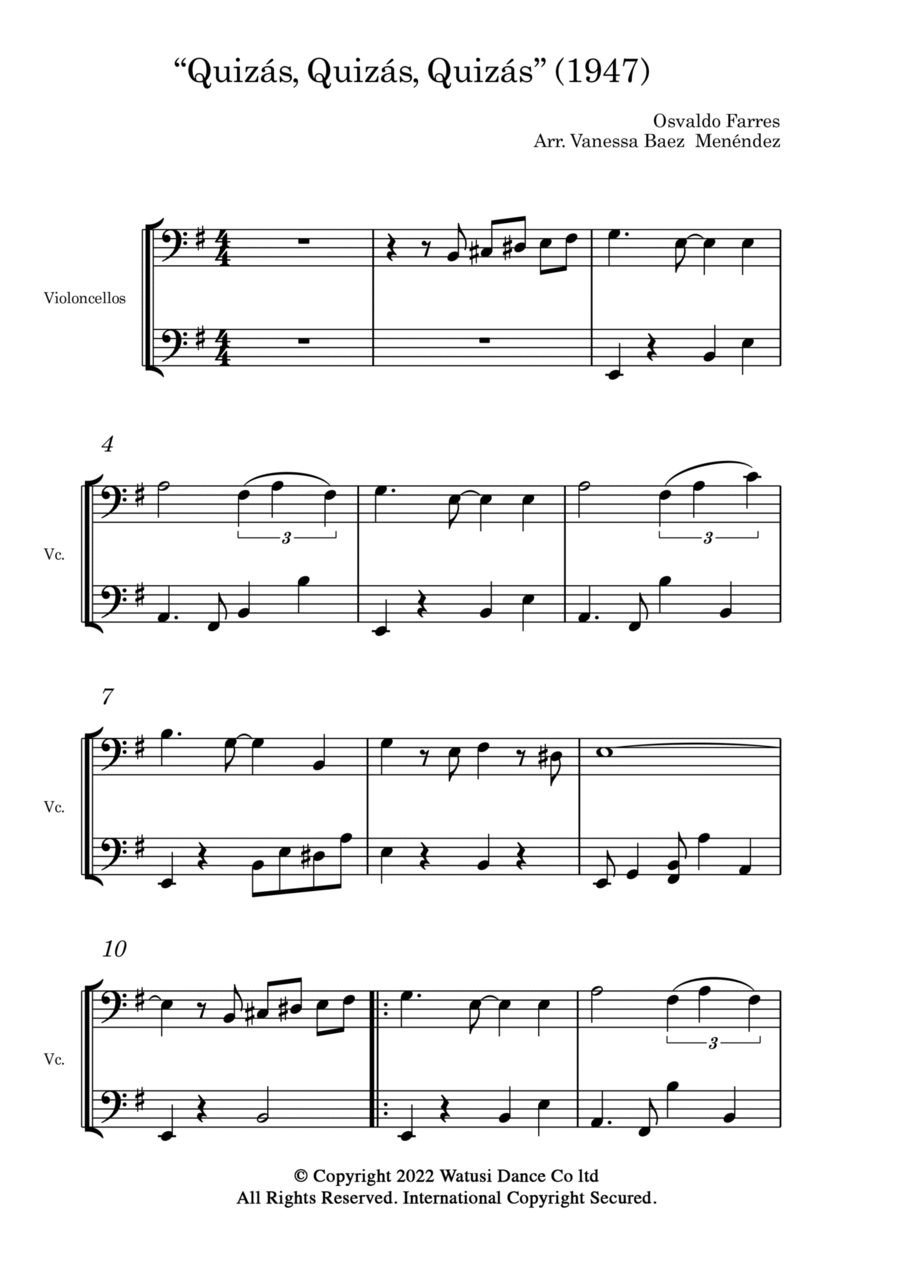
Quizás, Quizás, Quizás
2 Violoncelles (duo)
Osvaldo Farrés
$5.99 5.2 € 2 Violoncelles (duo) PDF SheetMusicPlus

Bassoon,Clarinet,Double Bass,Flute,Horn,Oboe - Level 4 - Digital Download SKU: A0.1335055 Composed by Erik Satie. Arranged by Ray Thompson. 20th Century,Chamber. 22 pages. RayThompsonMusic #920917. Published by RayThompsonMusic (A0.1335055). Satie: Parade - Final & Suite au Prélude de rideau rougeArranged wind dectet/bass (double wind quintet)The concluding music for Erik Satie's Ballet Parade.Other movements from Parade are available.Background info:Parade is a ballet choreographed by Leonide Massine, with music by Erik Satie and a one-act scenario by Jean Cocteau. The ballet was composed in 1916–17 for Sergei Diaghilev's Ballets Russes. The ballet premiered on Friday, May 18, 1917, at the Théâtre du Châtelet in Paris, with costumes and sets designed by Pablo Picasso, choreography by Léonide Massine (who danced), and the orchestra conducted by Ernest Ansermet.The ballet was remarkable for several reasons. It was the first collaboration between Satie and Picasso, and also the first time either of them had worked on a ballet, thus making it the first time either collaborated with Diaghilev and the Ballets Russes.The plot of Parade incorporated and was inspired by popular entertainments of the period, such as Parisian music-halls and American silent-films.Much of the settings used in Parade's plot occurred outside of the formal Parisian theater, depicting the streets of Paris.The plot reproduces various elements of everyday life such as the music hall and fairground.Before Parade, the use of popular entertainment materials was considered unsuitable for the elite world of the ballet.The plot of Parade composed by Cocteau includes the failed attempt of a troupe of performers to attract audience members to view their show.Some of Picasso's Cubist costumes were in solid cardboard, allowing the dancers only a minimum of movement.The score contained several noise-making instruments (typewriter, foghorn, an assortment of milk bottles, pistol, and so on), which had been added by Cocteau (somewhat to the dismay of Satie).It is supposedthat such additions by Cocteau showed his eagerness to create a succès de scandale, comparable to that of Igor Stravinsky's Le Sacre du Printemps which had been premiered by the Ballets Russes some years before, and caused no less scandal.Although Parade was quite revolutionary, bringing common street entertainments to the elite, being scorned by audiences and being praised by critics,nonetheless many years later Stravinsky could still pride himself in never having been topped in the matter of succès de scandale.The ragtime contained in Parade would later be adapted for piano solo and attained considerable success as a separate piano piece.The finale is a rapid ragtime dance in which the whole cast [makes] a last desperate attempt to lure the audience in to see their showI have omitted the  percussion in my arrangement of the finale.The premiere of the ballet resulted in a number of scandals. One faction of the audience booed, hissed, and was very unruly, nearly causing a riot before they were drowned out by enthusiastic applause.Many of their objections were focused on Picasso's cubist design, which was met with cries of sale boche.Arranged wind dectet/bass (double wind quintet).
Satie: Parade - Final & Suite au Prélude de rideau rouge - wind dectet

$14.95 12.98 € PDF SheetMusicPlus

Bassoon,Clarinet,Double Bass,Flute,Horn,Oboe - Level 4 - Digital Download SKU: A0.1293743 Composed by Erik Satie. Arranged by Ray Thompson. 20th Century,Chamber. 16 pages. RayThompsonMusic #884220. Published by RayThompsonMusic (A0.1293743). Arranged wind dectet/bass (double wind quintet)A taster of the opening music for Erik Satie's Ballet Parade.Choral and Prelude of the red curtainOther scores to follow.Background info:Parade is a ballet choreographed by Leonide Massine, with music by Erik Satie and a one-act scenario by Jean Cocteau. The ballet was composed in 1916–17 for Sergei Diaghilev's Ballets Russes. The ballet premiered on Friday, May 18, 1917, at the Théâtre du Châtelet in Paris, with costumes and sets designed by Pablo Picasso, choreography by Léonide Massine (who danced), and the orchestra conducted by Ernest Ansermet.The ballet was remarkable for several reasons. It was the first collaboration between Satie and Picasso, and also the first time either of them had worked on a ballet, thus making it the first time either collaborated with Diaghilev and the Ballets Russes.The plot of Parade incorporated and was inspired by popular entertainments of the period, such as Parisian music-halls and American silent-films.Much of the settings used in Parade's plot occurred outside of the formal Parisian theater, depicting the streets of Paris.The plot reproduces various elements of everyday life such as the music hall and fairground.Before Parade, the use of popular entertainment materials was considered unsuitable for the elite world of the ballet.The plot of Parade composed by Cocteau includes the failed attempt of a troupe of performers to attract audience members to view their show.Some of Picasso's Cubist costumes were in solid cardboard, allowing the dancers only a minimum of movement.The score contained several noise-making instruments (typewriter, foghorn, an assortment of milk bottles, pistol, and so on), which had been added by Cocteau (somewhat to the dismay of Satie).It is supposedthat such additions by Cocteau showed his eagerness to create a succès de scandale, comparable to that of Igor Stravinsky's Le Sacre du Printemps which had been premiered by the Ballets Russes some years before, and caused no less scandal.Although Parade was quite revolutionary, bringing common street entertainments to the elite, being scorned by audiences and being praised by critics,nonetheless many years later Stravinsky could still pride himself in never having been topped in the matter of succès de scandale.The ragtime contained in Parade would later be adapted for piano solo and attained considerable success as a separate piano piece.The finale is a rapid ragtime dance in which the whole cast [makes] a last desperate attempt to lure the audience in to see their showThe premiere of the ballet resulted in a number of scandals. One faction of the audience booed, hissed, and was very unruly, nearly causing a riot before they were drowned out by enthusiastic applause.Many of their objections were focused on Picasso's cubist design, which was met with cries of sale boche.
Satie: Parade - Choral & Prélude de rideau rouge - wind dectet

$4.99 4.33 € PDF SheetMusicPlus

A Clarinet,Bassoon,Double Bass,Flute,Oboe/English Horn,Percussion,Timpani,Tuba - Level 4 - Digital Download SKU: A0.1300657 Composed by Erik Satie. Arranged by Ray Thompson. 20th Century,Chamber. 27 pages. RayThompsonMusic #890400. Published by RayThompsonMusic (A0.1300657). Arranged double wind quintet/bass and optional percussion.Background info:Parade is a ballet choreographed by Leonide Massine, with music by Erik Satie and a one-act scenario by Jean Cocteau. The ballet was composed in 1916–17 for Sergei Diaghilev's Ballets Russes. The ballet premiered on Friday, May 18, 1917, at the Théâtre du Châtelet in Paris, with costumes and sets designed by Pablo Picasso, choreography by Léonide Massine (who danced), and the orchestra conducted by Ernest Ansermet.The ballet was remarkable for several reasons. It was the first collaboration between Satie and Picasso, and also the first time either of them had worked on a ballet, thus making it the first time either collaborated with Diaghilev and the Ballets Russes.The plot of Parade incorporated and was inspired by popular entertainments of the period, such as Parisian music-halls and American silent-films.Much of the settings used in Parade's plot occurred outside of the formal Parisian theater, depicting the streets of Paris.The plot reproduces various elements of everyday life such as the music hall and fairground.Before Parade, the use of popular entertainment materials was considered unsuitable for the elite world of the ballet.The plot of Parade composed by Cocteau includes the failed attempt of a troupe of performers to attract audience members to view their show.Some of Picasso's Cubist costumes were in solid cardboard, allowing the dancers only a minimum of movement.The score contained several noise-making instruments (typewriter, foghorn, an assortment of bottles, pistol, and so on), which had been added by Cocteau (somewhat to the dismay of Satie).It is supposedthat such additions by Cocteau showed his eagerness to create a succès de scandale, comparable to that of Igor Stravinsky's Le Sacre du Printemps which had been premiered by the Ballets Russes some years before, and caused no less scandal.Although Parade was quite revolutionary, bringing common street entertainments to the elite, being scorned by audiences and being praised by critics,nonetheless many years later Stravinsky could still pride himself in never having been topped in the matter of succès de scandale.The ragtime contained in Parade would later be adapted for piano solo and attained considerable success as a separate piano piece.The finale is a rapid ragtime dance in which the whole cast [makes] a last desperate attempt to lure the audience in to see their showThe premiere of the ballet resulted in a number of scandals. One faction of the audience booed, hissed, and was very unruly, nearly causing a riot before they were drowned out by enthusiastic applause.Many of their objections were focused on Picasso's cubist design, which was met with cries of sale boche.Prestidigitateur chinois (Chinese Conjuror) is no 1 in the ballet, and includes some of the odd percussion : sirens in addition to normal orchestral perc.The piece can be performed without percussion....but the percussion gives it an extra something!!
Satie: Parade I. Prestidigitateur chinois - wind dectet/bass (with optional percussion)

$19.95 17.32 € PDF SheetMusicPlus

Bassoon,Clarinet,Double Bass,Flute,Mallet Percussion,Multi-Percussion,Oboe/English Horn - Level 4 - Digital Download SKU: A0.1296860 Composed by Erik Satie. Arranged by Ray Thompson. 20th Century,Chamber,Comedy. 40 pages. RayThompsonMusic #887010. Published by RayThompsonMusic (A0.1296860). Arranged double wind quintet/bass and optional percussion.Background info:Parade is a ballet choreographed by Leonide Massine, with music by Erik Satie and a one-act scenario by Jean Cocteau. The ballet was composed in 1916–17 for Sergei Diaghilev's Ballets Russes. The ballet premiered on Friday, May 18, 1917, at the Théâtre du Châtelet in Paris, with costumes and sets designed by Pablo Picasso, choreography by Léonide Massine (who danced), and the orchestra conducted by Ernest Ansermet.The ballet was remarkable for several reasons. It was the first collaboration between Satie and Picasso, and also the first time either of them had worked on a ballet, thus making it the first time either collaborated with Diaghilev and the Ballets Russes.The plot of Parade incorporated and was inspired by popular entertainments of the period, such as Parisian music-halls and American silent-films.Much of the settings used in Parade's plot occurred outside of the formal Parisian theater, depicting the streets of Paris.The plot reproduces various elements of everyday life such as the music hall and fairground.Before Parade, the use of popular entertainment materials was considered unsuitable for the elite world of the ballet.The plot of Parade composed by Cocteau includes the failed attempt of a troupe of performers to attract audience members to view their show.Some of Picasso's Cubist costumes were in solid cardboard, allowing the dancers only a minimum of movement.The score contained several noise-making instruments (typewriter, foghorn, an assortment of bottles, pistol, and so on), which had been added by Cocteau (somewhat to the dismay of Satie).It is supposedthat such additions by Cocteau showed his eagerness to create a succès de scandale, comparable to that of Igor Stravinsky's Le Sacre du Printemps which had been premiered by the Ballets Russes some years before, and caused no less scandal.Although Parade was quite revolutionary, bringing common street entertainments to the elite, being scorned by audiences and being praised by critics,nonetheless many years later Stravinsky could still pride himself in never having been topped in the matter of succès de scandale.The ragtime contained in Parade would later be adapted for piano solo and attained considerable success as a separate piano piece.The finale is a rapid ragtime dance in which the whole cast [makes] a last desperate attempt to lure the audience in to see their showThe premiere of the ballet resulted in a number of scandals. One faction of the audience booed, hissed, and was very unruly, nearly causing a riot before they were drowned out by enthusiastic applause.Many of their objections were focused on Picasso's cubist design, which was met with cries of sale boche.Acrobates (Acrobats) is no 3 in the ballet, and includes some of the odd percussion : sirens and a bottle phone, in addition to normal orchestral perc.The piece can be performed without percussion....but the percussion gives it an extra something!!
Satie: Parade III.Acrobates (Acrobats) - wind dectet/bass (with optional percussion)

$19.95 17.32 € PDF SheetMusicPlus

Easy Piano - Level 3 - Digital Download SKU: A0.821399 Composed by Various. Arranged by Judith L. Maggs. 19th Century,20th Century,Instructional,Romantic Period,Standards. Score. 28 pages. Maggs #6332175. Published by Maggs (A0.821399). A Classical Salad is a collection of 8 eclectic classics arranged for intermediate to advanced intermediate piano. All of them are satisfying to play and listen to, even though simplified. They would work nicely as recital pieces.Each piece in the collection is also published separately on SLP. (I’ll include the product numbers, in case you’d like to be able to listen to each piece in its entirety.)Included are: Anitra’s Dance - Grieg (21979782)Theme from Chopin’s Etude Op. 10 No. 3 (21991996)Funeral March of a Marionette - Gounod (21848185)Dance of the Hours - Ponchielli (21978683)Salut d’amour - Elgar (21995628)Spring Song - Mendelssohn (21988308)Juba Dance - Dett (21986237)Liberty Bell March - Sousa (21981114)
A Classical Salad - Eight favorite classics arranged for the intermediate pianist
Piano Facile

$12.99 11.28 € Piano Facile PDF SheetMusicPlus

Concert Band - Level 5 - Digital Download SKU: A0.1477149 By Benny Goodman. By Gordon Jenkins. Arranged by Bryan Kidd. Jazz,Standards. 36 pages. BryanKiddMusic.com #1053751. Published by BryanKiddMusic.com (A0.1477149). “Goodbye”, Part 3 of the “Benny Goodman: Memories of You” medley “Benny Goodman: Memories of You” is Bryan Kidd’s tribute to the big band era’s masterful “King of Swing,” Benny Goodman. This enduring medley, introduced by clarinetist Chief Musician Matt Rutkowski, was commissioned by The United States Navy Band under the direction of Captain William J. Phillips. The premiere performance was on October 22, 1992, at the John F. Kennedy Center for the Performing Arts on the occasion of the United States Navy’s 217th Birthday Concert. For over 30 years it’s been a favorite with Navy Band clarinetists and world-wide audiences alike. This is a professional / advanced arrangement – an experienced jazz rhythm section is required.IMPORTANT: 1. because of licensing requirements, each movement must be purchased as a separate title (as though they are stand-alone titles). Links for each movement:      “Memories of You” click here     “Let’s Dance” click here     “Moonglow” click here     “Sing, Sing, Sing” click here2. “After You’ve Gone” is in the public domain and available at NO CHARGE directly from Bryan Kidd (info@bryankiddmusic.com) with proof of purchase of the rest of the medley.SCORES:A letter-size (8.5x11) score and instrumental parts are included with each set; a more easily read Tabloid (11x17) score is available separately (RECOMMENDED).      “Memories of You” Tabloid-size (11x17) score, click here     “Let’s Dance” Tabloid-size (11x17) score, click here     Goodbye Tabloid-size score, click here     “Moonglow” Tabloid-size (11x17) score, click here     “Sing, Sing, Sing” Tabloid-size (11x17) score, click here Please visit BryanKiddMusic.com With 26 years of service, Bryan Kidd retired as the Chief Composer and Arranger for The United States Navy Band, Washington, D.C.  Bryan's writing, conducting, and teaching experience range from elementary through collegiate and professional levels. Currently, he is the Composer/Arranger-in-Residence for The American Festival Pops Orchestra founded by Conductor Emeritus, Anthony Maiello, a professional ensemble affiliated with George Mason University, Fairfax, Virginia. 
Goodbye
Orchestre d'harmonie
Benny Goodman
$49.99 43.41 € Orchestre d'harmonie PDF SheetMusicPlus

Concert Band - Level 5 - Digital Download SKU: A0.1477150 By George Cates. By Eddie De Lange, Irving Mills, and Will Hudson. Arranged by Bryan Kidd. Jazz,Standards. 37 pages. BryanKiddMusic.com #1053755. Published by BryanKiddMusic.com (A0.1477150). “Moonglow”, Part 5 of the “Benny Goodman: Memories of You” medley “Benny Goodman: Memories of You” is Bryan Kidd’s tribute to the big band era’s masterful “King of Swing,” Benny Goodman. This enduring medley, introduced by clarinetist Chief Musician Matt Rutkowski, was commissioned by The United States Navy Band under the direction of Captain William J. Phillips. The premiere performance was on October 22, 1992, at the John F. Kennedy Center for the Performing Arts on the occasion of the United States Navy’s 217th Birthday Concert. For over 30 years it’s been a favorite with Navy Band clarinetists and world-wide audiences alike. This is a professional / advanced arrangement – an experienced jazz rhythm section is required.IMPORTANT: 1. because of licensing requirements, each movement must be purchased as a separate title (as though they are stand-alone titles). Links for each movement:      “Memories of You” click here     “Let’s Dance” click here     “Goodbye” click here      “Sing, Sing, Sing” click here2. “After You’ve Gone” is in the public domain and available at NO CHARGE directly from Bryan Kidd (info@bryankiddmusic.com) with proof of purchase of the rest of the medley.SCORES:A letter-size (8.5x11) score and instrumental parts are included with each set; a more easily read Tabloid (11x17) score is available separately (RECOMMENDED).      “Memories of You” Tabloid-size (11x17) score, click here     “Let’s Dance” Tabloid-size (11x17) score, click here     “Goodbye” Tabloid-size (11x17) score, click here        Moonglow Tabloid-size (11x17) score, click here        “Sing, Sing, Sing” Tabloid-size (11x17) score, click here Please visit BryanKiddMusic.com With 26 years of service, Bryan Kidd retired as the Chief Composer and Arranger for The United States Navy Band, Washington, D.C.  Bryan's writing, conducting, and teaching experience range from elementary through collegiate and professional levels. Currently, he is the Composer/Arranger-in-Residence for The American Festival Pops Orchestra founded by Conductor Emeritus, Anthony Maiello, a professional ensemble affiliated with George Mason University, Fairfax, Virginia.   
Moonglow
Orchestre d'harmonie
George Cates
$49.99 43.41 € Orchestre d'harmonie PDF SheetMusicPlus

Flute Duet Flute - Level 3 - Digital Download SKU: A0.1491277 Composed by Edward Poldini. Arranged by Kan Saito / Japan Duo Notes. 19th Century,20th Century,Classical,Film/TV,Romantic Period. Score. 3 pages. Japan Duo Notes #1068015. Published by Japan Duo Notes (A0.1491277). Title: Dancing Doll by Edward Poldini – Flute Duet ArrangementDescription:Delight in the playful charm of Edward Poldini’s Dancing Doll with this elegant flute duet arrangement. Originally from Poldini’s Poupée Valsante (Dancing Doll), this piece is known for its whimsical, light-hearted melody that evokes the image of a mechanical doll in motion. This arrangement for two flutes perfectly captures the lively, dance-like character of the original, making it an engaging and fun performance piece for flutists of all levels.Key Features:Composer: Edward PoldiniArrangement: Flute DuetDifficulty Level: IntermediateFormat: Digital Sheet Music PDFPages: Score: 3 pagesThis flute duet arrangement of Dancing Doll brings out the playful, waltz-like quality of Poldini’s composition, offering flutists the opportunity to explore its lively rhythms and charming melody. Ideal for recitals, concerts, and light music performances, this piece provides an enjoyable and musically rewarding experience for both performers and audiences.Why Choose This Arrangement?Faithful Adaptation: Captures the light, playful spirit of Poldini’s Dancing Doll, arranged for two flutes with attention to the original’s dance-like flow.Versatile and Fun: Perfect for a variety of performance settings, including recitals, concerts, and light music programs.Musically Engaging: Ideal for intermediate flutists, offering a balance of technical playfulness and artistic expression.Add the whimsical charm of Edward Poldini’s Dancing Doll to your flute duet repertoire with this delightful arrangement. It’s a wonderful choice for flutists looking to perform a piece that is both light-hearted and technically engaging.Keywords: Edward Poldini, Dancing Doll, flute duet, flute sheet music, Poldini arrangements, classical music, waltz, intermediate flute music, concert flute duet, recital music, playful music, light music.
Dancing Doll / Edward Poldini
2 Flûtes traversières (duo)

$4.99 4.33 € 2 Flûtes traversières (duo) PDF SheetMusicPlus


Partitions Gratuites
Acheter des Partitions Musicales
Acheter des Partitions Digitales à Imprimer
Acheter des Instruments de Musique

© 2000 - 2026

Accueil - Version intégrale





