EUROPE
6706 articles
USA
0 articles
DIGITAL
13175 articles (à imprimer)
Partitions Digitales
Partitions à imprimer
13175 partitions trouvées


Alto Saxophone,Piano - Level 2 - Digital Download SKU: A0.549015 Composed by Franz Schubert. Arranged by James M. Guthrie, ASCAP. Holiday,Romantic Period,Sacred,Standards. Score and part. 10 pages. Jmsgu3 #3447439. Published by jmsgu3 (A0.549015). Alto Sax version of Moment Musicaux, Op. 94 (D. 780) No. 3 by Franz Schubert, published in 1828. Duration: 1:53 Score 6 pg. 54 ms. Alto Sax 1 pg. Piano part 3 pg. One of Schubert's most well-known pieces. This is an effective recital encore due to its brevity and range of expression. Could work well for a variety of occasions: wedding receptions, church services (Easter), and anniversaries. It seems like a pleasant dance, unlike some previous dance music. Schubert improvised these dances at parties for his friends.  Although conceived on-the-fly, these dances are the work of a genius. Composers have similarly elevated dance music to artistic status. As a result, they freed it from the original purpose of dancing. Certainly, the older masters used the dance forms as vehicles for complex treatments. Here, however, Schubert retains the dance-like quality while finally expressing his innermost thoughts and emotions. The dance is certainly filled with a doleful expression, yet the texture remains even more light and refined. Therefore, to perform these with sensitivity we probably need to use a light but accurate touch. The accompaniment pattern needs to be crisp and delicate – probably even in the more forceful parts. The piano pedal should also be used very carefully so as a result not to blur the outline. Instead, it should contribute to the dynamic quality of the piece. Schubert Franz Schubert (1797–1828) was, in fact, a famous Austrian composer. Moreover, he composed during the late Classical and early Romantic periods. Schubert was comparatively prolific. He wrote more than 600 secular vocal works, seven symphonies, and, correspondingly, a massive amount of piano and chamber music. Critics agree, as a matter of fact, that his most famous works include his Piano Quintet in A major, D. 667 (also known as the Trout Quintet), the Symphony No. 8 in B minor, D. 759 (Unfinished Symphony), the last sonatas for piano (D. 958–960), and the song cycles Die schöne Müllerin (D. 795) and Winterreise (D. 911). Education Schubert was furthermore a musical child prodigy. He studied violin with his father as well as piano with his older brother. In addition, when Schubert was eleven he studied at Stadtkonvikt school, where he became familiar with the orchestral music of Haydn, Mozart, and likewise Beethoven. In due time he left school and returned home where he studied to become an educator; nevertheless, he continued studying composition with Antonio Salieri. Performance Eventually, Schubert was admitted to the Gesellschaft der Musikfreunde as a performer. This appointment straightaway established his name in Vienna as a composer and pianist. Finally, he gave his only composition recital in 1828. He died suddenly a few months later probably due to typhoid fever. Legacy Schubert’s music was by and large underappreciated while he was alive. There were all in all only a few enthusiasts in Vienna. After he died, however, interest in his work in fact increased. Felix Mendelssohn, Robert Schumann, Franz Liszt, Johannes Brahms, and other famous composers in due time discovered his compositions. Nowadays, historians rank Schubert expressly among the greatest composers of the era, and his music remains in general very popular.
Schubert: Moment Musicaux for Alto Sax & Piano
Saxophone Alto et Piano

$32.95 28.61 € Saxophone Alto et Piano PDF SheetMusicPlus

Baritone Saxophone,Piano - Level 2 - Digital Download SKU: A0.549018 Composed by Franz Schubert. Arranged by James M. Guthrie, ASCAP. Holiday,Romantic Period,Sacred,Standards. Score and part. 10 pages. Jmsgu3 #3447449. Published by jmsgu3 (A0.549018). Baritone Sax version of Moment Musicaux, Op. 94 (D. 780) No. 3 by Franz Schubert, published in 1828. Duration: 1:53 Score 6 pg. 54 ms. Bari Sax 1 pg. Piano part 3 pg. One of Schubert's most well-known pieces. This is an effective recital encore due to its brevity and range of expression. Could work well for a variety of occasions: wedding receptions, church services (Easter), and anniversaries. It seems like a pleasant dance, unlike some previous dance music. Schubert improvised these dances at parties for his friends.  Although conceived on-the-fly, these dances are the work of a genius. Composers have similarly elevated dance music to artistic status. As a result, they freed it from the original purpose of dancing. Certainly, the older masters used the dance forms as vehicles for complex treatments. Here, however, Schubert retains the dance-like quality while finally expressing his innermost thoughts and emotions. The dance is certainly filled with a doleful expression, yet the texture remains even more light and refined. Therefore, to perform these with sensitivity we probably need to use a light but accurate touch. The accompaniment pattern needs to be crisp and delicate – probably even in the more forceful parts. The piano pedal should also be used very carefully so as a result not to blur the outline. Instead, it should contribute to the dynamic quality of the piece. Schubert Franz Schubert (1797–1828) was, in fact, a famous Austrian composer. Moreover, he composed during the late Classical and early Romantic periods. Schubert was comparatively prolific. He wrote more than 600 secular vocal works, seven symphonies, and, correspondingly, a massive amount of piano and chamber music. Critics agree, as a matter of fact, that his most famous works include his Piano Quintet in A major, D. 667 (also known as the Trout Quintet), the Symphony No. 8 in B minor, D. 759 (Unfinished Symphony), the last sonatas for piano (D. 958–960), and the song cycles Die schöne Müllerin (D. 795) and Winterreise (D. 911). Education Schubert was furthermore a musical child prodigy. He studied violin with his father as well as piano with his older brother. In addition, when Schubert was eleven he studied at Stadtkonvikt school, where he became familiar with the orchestral music of Haydn, Mozart, and likewise Beethoven. In due time he left school and returned home where he studied to become an educator; nevertheless, he continued studying composition with Antonio Salieri. Performance Eventually, Schubert was admitted to the Gesellschaft der Musikfreunde as a performer. This appointment straightaway established his name in Vienna as a composer and pianist. Finally, he gave his only composition recital in 1828. He died suddenly a few months later probably due to typhoid fever. Legacy Schubert’s music was by and large underappreciated while he was alive. There were all in all only a few enthusiasts in Vienna. After he died, however, interest in his work in fact increased. Felix Mendelssohn, Robert Schumann, Franz Liszt, Johannes Brahms, and other famous composers in due time discovered his compositions. Nowadays, historians rank Schubert expressly among the greatest composers of the era, and his music remains in general very popular.
Schubert: Moment Musicaux for Baritone Sax & Piano
Saxophone Baryton, Piano

$32.95 28.61 € Saxophone Baryton, Piano PDF SheetMusicPlus

Instrumental Duet Guitar,Instrumental Duet,Violin - Level 2 - Digital Download SKU: A0.836062 Composed by Ferdinando Carulli. Arranged by Joshua S. Kim. Concert,Holiday,Romantic Period,Wedding. Score and parts. 19 pages. Joshua S. Kim #3505703. Published by Joshua S. Kim (A0.836062). Sweet duo music for violin and classical guitar. Arranged from the original MS for guitar duo. This set of six contra dance pieces are perfect for a recital or party. Contre-Danses (French) means contra dance (also contradance or contra-dance) in English. It is a folk dance made up of long lines of couples. Includes a score and a set of parts. Contents: I. L'Excuse (The Excuse) II. La Ruse (The Ruse) III. La Constance (The Constancy) IV. La Fidélité (Faithfulness) V. La Douceur (Sweetness) VI. La Tolérance (Tolerance)
Six Contre-Danses for Violin and Guitar
Violon, Guitare (duo)

$9.50 8.25 € Violon, Guitare (duo) PDF SheetMusicPlus

Instrumental Duet Guitar,Instrumental Duet,Violin - Level 5 - Digital Download SKU: A0.861799 Composed by Mark O'Connor. 20th Century,Contemporary,Folk. Score and parts. 18 pages. Mark O'Connor Musik International #6202089. Published by Mark O'Connor Musik International (A0.861799). Strings & Threads Suite (guitar part - adapted for violin and guitar) MO171CGuitar Part (score and violin part available)Music by Mark O’Connor14 pages - 15:00 minutes in length I. Fair Dancer ReelII. Sailor’s JigIII. Captain’s JigIV. Off To SeaV. Pilgim’s WaltzVI. Road To AppalachiaVII. Shine OnVIII. Cotton Pickin’ BluesIX. Pickin’ Parlor RagX. Queen Of The CumberlandXI. Texas Dance Hall BluesXII. Swing 11:11XIII. Sweet Suzanne  Strings & Threads Suite adapted for violin and guitar is a piece comprising of thirteen tunes composed by Mark O’Connor. In 1986, the Tennessee Dance Theater commissioned the Suite from O’Connor to be performed as a violin solo at Nashville’s Summer Lights Festival. The individual tunes are in various folk styles appearing in a chronological form for which O’Connor says not only represents the evolution of American folk music, but also mirrors his own family’s migration from Ireland and Holland to America. It traces the family’s route through the thirteen colonies initially, and then eventually out West during WWl nearly 300 hundred years later. O’Connor wrote the pieces in a manner and style in which he felt his family could have heard along the way. The Suite begins with Irish music, maybe similar to what O’Connor’s family brought with them. Then in a thoughtful progression, reveals music they must of encountered living in early America. Strings & Threads musically describes how folk music styles hundreds of years apart are interconnected - possessing a common thread, from an Irish reel to jazz. The music is suited for advanced and intermediate.Original music printed from the composer’s manuscripts.Music editing, copying and engraving by Mark O’Connorusing Finale on Apple Macintosh 1986 Composed By Mark O’ConnorAdaptation for violin and guitar was commissioned by Sharon Isbin in 2006, and won a Grammy for BEST INSTRUMENTAL SOLOIST PERFORMANCE (WITHOUT ORCHESTRA) IN 2009Strings & Threads Suite (adapted for violin and guitar) can be heard on Journey to the New World by Sharon Isbin, Sony Classical Mark O’Connor – violin, Sharon Isbin - guitarCatalogue Number MO171CCopyright © 1986 by Mark O’Connor Music InternationalFor more information on violinist and composer Mark O'Connor, O’Connor String Camps, Touring Ensembles, Discography, Bio, Repertoire and more, please visitwww.markoconnor.com For information on the O’Connor Method – instructional book series for violin, viola, cello and school string orchestra programs:www.oconnormethod.com  
Strings & Threads Suite (guitar part - adapted for violin and guitar)
Violon, Guitare (duo)
Mark O’Connor

Adaptation for violin and guitar was commissioned by Sharon Isbin in 2006, and won a Grammy for BEST INSTRUMENTAL SOLOIST PERFORMANCE (WITHOUT ORCHESTRA) IN 2009

Strings & Threads Suite (adapted for violin and guitar) can be heard on Journey to the New World by Sharon Isbin, Sony Classical 

Mark O’Connor – violin, Sharon Isbin - guitar


Catalogue Number MO171C

Copyright © 1986 by Mark O’Connor Music International


For more information on violinist and composer Mark O'Connor, O’Connor String Camps, Touring Ensembles, Discography, Bio, Repertoire and more, please visit

markoconnor
$18.00 15.63 € Violon, Guitare (duo) PDF SheetMusicPlus

String Orchestra - Level 4 - Digital Download SKU: A0.861800 Composed by Mark O'Connor. 20th Century,Contemporary,Folk. Score and parts. 47 pages. Mark O'Connor Musik International #6202123. Published by Mark O'Connor Musik International (A0.861800). Strings & Threads Suite (score - for violin and string orchestra) MO134AScore (violin and string parts available)Music by Mark O’Connor43 pages - 15:00 minutes in length I. Fair Dancer Reel - p. 1II. Sailor’s Jig - p. 6III. Captain’s Jig - p. 9IV. Off To Sea - p. 11V. Pilgim’s Waltz - p. 12VI. Road To Appalachia - p. 15VII. Shine On - p. 18VIII. Cotton Pickin’ Blues - p. 21IX. Pickin’ Parlor Rag - p. 23X. Queen Of The Cumberland - p. 27XI. Texas Dance Hall Blues - p. 30XII. Swing 11:11 - p. 33XIII. Sweet Suzanne - p. 37 Strings & Threads Suite for violin and string orchestra is a piece comprising thirteen tunes composed by Mark O’Connor. In 1986, the Tennessee Dance Theater commissioned the Suite to be performed at Nashville’s Summer Lights Festival. A few years later Edgar Meyer provided the beautiful string orchestra arrangement that is contained in this score. The individual tunes are in various folk styles appearing in a chronological order O’Connor says, not only represents the evolution of American folk music, but also mirrors his own family’s migration from Ireland and Holland to America. It traces the family’s route through the thirteen colonies initially, and then eventually West during WWI nearly 300 hundred years later. O’Connor wrote the pieces in a manner and style he felt his family could have heard along the way. The Suite begins with Irish music, perhaps similar to the music O’Connor’s family brought with them. Then in a thoughtful progression, he reveals music they must have encountered living in early America. Strings & Threads musically describes how folk music styles hundreds of years apart are interconnected – possessing a common thread – from an Irish reel to jazz. The music is suited for advanced and intermediate levels but portions of the piece can be appropriate for beginners. Original music printed from the composer’s manuscripts.Music editing, copying and engraving by Mark O’Connorusing Finale on Apple Macintosh 1986 Composed By Mark O’ConnorString Orchestra arrangement by Edgar MeyerStrings & Threads Suite (violin and string orchestra version) can be heard on American Seasons Sony Classical Mark O’Connor – violin, Metamorphosen Chamber Orchestra, Scott YooCatalogue Number MO134ACopyright © 1986 by Mark O’Connor Music InternationalFor more information on violinist and composer Mark O'Connor, O’Connor String Camps, Touring Ensembles, Discography, Bio, Repertoire and more, please visitwww.markoconnor.com For information on the O’Connor Method – instructional book series for violin, viola, cello and school string orchestra programs:www.oconnormethod.com  
Strings & Threads Suite (score - for violin and string orchestra)
Orchestre à Cordes
Mark O’Connor

String Orchestra arrangement by Edgar Meyer

Strings & Threads Suite (violin and string orchestra version) can be heard on American Seasons Sony Classical 

Mark O’Connor – violin, Metamorphosen Chamber Orchestra, Scott Yoo


Catalogue Number MO134A

Copyright © 1986 by Mark O’Connor Music International


For more information on violinist and composer Mark O'Connor, O’Connor String Camps, Touring Ensembles, Discography, Bio, Repertoire and more, please visit

markoconnor
$22.50 19.54 € Orchestre à Cordes PDF SheetMusicPlus

String Orchestra - Level 4 - Digital Download SKU: A0.861802 Composed by Mark O'Connor. 20th Century,Contemporary,Folk. Score and parts. 69 pages. Mark O'Connor Musik International #6202135. Published by Mark O'Connor Musik International (A0.861802). Strings & Threads Suite (string parts - for violin and string orchestra) MO134C-GString Parts - vlns, vla, cel, bs (violin and string parts available)Music by Mark O’Connor69 pages - 15:00 minutes in length I. Fair Dancer Reel - p. 1II. Sailor’s Jig - p. 6III. Captain’s Jig - p. 9IV. Off To Sea - p. 11V. Pilgim’s Waltz - p. 12VI. Road To Appalachia - p. 15VII. Shine On - p. 18VIII. Cotton Pickin’ Blues - p. 21IX. Pickin’ Parlor Rag - p. 23X. Queen Of The Cumberland - p. 27XI. Texas Dance Hall Blues - p. 30XII. Swing 11:11 - p. 33XIII. Sweet Suzanne - p. 37 Strings & Threads Suite for violin and string orchestra is a piece comprising thirteen tunes composed by Mark O’Connor. In 1986, the Tennessee Dance Theater commissioned the Suite to be performed at Nashville’s Summer Lights Festival. A few years later Edgar Meyer provided the beautiful string orchestra arrangement that is contained in this score. The individual tunes are in various folk styles appearing in a chronological order O’Connor says, not only represents the evolution of American folk music, but also mirrors his own family’s migration from Ireland and Holland to America. It traces the family’s route through the thirteen colonies initially, and then eventually West during WWI nearly 300 hundred years later. O’Connor wrote the pieces in a manner and style he felt his family could have heard along the way. The Suite begins with Irish music, perhaps similar to the music O’Connor’s family brought with them. Then in a thoughtful progression, he reveals music they must have encountered living in early America. Strings & Threads musically describes how folk music styles hundreds of years apart are interconnected – possessing a common thread – from an Irish reel to jazz. The music is suited for advanced and intermediate levels but portions of the piece can be appropriate for beginners. Original music printed from the composer’s manuscripts.Music editing, copying and engraving by Mark O’Connorusing Finale on Apple Macintosh 1986 Composed By Mark O’ConnorString Orchestra arrangement by Edgar MeyerStrings & Threads Suite (violin and string orchestra version) can be heard on American Seasons Sony Classical Mark O’Connor – violin, Metamorphosen Chamber Orchestra, Scott YooCatalogue Number MO134C-GCopyright © 1986 by Mark O’Connor Music InternationalFor more information on violinist and composer Mark O'Connor, O’Connor String Camps, Touring Ensembles, Discography, Bio, Repertoire and more, please visitwww.markoconnor.com For information on the O’Connor Method – instructional book series for violin, viola, cello and school string orchestra programs:www.oconnormethod.com  
Strings & Threads Suite (string parts - for violin and string orchestra)
Orchestre à Cordes
Mark O’Connor

String Orchestra arrangement by Edgar Meyer

Strings & Threads Suite (violin and string orchestra version) can be heard on American Seasons Sony Classical 

Mark O’Connor – violin, Metamorphosen Chamber Orchestra, Scott Yoo


Catalogue Number MO134C-G

Copyright © 1986 by Mark O’Connor Music International


For more information on violinist and composer Mark O'Connor, O’Connor String Camps, Touring Ensembles, Discography, Bio, Repertoire and more, please visit

markoconnor
$45.00 39.07 € Orchestre à Cordes PDF SheetMusicPlus

Instrumental Duet Guitar,Instrumental Duet,Violin - Level 5 - Digital Download SKU: A0.861797 Composed by Mark O'Connor. 20th Century,Contemporary,Folk. Score and parts. 28 pages. Mark O'Connor Musik International #6202083. Published by Mark O'Connor Musik International (A0.861797). Strings & Threads Suite (adapted for violin and guitar) MO171AScore (violin and guitar parts available)Music by Mark O’Connor24 pages - 15:00 minutes in length I. Fair Dancer ReelII. Sailor’s JigIII. Captain’s JigIV. Off To SeaV. Pilgim’s WaltzVI. Road To AppalachiaVII. Shine OnVIII. Cotton Pickin’ BluesIX. Pickin’ Parlor RagX. Queen Of The CumberlandXI. Texas Dance Hall BluesXII. Swing 11:11XIII. Sweet Suzanne  Strings & Threads Suite adapted for violin and guitar is a piece comprising of thirteen tunes composed by Mark O’Connor. In 1986, the Tennessee Dance Theater commissioned the Suite from O’Connor to be performed as a violin solo at Nashville’s Summer Lights Festival. The individual tunes are in various folk styles appearing in a chronological form for which O’Connor says not only represents the evolution of American folk music, but also mirrors his own family’s migration from Ireland and Holland to America. It traces the family’s route through the thirteen colonies initially, and then eventually out West during WWl nearly 300 hundred years later. O’Connor wrote the pieces in a manner and style in which he felt his family could have heard along the way. The Suite begins with Irish music, maybe similar to what O’Connor’s family brought with them. Then in a thoughtful progression, reveals music they must of encountered living in early America. Strings & Threads musically describes how folk music styles hundreds of years apart are interconnected - possessing a common thread, from an Irish reel to jazz. The music is suited for advanced and intermediate.Original music printed from the composer’s manuscripts.Music editing, copying and engraving by Mark O’Connorusing Finale on Apple Macintosh 1986 Composed By Mark O’ConnorAdaptation for violin and guitar was commissioned by Sharon Isbin in 2006, and won a Grammy for BEST INSTRUMENTAL SOLOIST PERFORMANCE (WITHOUT ORCHESTRA) IN 2009Strings & Threads Suite (adapted for violin and guitar) can be heard on Journey to the New World by Sharon Isbin, Sony Classical Mark O’Connor – violin, Sharon Isbin - guitarCatalogue Number MO171ACopyright © 1986 by Mark O’Connor Music InternationalFor more information on violinist and composer Mark O'Connor, O’Connor String Camps, Touring Ensembles, Discography, Bio, Repertoire and more, please visitwww.markoconnor.com For information on the O’Connor Method – instructional book series for violin, viola, cello and school string orchestra programs:www.oconnormethod.com  
Strings & Threads Suite (score - adapted for violin and guitar)
Violon, Guitare (duo)
Mark O’Connor

Adaptation for violin and guitar was commissioned by Sharon Isbin in 2006, and won a Grammy for BEST INSTRUMENTAL SOLOIST PERFORMANCE (WITHOUT ORCHESTRA) IN 2009

Strings & Threads Suite (adapted for violin and guitar) can be heard on Journey to the New World by Sharon Isbin, Sony Classical 

Mark O’Connor – violin, Sharon Isbin - guitar


Catalogue Number MO171A

Copyright © 1986 by Mark O’Connor Music International


For more information on violinist and composer Mark O'Connor, O’Connor String Camps, Touring Ensembles, Discography, Bio, Repertoire and more, please visit

markoconnor
$22.50 19.54 € Violon, Guitare (duo) PDF SheetMusicPlus

Instrumental Duet Guitar,Instrumental Duet,Violin - Level 5 - Digital Download SKU: A0.861798 Composed by Mark O'Connor. 20th Century,Contemporary,Folk. Score and parts. 18 pages. Mark O'Connor Musik International #6202085. Published by Mark O'Connor Musik International (A0.861798). Strings & Threads Suite (violin part - adapted for violin and guitar) MO171BViolin Part (score and guitar parts available)Music by Mark O’Connor14 pages - 15:00 minutes in length I. Fair Dancer ReelII. Sailor’s JigIII. Captain’s JigIV. Off To SeaV. Pilgim’s WaltzVI. Road To AppalachiaVII. Shine OnVIII. Cotton Pickin’ BluesIX. Pickin’ Parlor RagX. Queen Of The CumberlandXI. Texas Dance Hall BluesXII. Swing 11:11XIII. Sweet Suzanne Strings & Threads Suite adapted for violin and guitar is a piece comprising of thirteen tunes composed by Mark O’Connor. In 1986, the Tennessee Dance Theater commissioned the Suite from O’Connor to be performed as a violin solo at Nashville’s Summer Lights Festival. The individual tunes are in various folk styles appearing in a chronological form for which O’Connor says not only represents the evolution of American folk music, but also mirrors his own family’s migration from Ireland and Holland to America. It traces the family’s route through the thirteen colonies initially, and then eventually out West during WWl nearly 300 hundred years later. O’Connor wrote the pieces in a manner and style in which he felt his family could have heard along the way. The Suite begins with Irish music, maybe similar to what O’Connor’s family brought with them. Then in a thoughtful progression, reveals music they must of encountered living in early America. Strings & Threads musically describes how folk music styles hundreds of years apart are interconnected - possessing a common thread, from an Irish reel to jazz. The music is suited for advanced and intermediate.Original music printed from the composer’s manuscripts.Music editing, copying and engraving by Mark O’Connorusing Finale on Apple Macintosh 1986 Composed By Mark O’ConnorAdaptation for violin and guitar was commissioned by Sharon Isbin in 2006, and won a Grammy for BEST INSTRUMENTAL SOLOIST PERFORMANCE (WITHOUT ORCHESTRA) IN 2009Strings & Threads Suite (adapted for violin and guitar) can be heard on Journey to the New World by Sharon Isbin, Sony Classical Mark O’Connor – violin, Sharon Isbin - guitarCatalogue Number MO171BCopyright © 1986 by Mark O’Connor Music InternationalFor more information on violinist and composer Mark O'Connor, O’Connor String Camps, Touring Ensembles, Discography, Bio, Repertoire and more, please visitwww.markoconnor.com For information on the O’Connor Method – instructional book series for violin, viola, cello and school string orchestra programs:www.oconnormethod.com  
Strings & Threads Suite (violin part - adapted for violin and guitar)
Violon, Guitare (duo)
Mark O’Connor

Adaptation for violin and guitar was commissioned by Sharon Isbin in 2006, and won a Grammy for BEST INSTRUMENTAL SOLOIST PERFORMANCE (WITHOUT ORCHESTRA) IN 2009

Strings & Threads Suite (adapted for violin and guitar) can be heard on Journey to the New World by Sharon Isbin, Sony Classical 

Mark O’Connor – violin, Sharon Isbin - guitar


Catalogue Number MO171B

Copyright © 1986 by Mark O’Connor Music International


For more information on violinist and composer Mark O'Connor, O’Connor String Camps, Touring Ensembles, Discography, Bio, Repertoire and more, please visit

markoconnor
$18.00 15.63 € Violon, Guitare (duo) PDF SheetMusicPlus

String Orchestra - Level 4 - Digital Download SKU: A0.861801 Composed by Mark O'Connor. 20th Century,Contemporary,Folk. Score and parts. 20 pages. Mark O'Connor Musik International #6202131. Published by Mark O'Connor Musik International (A0.861801). Strings & Threads Suite (violin solo part - for violin and string orchestra) MO134BViolin Solo Part (score and string parts available)Music by Mark O’Connor16 pages - 15:00 minutes in length I. Fair Dancer Reel - p. 1II. Sailor’s Jig - p. 6III. Captain’s Jig - p. 9IV. Off To Sea - p. 11V. Pilgim’s Waltz - p. 12VI. Road To Appalachia - p. 15VII. Shine On - p. 18VIII. Cotton Pickin’ Blues - p. 21IX. Pickin’ Parlor Rag - p. 23X. Queen Of The Cumberland - p. 27XI. Texas Dance Hall Blues - p. 30XII. Swing 11:11 - p. 33XIII. Sweet Suzanne - p. 37 Strings & Threads Suite for violin and string orchestra is a piece comprising thirteen tunes composed by Mark O’Connor. In 1986, the Tennessee Dance Theater commissioned the Suite to be performed at Nashville’s Summer Lights Festival. A few years later Edgar Meyer provided the beautiful string orchestra arrangement that is contained in this score. The individual tunes are in various folk styles appearing in a chronological order O’Connor says, not only represents the evolution of American folk music, but also mirrors his own family’s migration from Ireland and Holland to America. It traces the family’s route through the thirteen colonies initially, and then eventually West during WWI nearly 300 hundred years later. O’Connor wrote the pieces in a manner and style he felt his family could have heard along the way. The Suite begins with Irish music, perhaps similar to the music O’Connor’s family brought with them. Then in a thoughtful progression, he reveals music they must have encountered living in early America. Strings & Threads musically describes how folk music styles hundreds of years apart are interconnected – possessing a common thread – from an Irish reel to jazz. The music is suited for advanced and intermediate levels but portions of the piece can be appropriate for beginners. Original music printed from the composer’s manuscripts.Music editing, copying and engraving by Mark O’Connorusing Finale on Apple Macintosh 1986 Composed By Mark O’ConnorString Orchestra arrangement by Edgar MeyerStrings & Threads Suite (violin and string orchestra version) can be heard on American Seasons Sony Classical Mark O’Connor – violin, Metamorphosen Chamber Orchestra, Scott YooCatalogue Number MO134BCopyright © 1986 by Mark O’Connor Music InternationalFor more information on violinist and composer Mark O'Connor, O’Connor String Camps, Touring Ensembles, Discography, Bio, Repertoire and more, please visitwww.markoconnor.com For information on the O’Connor Method – instructional book series for violin, viola, cello and school string orchestra programs:www.oconnormethod.com  
Strings & Threads Suite (violin solo part - for violin and string orchestra)
Orchestre à Cordes
Mark O’Connor

String Orchestra arrangement by Edgar Meyer

Strings & Threads Suite (violin and string orchestra version) can be heard on American Seasons Sony Classical 

Mark O’Connor – violin, Metamorphosen Chamber Orchestra, Scott Yoo


Catalogue Number MO134B

Copyright © 1986 by Mark O’Connor Music International


For more information on violinist and composer Mark O'Connor, O’Connor String Camps, Touring Ensembles, Discography, Bio, Repertoire and more, please visit

markoconnor
$15.00 13.02 € Orchestre à Cordes PDF SheetMusicPlus

Small Ensemble Organ,Piano Accompaniment - Level 5 - Digital Download SKU: A0.961865 Composed by Various. Arranged by Daniel Kelley. Baroque,Classical,Romantic Period,Traditional. Score and parts. 94 pages. Last Resort Music Publishing #567576. Published by Last Resort Music Publishing (A0.961865). Music for Three, Volume 8 - More Baroque, Classical & Romantic Favorites Keyboard or Guitar Including works by Bizet, Faure, Borodin, Gottschalk, and Rossini and more! An incredible collection of 35 arrangements for strings, woodwinds and piano – these mix and match trios allow the performer to pick the instrumentation. A versatile must-have for any musician, Music for Three is perfect for weddings, recitals, concerts, and any chamber music gatherings. Parts are available separately or may be purchased as sets. The keyboard/guitar part encompasses both parts 2 and 3. Therefore, the arrangements could be played as a piano trio, or an entire trio can play with a pianist - as long as Part 1 is being played. The parts available for this volume are listed here! 50811 Part 1 Flute or Oboe or Violin 50813 Part 1 Clarinet in Bb 50821 Part 2 Flute or Oboe or Violin 50822 Part 2 Viola 50823 Part 2 Clarinet in Bb 50831 Part 3 Cello or Bassoon 50840 Keyboard or Guitar 50899 Score Table of Contents Badinerie from Suite #2 in b minor (Bach) Bist Du Bei Mir (Bach) Allegro Moderato & Allegro from Brandenburg Concerto #3 in G Major (Bach) Fur Elise (Beethoven) Galop & Petit Mari, Petite Femme from Jeux d'Enfants, Op. 22 (Bizet) Farandole & Menuet from L'Arlesienne Suite #2 (Bizet) Minuet from Quintet in E Major, Op. 13 #5 (Boccherini) Theme from Polovetzian Dances from Prince Igor (Borodin) Fantasie-Impromptu from Fantasie-Impromptu in C# minor, Op. 66 (Chopin) Adagio from Violin Sonata in G minor, Op. 5 #5 (Corelli) Flower Duet from Lakme (Delibes) Slavonic Dance #1 from Slavonic Dances, Op. 46 #1 (Dvorak) Slavonic Dance #2 from Slavonic Dances, Op. 46 #2 (Dvorak) Bereceuse from Dolly Suite, Op. 56 (Faure) Bananier, Le (Gottschalk) Dying Poet, The (Gottschalk) Tournament Galop (Gottschalk) Funeral March for a Marionette (Gounod) Juliet's Waltz Song Je veux vivre from Romeo and Juliet (Gounod) I Love Thee Ich Liebe Dich from The Heart's Melodies, Op. 5 (Grieg) Arrival of the Queen of Sheba from the Oratorio Solomon (Handel) Allegro & Hornpipe from The Water Music (Handel) Theme from Jupiter from The Planets (Holst) Capriccio #24 from 24 Capricci, Op. 1 (Paganini) Galop from La Boutique Fantastique (Rossini) Mon Coeur S'ouvre A Ta Voix from the opera Samson and Delilah (Saint-Saens) Rosamunde Ballet Music from incidental music to Rosamunde (Schubert) The Trout from the Trout Quintet, Op. 114 (Schubert) The Laughing Song from Die Fledermaus (Strauss) Danses des petits cygnes from the ballet Swan Lake (Tschaikovsky) None But the Lonely Heart from Six Songs, Op. 6 #6 (Tschaikovsky).
Music for Three, Volume 8 - Keyboard or Guitar 50840

$26.00 22.58 € PDF SheetMusicPlus

Voice, recorder and percussion - Digital Download SKU: S9.Q2433 Minor: Bordun. Composed by Carl Orff and Gunild Keetman. Arranged by Arnold Walter and Doreen Hall. This edition: score for voice and/or instruments. Orff-Schulwerk. Downloadable, Vocal and performing score. Op. 4. Schott Music - Digital #Q2433. Published by Schott Music - Digital (S9.Q2433). English.Carl Orff devoted much of his life to the development of a philosophy of Music for Children, based on his belief that music is the natural outcome of speech, rhythm and movement. His ideas and pioneering work have had a major influence on music and dance education throughout the world and today that work continues under the guidance of leading teachers and educators in many countries. The five basic German volumes of Music for Children by Carl Orff and Gunild Keetman were published between 1950 and 1954. Edition have since been published in Bolivia, Brazil, Canada, Czechoslovakia, Denmark, Estonia, France, Ghana, Great Britain (including a special Welsh edition), Greece, Italy, Japan, Korea, Latin-America, the Netherlands, Portugal, Spain, Sweden, Taiwan and the USA. In 1952 the first edition in translation appeared, an English language adaptation by Doreen Hall and Arnold Walter for their Canadian and American students. A few years later, Margaret Murray independently developed a version (1957-1966), essentially to fulfil the needs of United Kingdom teachers. Inevitably the considerable growth of Orff-Schulwerk in the United States led to the publication of the American Edition (1977) to satisfy the requirements of a different educational system and national heritage. Orff-Schulwerk: Music for Children has proved itself to be a stimulating source of material for music teaching. Carl Orff's fundamental educational ideas have revitalized music education in nursery schools, at all levels of primary and secondary education and in special music schools, based on the concepts that: - music, dance and language are inter-related and animated through rhythm. - when children discover, invent, improvise and compose, their experience of music is intensified. These creative activities are complementary to those of interpreting and listening to music. - all who take part are encouraged to contribute, not only vocally but also instrumentally. - the Orff approach to music education is many sided; it is concerned with practical music-making, it provides fundamental experiences and it lays the foundation for a comprehensive musical training. - movement games and activities for body awareness in space, time and flow, lead to movement improvisation and dance forms. - music and dance have been notated in many different ways in history. Various ways of writing down sounds and music, as well as playing from and interpreting different kinds of sources are being explored. Today, countless teachers and institutions are using these ideas. More and more teachers look for ways of invovling their students in active music making. In particular, they seek to challenge their pupils' creativity by the use of music, dance and speech - as media of human expression - as a foundation of all education. A prerequisite for work in Orff-Schulwerk is the artistic and pedagogical training of teachers. The Orff Institute was founded in 1961 as a Department of the 'Mozarteum', in Salzburg, Austria. Training offered includes a four-year diploma course, a two-year post-graduate course, and a one-year-course in English. At the opening of the Orff Institute in Salzburg in 1963, Carl Orff ended his speech with a quotation from Schiller: 'I have done my part, now do yours.' That challenge has been taken up by teachers worldwide. Hall/Walter Edition Based on Volumes 1, 2 and 4 of the original German Edition musik für Kinder, english adaption with additional material by Doreen Hall and Arnold Walter.
Music for Children

$11.99 10.41 € PDF SheetMusicPlus

Voice, recorder and percussion - Digital Download SKU: S9.Q25928 Pentatonic. Composed by Carl Orff and Gunild Keetman. Arranged by Arnold Walter and Doreen Hall. This edition: score for voice and/or instruments. Orff-Schulwerk. Downloadable, Vocal and performing score. Op. 1. Schott Music - Digital #Q25928. Published by Schott Music - Digital (S9.Q25928). English.Carl Orff devoted much of his life to the development of a philosophy of Music for Children, based on his belief that music is the natural outcome of speech, rhythm and movement. His ideas and pioneering work have had a major influence on music and dance education throughout the world and today that work continues under the guidance of leading teachers and educators in many countries. The five basic German volumes of Music for Children by Carl Orff and Gunild Keetman were published between 1950 and 1954. Edition have since been published in Bolivia, Brazil, Canada, Czechoslovakia, Denmark, Estonia, France, Ghana, Great Britain (including a special Welsh edition), Greece, Italy, Japan, Korea, Latin-America, the Netherlands, Portugal, Spain, Sweden, Taiwan and the USA. In 1952 the first edition in translation appeared, an English language adaptation by Doreen Hall and Arnold Walter for their Canadian and American students. A few years later, Margaret Murray independently developed a version (1957-1966), essentially to fulfil the needs of United Kingdom teachers. Inevitably the considerable growth of Orff-Schulwerk in the United States led to the publication of the American Edition (1977) to satisfy the requirements of a different educational system and national heritage. Orff-Schulwerk: Music for Children has proved itself to be a stimulating source of material for music teaching. Carl Orff's fundamental educational ideas have revitalized music education in nursery schools, at all levels of primary and secondary education and in special music schools, based on the concepts that: - music, dance and language are inter-related and animated through rhythm. - when children discover, invent, improvise and compose, their experience of music is intensified. These creative activities are complementary to those of interpreting and listening to music. - all who take part are encouraged to contribute, not only vocally but also instrumentally. - the Orff approach to music education is many sided; it is concerned with practical music-making, it provides fundamental experiences and it lays the foundation for a comprehensive musical training. - movement games and activities for body awareness in space, time and flow, lead to movement improvisation and dance forms. - music and dance have been notated in many different ways in history. Various ways of writing down sounds and music, as well as playing from and interpreting different kinds of sources are being explored. Today, countless teachers and institutions are using these ideas. More and more teachers look for ways of invovling their students in active music making. In particular, they seek to challenge their pupils' creativity by the use of music, dance and speech - as media of human expression - as a foundation of all education. A prerequisite for work in Orff-Schulwerk is the artistic and pedagogical training of teachers. The Orff Institute was founded in 1961 as a Department of the 'Mozarteum', in Salzburg, Austria. Training offered includes a four-year diploma course, a two-year post-graduate course, and a one-year-course in English. At the opening of the Orff Institute in Salzburg in 1963, Carl Orff ended his speech with a quotation from Schiller: 'I have done my part, now do yours.' That challenge has been taken up by teachers worldwide. Hall/Walter Edition Based on Volumes 1, 2 and 4 of the original German Edition musik für Kinder, english adaption with additional material by Doreen Hall and Arnold Walter.
Music for Children

$10.99 9.54 € PDF SheetMusicPlus

Voice, recorder and percussion - Digital Download SKU: S9.Q47192 Minor: Drone Bass-Triads. Arranged by Margaret Murray. This edition: score for voice and/or instruments. Songs - Orff Schulwerk - pieces. Orff-Schulwerk. Downloadable, Vocal and performing score. Op. 4. Schott Music - Digital #Q47192. Published by Schott Music - Digital (S9.Q47192). English.Carl Orff devoted much of his life to the development of a philosophy of Music for Children, based on his belief that music is the natural outcome of speech, rhythm and movement. His ideas and pioneering work have had a major influence on music and dance education throughout the world and today that work continues under the guidance of leading teachers and educators in many countries. The five basic German volumes of Music for Children by Carl Orff and Gunild Keetman were published between 1950 and 1954. Editions have since been published in Bolivia, Brazil, Canada, Czechoslovakia, Denmark, Estonia, France, Ghana, Great Britain (including a special Welsh edition), Greece, Italy, Japan, Korea, Latin-America, the Netherlands, Portugal, Spain, Sweden, Taiwan and the USA. In 1952 the first edition in translation appeared an English language adaptation by Doreen Hall and Arnold Walter for their Canadian and American students. A few years later, Margaret Murray independently developed a version (1957-1966), essentially to fulfil the needs of United Kingdom teachers. Inevitably the considerable growth of Orff-Schulwerk in the United States led to the publication of the American Edition (1977) to satisfy the requirements of a different educational system and national heritage. Orff-Schulwerk: Music for Children has proved itself to be a stimulating source of material for music teaching. Carl Orff's fundamental educational ideas have revitalized music education in nursery schools, at all levels of primary and secondary education and in special music schools, based on the concepts that: - music, dance and language are inter-related and animated through rhythm. - when children discover, invent, improvise and compose, their experience of music is intensified. These creative activities are complementary to those of interpreting and listening to music. - all who take part are encouraged to contribute, not only vocally but also instrumentally. - the Orff approach to music education is many sided; it is concerned with practical music-making, it provides fundamental experiences and it lays the foundation for a comprehensive musical training. - movement games and activities for body awareness in space, time and flow, lead to movement improvisation and dance forms. - music and dance have been notated in many different ways in history. Various ways of writing down sounds and music, as well as playing from and interpreting different kinds of sources are being explored. Today, countless teachers and institutions are using these ideas. More and more teachers look for ways of involving their students in active music making. In particular, they seek to challenge their pupils' creativity by the use of music, dance and speech - as media of human expression - as a foundation of all education. A prerequisite for work in Orff-Schulwerk is the artistic and pedagogical training of teachers. The Orff Institute was founded in 1961 as a Department of the 'Mozarteum', in Salzburg, Austria. Training offered includes a four-year diploma course, a two-year post-graduate course, and a one-year-course in English. At the opening of the Orff Institute in Salzburg in 1963, Carl Orff ended his speech with a quotation from Schiller: 'I have done my part, now do yours.' That challenge has been taken up by teachers worldwide. Murray Edition English adaption, with additional material, by Margaret Murray. Besed on, and containing all the rhythmic and instrumental material from the main five volumes of the original German edition. Contents of this fourth volume: Songs and pieces using the full range of the aeolian, dorian and phrygian modes. Accompaniements are founded on drone bass with the later addition of simple chords.
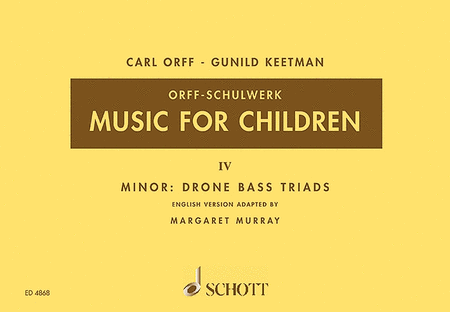
Music for Children

$21.99 19.09 € PDF SheetMusicPlus


Partitions Gratuites
Acheter des Partitions Musicales
Acheter des Partitions Digitales à Imprimer
Acheter des Instruments de Musique

© 2000 - 2026

Accueil - Version intégrale





