EUROPE
6706 articles
USA
0 articles
DIGITAL
13175 articles (à imprimer)
Partitions Digitales
Partitions à imprimer
13175 partitions trouvées


String quartet - advanced - Digital Download SKU: S9.Q54881 Composed by Mike Curtis. This edition: score and parts. Klezmer - quartet - string instrument. Downloadable, Score and parts. Advance Music GmbH - Digital #Q54881. Published by Advance Music GmbH - Digital (S9.Q54881). A Klezmer Wedding is a set of four dances, newly-composed but based on traditional models. The Doina is an expressive chant for three successive soloists; it twists and turns with the wailing lament of a shepherd's pipe. Next follows the Hora, a slow Rumanian dance in three with a mood that reflects the wedding's solemn vows. A Chusidl, with a moderate speed and bouncy rhythms, gets the party to the dance floor. The concluding Freylach (happy, but still in a minor key!) takes the bride, groom, and guests to the edge of frenzy.
A Klezmer Wedding
Quatuor à cordes: 2 violons, alto, violoncelle

$17.99 15.62 € Quatuor à cordes: 2 violons, alto, violoncelle PDF SheetMusicPlus

Woodwind Ensemble Flute - Level 5 - Digital Download SKU: A0.582048 Composed by Peter Warlock. Arranged by John Gibson. Contemporary. 63 pages. JB Linear #4642171. Published by JB Linear (A0.582048). Warlock's Capriol Suite is a set of 6 dances that freely utilize songs found in a Renaissance dancing guide. They vary from soft, gentle pieces to vigorous dance forms. Warlock did not simply transcribe these songs, but added his own touches, sometimes with surprising combinations. So....even if something sounds a little wrong, most likely it is not! Five movements are presented here. They include Basse-Danse, Pavane,  Bransles, Pieds-en-l'air, and Mattachins (Sword Dance). This setting of the string orchestra version for FLUTE CHOIR by John Gibson is for Piccolo, Flute 1 - 3, Alto Flute, and Bass Flute.
Capriol Suite

$19.25 16.71 € PDF SheetMusicPlus

Woodwind Ensemble Bass Clarinet,E-Flat Clarinet - Level 5 - Digital Download SKU: A0.582043 Composed by Peter Warlock. Arranged by John Gibson. Contemporary. 95 pages. JB Linear #4621593. Published by JB Linear (A0.582043). Warlock's Capriol Suite is a set of 6 dances that freely utilize songs found in a Renaissance  dancing guide. They vary from soft, gentle pieces to vigorous dance forms. Warlock did not simply transcribe these songs, but added his own touches, sometimes with surprising combinations. So....even if something sounds a little wrong, most likely it is not! The movements include Basse-Danse, Pavane, Tordion, Bransles, Pieds-en-l'air, and Mattachins (Sword Dance). This setting of the string orchestra version for CLARINET CHOIR BY JOHN GIBSON IS FOR Eb SOPRANO, Bb SOPRANO 1-3 ALTO, BASS, AND CONTRA. THERE IS AN ALTERNATE PART IF THERE IS NO ALTO.
Capriol Suite

$19.25 16.71 € PDF SheetMusicPlus

Small Ensemble Clarinet,Piano,Viola - Level 5 - Digital Download SKU: A0.1509169 Composed by Ulrich Lehensteiner. 21st Century,Chamber,Classical,Contemporary,Halloween. 32 pages. Ulrich Lehensteiner #1084420. Published by Ulrich Lehensteiner (A0.1509169). The devil dances Trepak! A truly devilishly fast-paced piece in the form of a russian folk-dance. Don't be fooled by the moderate opening, because the unpredictably sudden dynamic changes and continiuous increase of drive and tempo make this piece feel like an invitation to dance from the devil himself.This piece is part of the Paranormania-Trio, a collection of five pieces depicting various supernatural, halloween-esque scenes, like visiting a witch's lair, watching ghosts assemble, or summoning demons.
Devilish Trepak (from the "Paranormania"-Trio)

$19.99 17.36 € PDF SheetMusicPlus

String Quartet String Quartet - Level 4 - Digital Download SKU: A0.881367 Composed by Maurice Ravel. Arranged by Ted Lucas. 20th Century,Contemporary. 39 pages. Tuxedo Music Publishing #5022161. Published by Tuxedo Music Publishing (A0.881367). Rigaudon is the fourth dance in Ravel’s popular piano suite Le Tombeau de Couperin and one of the most well known.. Ravel liked Le Tombeau so much that he later orchestrated four of the dances, ending with Rigaudon. Arranged by accomplished violinist Ted Lucas, who has decades of string quartet experience, this lively dance is a perfect concert-opener or an ideal closer as an encore. This is the only piece in Le Tombeau where Ravel did not include a metronome marking, so it can be played at any spritely tempo you are comfortable with. Take a listen to part of it.
Rigaudon - Score and Parts
Quatuor à cordes: 2 violons, alto, violoncelle

$8.99 7.81 € Quatuor à cordes: 2 violons, alto, violoncelle PDF SheetMusicPlus

Concert Band - Level 5 - Digital Download SKU: A0.1007977 Composed by Herman Koenig. Arranged by John M. Laverty. Romantic Period. Score and parts. 113 pages. Zephyrwindmusic.com #4348177. Published by zephyrwindmusic.com (A0.1007977). The Trumpet Polka, first published in 1856 as part of the Jullien Military Band Journal is a typical composition composed for and used as dance music during the Victorian era. It employees both trumpets and cornets, showcasing the trumpets. The form is that of a dance piece, with large repeated sections designed to be choreographed by a large group of dances, an activity popular at the time. While there is much known about Herman Koenig (1815-1870), there is much that is still somewhat of a mystery, like exactly where he was born and died. What is known is that he was perhaps the ï¬rst cornetist who was indeed an international star. Born in Germany, he became well-known in London as a featured soloist in Louis Jullien’s famous Drury Lane Orchestra in the 1840s. His travels took him to America in 1853 with Jullien in what was the ï¬rst major tour of a European orchestra in America. He also played violin, was a composer and publisher, a music educator, and he helped design and market a cornet, what is known today as the Koenig Cornet.
The Trumpet Polka
Orchestre d'harmonie

$40.00 34.73 € Orchestre d'harmonie PDF SheetMusicPlus

Instrumental Solo,Piano,Violin - Level 1 - Interactive Download SKU: A0.1346471 By Traditional Fiddle Tunes. By Trad. Arranged by Heather M Music. This edition: Interactive Download. Folk,World. Individual part. 4 pages. Duration 96. Heather Mueller Music #2jaB4YxSxACShxCfDInGf2. Published by Heather Mueller Music (A0.1346471). Key: G major.Presenting Dancing Bear: Traditional Fiddle Tunes Step into the lively world of American contra dancing with Dancing Bear, a delightful addition to our Traditional Fiddle Tunes collection. Crafted for fiddlers and violinists, this sheet music invites you to explore the dynamic rhythms of American contra, providing an authentic and invigorating musical experience. Key Features: Interactive Learning: Elevate your playing with adjustable speeds and explore different keys, allowing for personalized practice and seamless integration into contra dance performances. Americana Delight: Immerse yourself in the classic and folk elements of American fiddling, as Dancing Bear captures the vibrant spirit and cultural nuances of this cherished tradition. Versatile Repertoire: Uncover the beauty of these traditional tunes, perfect for contra dances and other social gatherings, showcasing the enduring legacy of American fiddle tunes. Add Dancing Bear to your Fiddler's Repertoire and let the lively melodies become an integral part of your musical expression. Expand your Sheet Music Catalog with this authentic piece of American contra dance tradition, designed to resonate with violinists seeking the perfect blend of tradition and innovation.
Dancing Bear
Violon et Piano
Traditional Fiddle Tunes
$2.99 2.6 € Violon et Piano PDF SheetMusicPlus

Violin Solo - Level 4 - Digital Download SKU: A0.966341 Composed by Martin Bonk. Contemporary,Jazz,World. 2 pages. Martin Bonk #2858375. Published by Martin Bonk (A0.966341). The Elf Suite is a piece for solo violin and consists of a March, Dance, Polka, and Waltz and chronicles what I believe to be the events on the day of an Elvian Ball. The March allows some improvisation in the beginning using ricochet and glissando harmonics to  imitate the snoring sounds of the elves  and also at the end there is improv as the march devolves into chaos. The music incorporates odd meters and scales. The Dance of the Elves  was written for and premiered by Eva Ingolf in 2015 at The Composers' Forum in New York and was the first piece written of the suite and he entire Suite was premiered in Sao Paolo Brazil in 2016 by Stephanie Stasiu Bonk.  The entire suite's performance takes about 11 minutes with individual dances 1 1/2 to 3 1/2 minutes in length.
Elf Suite for Solo Violin
Violon

$5.99 5.2 € Violon PDF SheetMusicPlus

Saxophone Quartet,Woodwind Ensemble Alto Saxophone,Baritone Saxophone,Soprano Saxophone,Tenor Saxophone - Level 4 - Digital Download SKU: A0.1407234 Composed by Johann Sebastian Bach. Arranged by James M. Guthrie. Baroque,Chamber,Contest,Festival,Historic,Standards. 261 pages. Jmsgu3 #989925. Published by jmsgu3 (A0.1407234). The importance of Bach's French Suites lies in their unique blend of French and Italian styles despite the misleading title. These suites, composed between 1722 and 1725 for the clavier, showcase Bach's mastery in stylizing traditional dances like allemandes, courantes, sarabandes, and gigues. While named French Suites by later sources like Johann Nikolaus Forkel, they follow Italian conventions with some French influences. The suites offer a rich musical experience, bridging different European styles and serving as valuable teaching pieces. Bach's French Suites are a testament to his compositional genius and continue to be cherished by musicians and audiences alike. The history behind Bach's French Suites is intertwined with a bittersweet period in Bach's life. In May 1720, Bach embarked on a trip, leaving his wife, Maria Barbara, and four children. Tragically, upon his return, he discovered that Maria Barbara had passed away. This loss led to a significant change in Bach's personal life as he became a single father mourning his wife. Despite this tragedy, Bach found love again with Anna Magdalena Wülcken, whom he married. As a gesture of affection and to cultivate her musical skills, Bach composed music for Anna Magdalena, including what would later become the French Suites. These suites were likely performed at court and reflected the couple's intimate musical companionship. The French Suites were not published during Bach's lifetime, possibly because he did not deem it challenging enough. Today, these suites offer an accessible path to Bach's music and are cherished for their stylized dance movements inspired by French and Italian forms.
Bach: The Six French Suites Complete for Saxophone Quartet
Quatuor de Saxophones: 4 saxophones

$98.85 85.83 € Quatuor de Saxophones: 4 saxophones PDF SheetMusicPlus

Woodwind Ensemble,Woodwind Quartet - Level 4 - Digital Download SKU: A0.1407178 Composed by Johann Sebastian Bach. Arranged by James M. Guthrie. Baroque,Chamber,Contest,Festival,Historic,Standards. 25 pages. Jmsgu3 #989877. Published by jmsgu3 (A0.1407178). The importance of Bach's French Suites lies in their unique blend of French and Italian styles despite the misleading title. These suites, composed between 1722 and 1725 for the clavier, showcase Bach's mastery in stylizing traditional dances like allemandes, courantes, sarabandes, and gigues. While named French Suites by later sources like Johann Nikolaus Forkel, they follow Italian conventions with some French influences. The suites offer a rich musical experience, bridging different European styles and serving as valuable teaching pieces. Bach's French Suites are a testament to his compositional genius and continue to be cherished by musicians and audiences alike. The history behind Bach's French Suites is intertwined with a bittersweet period in Bach's life. In May 1720, Bach embarked on a trip, leaving his wife, Maria Barbara, and four children. Tragically, upon his return, he discovered that Maria Barbara had passed away. This loss led to a significant change in Bach's personal life as he became a single father mourning his wife. Despite this tragedy, Bach found love again with Anna Magdalena Wülcken, whom he married. As a gesture of affection and to cultivate her musical skills, Bach composed music for Anna Magdalena, including what would later become the French Suites. These suites were likely performed at court and reflected the couple's intimate musical companionship. The French Suites were not published during Bach's lifetime, possibly because he did not deem it challenging enough. Today, these suites offer an accessible path to Bach's music and are cherished for their stylized dance movements inspired by French and Italian forms.
Bach: French Suite No. 1, BWV 812, for Saxophone Quartet - Score Only
Quatuor de Saxophones: 4 saxophones

$32.95 28.61 € Quatuor de Saxophones: 4 saxophones PDF SheetMusicPlus

Woodwind Ensemble,Woodwind Quartet - Level 4 - Digital Download SKU: A0.1406743 Composed by Johann Sebastian Bach. Arranged by James M. Guthrie. Baroque,Chamber,Contest,Festival,Historic,Standards. 20 pages. Jmsgu3 #989498. Published by jmsgu3 (A0.1406743). The importance of Bach's French Suites lies in their unique blend of French and Italian styles despite the misleading title. These suites, composed between 1722 and 1725 for the clavier, showcase Bach's mastery in stylizing traditional dances like allemandes, courantes, sarabandes, and gigues. While named French Suites by later sources like Johann Nikolaus Forkel, they follow Italian conventions with some French influences. The suites offer a rich musical experience, bridging different European styles and serving as valuable teaching pieces. Despite the misleading title, Bach's French Suites are a testament to his compositional genius and continue to be cherished by musicians and audiences alike. The history behind Bach's French Suites is intertwined with a bittersweet period in Bach's life. In May 1720, Bach embarked on a trip, leaving his wife, Maria Barbara, and four children. Tragically, upon his return, he discovered that Maria Barbara had passed away. This loss led to a significant change in Bach's personal life as he became a single father mourning his wife. Despite this tragedy, Bach found love again with Anna Magdalena Wülcken, whom he married. As a gesture of affection and to cultivate her musical skills, Bach composed music for Anna Magdalena, including what would later become the French Suites. These suites were likely performed at court and reflected the couple's intimate musical companionship. The French Suites were not published during Bach's lifetime, possibly because he did not deem it challenging enough. Today, these suites offer an accessible path to Bach's music and are cherished for their stylized dance movements inspired by French and Italian forms.

Bach: French Suite No. 6, BWV 817, for Saxophone Quartet - Score Only
Quatuor de Saxophones: 4 saxophones

$32.95 28.61 € Quatuor de Saxophones: 4 saxophones PDF SheetMusicPlus

Saxophone Quartet,Woodwind Ensemble Alto Saxophone,Baritone Saxophone,Soprano Saxophone,Tenor Saxophone - Level 4 - Digital Download SKU: A0.1404877 Composed by Johann Sebastian Bach. Arranged by James M. Guthrie. Baroque,Chamber,Contest,Festival,Historic,Standards. 44 pages. Jmsgu3 #987907. Published by jmsgu3 (A0.1404877). The importance of Bach's French Suites lies in their unique blend of French and Italian styles despite the misleading title. These suites, composed between 1722 and 1725 for the clavier, showcase Bach's mastery in stylizing traditional dances like allemandes, courantes, sarabandes, and gigues. While named French Suites by later sources like Johann Nikolaus Forkel, they follow Italian conventions with some French influences. The suites offer a rich musical experience, bridging different European styles and serving as valuable teaching pieces. Despite the misleading title, Bach's French Suites are a testament to his compositional genius and continue to be cherished by musicians and audiences alike.The history behind Bach's French Suites is intertwined with a bittersweet period in Bach's life. In May 1720, Bach embarked on a trip, leaving his wife, Maria Barbara, and four children. Tragically, upon his return, he discovered that Maria Barbara had passed away. This loss led to a significant change in Bach's personal life as he became a single father mourning his wife. Despite this tragedy, Bach found love again with Anna Magdalena Wülcken, whom he married. As a gesture of affection and to cultivate her musical skills, Bach composed music for Anna Magdalena, including what would later become the French Suites. These suites were likely performed at court and reflected the couple's intimate musical companionship. The French Suites were not published during Bach's lifetime, possibly because he did not deem it challenging enough. Today, these suites offer an accessible path to Bach's music and are cherished for their stylized dance movements inspired by French and Italian forms.

Bach: French Suite No. 2, BWV 813, for Saxophone Quartet
Quatuor de Saxophones: 4 saxophones

$52.95 45.98 € Quatuor de Saxophones: 4 saxophones PDF SheetMusicPlus

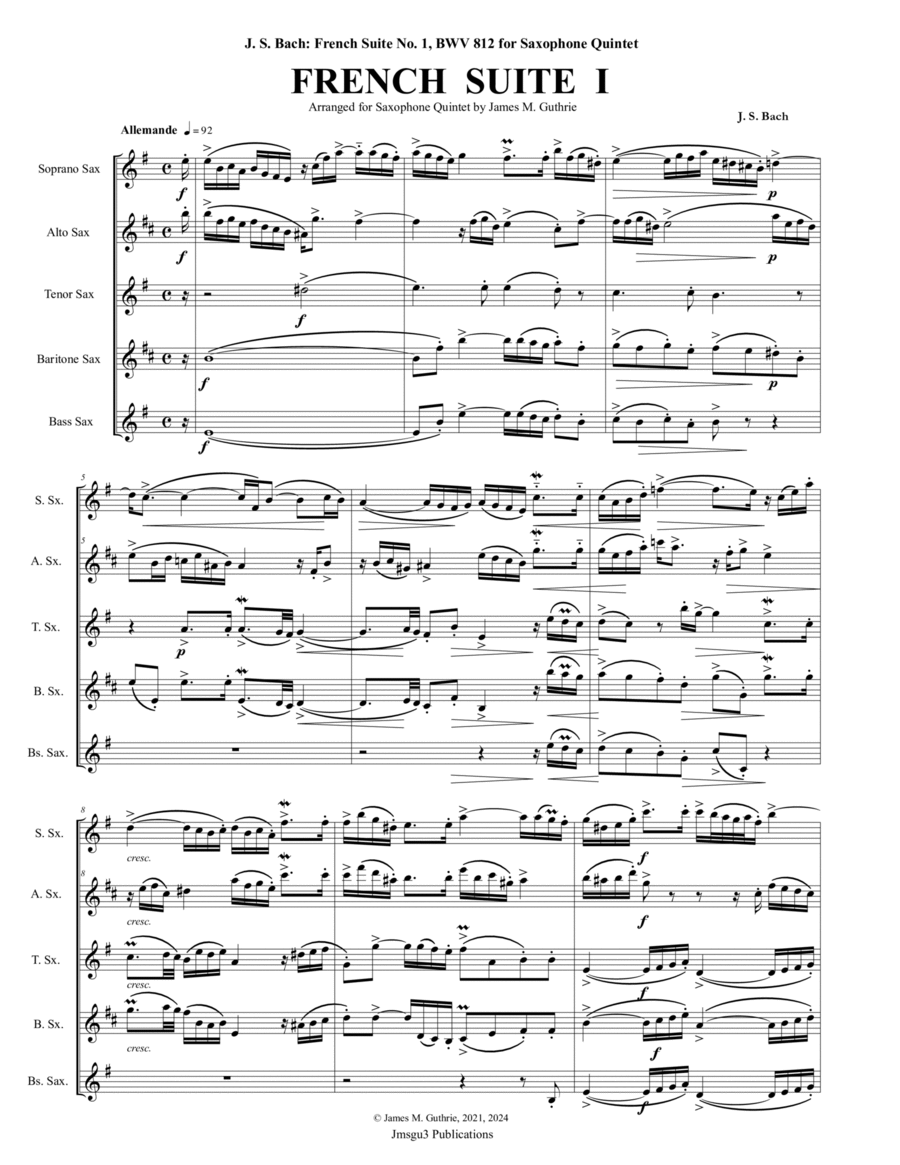
Saxophone Quintet,Woodwind Ensemble Alto Saxophone,Baritone Saxophone,Bass Saxophone,Soprano Saxophone,Tenor Saxophone - Level 4 - Digital Download SKU: A0.1404856 Composed by Johann Sebastian Bach. Arranged by James M. Guthrie. Baroque,Chamber,Contest,Festival,Historic,Standards. 36 pages. Jmsgu3 #987886. Published by jmsgu3 (A0.1404856). The importance of Bach's French Suites lies in their unique blend of French and Italian styles despite the misleading title. These suites, composed between 1722 and 1725 for the clavier, showcase Bach's mastery in stylizing traditional dances like allemandes, courantes, sarabandes, and gigues. While named French Suites by later sources like Johann Nikolaus Forkel, they follow Italian conventions with some French influences. The suites offer a rich musical experience, bridging different European styles and serving as valuable teaching pieces. Despite the misleading title, Bach's French Suites are a testament to his compositional genius and continue to be cherished by musicians and audiences alike.The history behind Bach's French Suites is intertwined with a bittersweet period in Bach's life. In May 1720, Bach embarked on a trip, leaving his wife, Maria Barbara, and four children. Tragically, upon his return, he discovered that Maria Barbara had passed away. This loss led to a significant change in Bach's personal life as he became a single father mourning his wife. Despite this tragedy, Bach found love again with Anna Magdalena Wülcken, whom he married. As a gesture of affection and to cultivate her musical skills, Bach composed music for Anna Magdalena, including what would later become the French Suites. These suites were likely performed at court and reflected the couple's intimate musical companionship. The French Suites were not published during Bach's lifetime, possibly because he did not deem it challenging enough. Today, these suites offer an accessible path to Bach's music and are cherished for their stylized dance movements inspired by French and Italian forms.

Bach: French Suite No. 1, BWV 812, for Saxophone Quintet
Quintette de Saxophone: 5 saxophones

$52.95 45.98 € Quintette de Saxophone: 5 saxophones PDF SheetMusicPlus

Saxophone Quartet,Woodwind Ensemble Alto Saxophone,Baritone Saxophone,Soprano Saxophone,Tenor Saxophone - Level 4 - Digital Download SKU: A0.1407094 Composed by Johann Sebastian Bach. Arranged by James M. Guthrie. Baroque,Chamber,Contest,Festival,Historic,Standards. 42 pages. Jmsgu3 #989793. Published by jmsgu3 (A0.1407094). The importance of Bach's French Suites lies in their unique blend of French and Italian styles despite the misleading title. These suites, composed between 1722 and 1725 for the clavier, showcase Bach's mastery in stylizing traditional dances like allemandes, courantes, sarabandes, and gigues. While named French Suites by later sources like Johann Nikolaus Forkel, they follow Italian conventions with some French influences. The suites offer a rich musical experience, bridging different European styles and serving as valuable teaching pieces. Despite the misleading title, Bach's French Suites are a testament to his compositional genius and continue to be cherished by musicians and audiences alike. The history behind Bach's French Suites is intertwined with a bittersweet period in Bach's life. In May 1720, Bach embarked on a trip, leaving his wife, Maria Barbara, and four children. Tragically, upon his return, he discovered that Maria Barbara had passed away. This loss led to a significant change in Bach's personal life as he became a single father mourning his wife. Despite this tragedy, Bach found love again with Anna Magdalena Wülcken, whom he married. As a gesture of affection and to cultivate her musical skills, Bach composed music for Anna Magdalena, including what would later become the French Suites. These suites were likely performed at court and reflected the couple's intimate musical companionship. The French Suites were not published during Bach's lifetime, possibly because he did not deem it challenging enough. Today, these suites offer an accessible path to Bach's music and are cherished for their stylized dance movements inspired by French and Italian forms.

Bach: French Suite No. 6, BWV 817, for Saxophone Quartet
Quatuor de Saxophones: 4 saxophones

$52.95 45.98 € Quatuor de Saxophones: 4 saxophones PDF SheetMusicPlus

Woodwind Ensemble - Level 4 - Digital Download SKU: A0.1405104 Composed by Johann Sebastian Bach. Arranged by James M. Guthrie. Baroque,Chamber,Contest,Festival,Historic,Standards. 16 pages. Jmsgu3 #988142. Published by jmsgu3 (A0.1405104). The importance of Bach's French Suites lies in their unique blend of French and Italian styles despite the misleading title. These suites, composed between 1722 and 1725 for the clavier, showcase Bach's mastery in stylizing traditional dances like allemandes, courantes, sarabandes, and gigues. While named French Suites by later sources like Johann Nikolaus Forkel, they follow Italian conventions with some French influences. The suites offer a rich musical experience, bridging different European styles and serving as valuable teaching pieces. Despite the misleading title, Bach's French Suites are a testament to his compositional genius and continue to be cherished by musicians and audiences alike.The history behind Bach's French Suites is intertwined with a bittersweet period in Bach's life. In May 1720, Bach embarked on a trip, leaving his wife, Maria Barbara, and four children. Tragically, upon his return, he discovered that Maria Barbara had passed away. This loss led to a significant change in Bach's personal life as he became a single father mourning his wife. Despite this tragedy, Bach found love again with Anna Magdalena Wülcken, whom he married. As a gesture of affection and to cultivate her musical skills, Bach composed music for Anna Magdalena, including what would later become the French Suites. These suites were likely performed at court and reflected the couple's intimate musical companionship. The French Suites were not published during Bach's lifetime, possibly because he did not deem it challenging enough. Today, these suites offer an accessible path to Bach's music and are cherished for their stylized dance movements inspired by French and Italian forms.

Bach: French Suite No. 3 , BWV 814, for Saxophone Quartet - Score Only
Quatuor de Saxophones: 4 saxophones

$32.95 28.61 € Quatuor de Saxophones: 4 saxophones PDF SheetMusicPlus


Partitions Gratuites
Acheter des Partitions Musicales
Acheter des Partitions Digitales à Imprimer
Acheter des Instruments de Musique

© 2000 - 2026

Accueil - Version intégrale
