EUROPE
6706 articles
USA
0 articles
DIGITAL
13174 articles (à imprimer)
Partitions Digitales
Partitions à imprimer
13174 partitions trouvées


Alto Saxophone,Piano - Level 3 - Digital Download SKU: A0.1266549 Composed by Antonin Dvorak. Arranged by Diego Marani. Classical,Contest,Festival,Folk,Instructional,Romantic Period. Score and part. 10 pages. Diego Marani #859222. Published by Diego Marani (A0.1266549). The Slavonic Dances are a series of 16 orchestral pieces composed by Antonín Dvořák in 1878 and 1886 and published in two sets. Originally written for piano four hands, the Slavonic Dances were inspired by Johannes Brahms's own Hungarian Dances and were orchestrated at the request of Dvořák's publisher soon after composition. The pieces, lively and full of national character, were well received at the time and today are considered among the composer's most memorable works, occasionally making appearances in popular culture. This arrangement for alto sax (or baritone sax) with piano accompaniment of the marvelous and nostalgic dance no. 2 is suitable for classroom, repertoire, recital or for a thoughtful encore.
Slavonic Dance Op. 72 No. 2 for Alto Saxophone and Piano
Saxophone Alto et Piano

$9.99 8.67 € Saxophone Alto et Piano PDF SheetMusicPlus

Piano,Soprano Saxophone - Level 3 - Digital Download SKU: A0.1270348 Composed by Antonin Dvorak. Arranged by Diego Marani. Classical,Contest,Festival,Folk,Instructional,Romantic Period. Score and part. 12 pages. Diego Marani #862758. Published by Diego Marani (A0.1270348). The Slavonic Dances are a series of 16 orchestral pieces composed by Antonín Dvořák in 1878 and 1886 and published in two sets. Originally written for piano four hands, the Slavonic Dances were inspired by Johannes Brahms's own Hungarian Dances and were orchestrated at the request of Dvořák's publisher soon after composition. The pieces, lively and full of national character, were well received at the time and today are considered among the composer's most memorable works, occasionally making appearances in popular culture. This arrangement for soprano sax (or tenor sax) with piano accompaniment of the marvelous dance no. 2 (Dumka) is suitable for classroom, repertoire, recital or for a thoughtful encore.
Slavonic Dance Op. 46 No. 2 for Soprano Saxophone and Piano
Saxophone Soprano et Piano

$9.99 8.67 € Saxophone Soprano et Piano PDF SheetMusicPlus

Digital Download SKU: A0.1471488 Composed by Robert A. Howard. 20th Century,Classical,Contemporary,Halloween,Thriller. 30 pages. Robert A. Howard #1049261. Published by Robert A. Howard (A0.1471488). This work aims to depict a common theme of certain pieces by some classical composers: that of deathly or devilish dances, and the like. This piece is an extended single movement structure for a mixed chamber ensemble that is an octet of oboe, 2 clarinets, bassoon, piano, viola, cello, and double bass. The form is divided into a series of contrasting dances (labelled as Dance, Folk Lament, Jig, Meditation, and Funeral March), all of which are interspersed with differing statements of an ostinato-based 'chorale' idea on the piano. The whole work is framed by an 'intrada', which builds the germinal motif on which the whole piece is based, characterised by semitones and fourths. Indeed, the 'devil's interval' of the augmented fourth has a particular function and significance. The piece actually ends with an 'epilogue', which features mysterious and ghostly reminiscences of the previous main sections. The title of this work also refers to the episode 'Dance of the Dead' from the 1960s cult TV series 'The Prisoner'. In part, the piece attempts to capture the mystery and atmosphere of the series, and of that specific episode. Indeed, the music's series of related but contrasting sections act almost as an original sequence of dramatic TV incidental music cues. The work is accessible to both performers and audience alike. The attached document is the full score only, with audio provided.Duration: 11 minutes 40 minutes.Registered with PRS (Performing Rights Society, UK).Composer's website: www.roberthowardmusic.co.uk
Dances of the Dead - Score Only

$8.99 7.8 € PDF SheetMusicPlus

String quartet - Digital Download SKU: MQ.LMP046-E Composed by Kareem Roustom. 46 pages. MorningStar Music Publishers - Digital Sheet Music #LMP046-E. Published by MorningStar Music Publishers - Digital Sheet Music (MQ.LMP046-E). These Four Dances from CLORINDA AGONISTES (Clorinda the warrior) are taken from a recently completed dramatic work; a hybrid opera & dance theatre work currently of the same title. The name Clorinda comes from Monteverdi’s opera Il Combattimento di Tancredi e Clorinda , whose libretto is from the epic poem by Tasso titled, Gerusalemme Liberata (Jerusalem Liberated). The dramatic work, which was commissioned by the London based Shobana Jeyasingh Dance company, the Sadler’s Wells Theatre and the Royal Philharmonic Society, was composed as a companion piece to Monteverdi’s Il Combattimento. Contents: I. Transitions II. Pursuit III. Shawq شوق (Yearning) IV. Unity (We dance together)
Four Dances from Clorinda Agonistes (Full Score)
Quatuor à cordes: 2 violons, alto, violoncelle

$27.00 23.43 € Quatuor à cordes: 2 violons, alto, violoncelle PDF SheetMusicPlus

Fl. Afl. (guit/kbd) - Intermediate-Advanced - Digital Download SKU: F2.FM628 Composed by Alexandra Lehmann. A set of dances for flute and alto flute duet. Score. 6 pages. Forton Music - Digital #FM628. Published by Forton Music - Digital (F2.FM628). ISBN 9790570485277.'Plateau of Dances with a Scottish Flavour' Plateau of Dances with a Scottish Flavour was composed in autumn 2016, Eastbourne, and is inspired by my childhood in Doune, Perthshire; as well as the Ceilidhs and Feis (cultural festival in the Highlands) my daughter, Clara, and I were immersed in when we lived in the picturesque village of Kingussie, Badenoch and Strathspey. The four dances are a celebration of my love and nostalgia for Scotland, and an expression of my family's Scottish memories. Each dance comes with a quote from my favourite poet, Robert Burns, whose insightful and sensitive observations are a poignant appreciation of everyday life. Why the reference to Scottish food? Because this piece is dedicated to my father, Papou, who appreciates a merry supper. The 1st Movement, 'To the Mighty Haggis', is a Strathspey with its characteristic Scotch snap -a short-long rhythm, as if saying the word 'haggis'; which is fitting as the Scottish bard's quote comes from his poem Address to a Haggis, traditionally said on Burns' Night. The 2nd Movement, 'The Humble Shortbread', is a Reel; as is usually the case in Scottish dances. It should be played with a slightly 'snappy', swung rhythm. 'What though on homely fare we dine, [...] A man is a man for all that' comes from my favourite Burns' poem: A Man's a Man for A' That. And who doesn't enjoy the humble shortbread? There is a more reflective, nostalgic mood to the 3rd Movement, 'Ode to the Homely (salty) Porridge'. The Air is a reminiscence of the quiet evenings Clara and I would spend in Kingussie, with our view of the beautifully haunting mountains. 'What will I get to my supper, [...] Ye'se get a panfu' o' plumpin parridge' comes from Burns' The Shepherd's Wife who tries to entice her husband back home with the promise of porridge (the Scottish way: with salt). Finally, the 4th Movement, 'Too Many Drams of Whisky', is a cheerful and lively Jig. It's the convivial merriness of being with friends and family, maybe at a Ceilidh, with a wink to Scotland's 'water of life'. 'We'll tak a cup o' kindness yet, For auld lang syne' comes from Burns' famous Auld Lang Syne: a fitting end to our musical and culinary tour of Scotland.
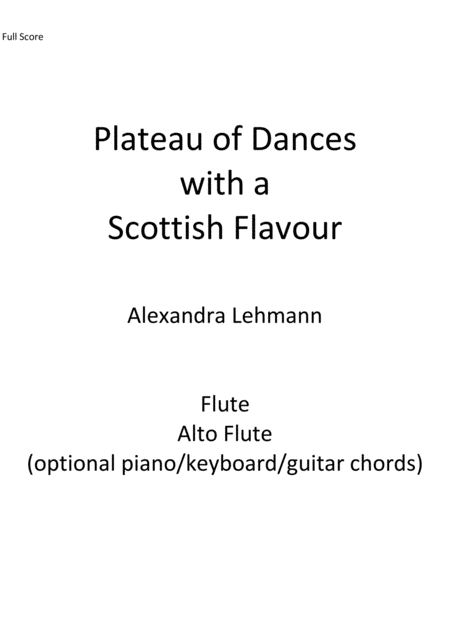
Plateau of Dances with a Scottish Flavour

$7.95 6.9 € PDF SheetMusicPlus

Saxophone Quartet,Woodwind Ensemble Alto Saxophone,Baritone Saxophone,Soprano Saxophone,Tenor Saxophone - Level 4 - Digital Download SKU: A0.764696 Composed by Pyotr Ilyich Tchaikovsky (1840-1893). Arranged by James Pybus. Classical. 9 pages. James Pybus #4626349. Published by James Pybus (A0.764696). Swan Lake Op. 20 is a ballet composed by Pyotr Ilyich Tchaikovsky in 1875–76. Despite its initial failure, it is now one of the most popular of all ballets. The Neapolitan Dance occurs in Act III of the ballet. It was famously danced in the 1980s in London’s Covent Garden by Wayne Sleep and Rosemary Taylor. This arrangement for SATB Saxophone Quartet features the soprano saxophone in a slower section at the beginning followed by a lively vivace section, which is then repeated. The duration is 2:22. Please contact me at james.pybus56@gmail.com.
Neapolitan Dance from Swan Lake
Quatuor de Saxophones: 4 saxophones

$15.00 13.02 € Quatuor de Saxophones: 4 saxophones PDF SheetMusicPlus

Bassoon,Clarinet,Double Bass,Flute,Horn,Oboe - Level 3 - Digital Download SKU: A0.1310667 Composed by Edvard Grieg. Arranged by Ray Thompson. 20th Century,Chamber,Romantic Period. 18 pages. RayThompsonMusic #899645. Published by RayThompsonMusic (A0.1310667). Arranged wind dectet and bass.Edvard Grieg 4 Norwegian Dances Op.35Arranged wind dectet/bass.This is my arrangement of No 3Thanks to Runyon programm notes for the following extract..... (https://www.runyanprogramnotes.com)Grieg first wrote and published the Norwegian Dances as Piano duets in 1881.There are 4 Dance movements.The four movements are derived from traditional Norwegian folk tunes contained in a collection published in 1853 by Ludvig Mathias Lindemans, entitled, “Mountain Melodies Old and New.â€Â They were not orchestrated by Grieg, but later, in 1888, Hans Sitt, a distinguished Czech violinist, did the honors.   They have become orchestral chestnuts ever since.Almost everyone has heard the demure, sly and winsome second dance - available hereThis my arrangement of the third dance.Extract  from Runyon's programme notes:The third movement is shaped rather like the first, but is a march, rather than a halling, though.  Listen for the rather humorous interruption by the angry brass in frenzied triplets. My arrangement has the triplet figure played by  both clarinets,  1st horn and 1st bassoon.© 2015 William E. Runyan.
Grieg: 4 Norwegian Dances Op.35 No.III Allegro moderato alla Marcia - wind dectet/bass

$14.95 12.97 € PDF SheetMusicPlus

Instrumental Duet Bassoon,Clarinet,Instrumental Duet - Level 4 - Digital Download SKU: A0.956613 Composed by Antonin Dvorak. Arranged by Catriona Melville-Mason. Concert,Romantic Period,Standards. Score and parts. 7 pages. C Melville-Mason #6477753. Published by C Melville-Mason (A0.956613). Slavonic Dances Op 46, written in 1878, was something of a breakthrough work for Czech composer Antonin Dvorak, finally establishing his reputation well beyond his native land.  The dances are original melodies, inspired by, and drawing on, the character of traditional national dances, rather than works based on existing folk tunes, as was the fashion among composers at around that time.  These Slavonic Dances were originally written for piano 4 hands but, at his publisher’s request, Dvorak produced orchestrated versions shortly thereafter.  The pieces proved so popular that Dvorak composed a second set, Op. 72, in 1886. Op. 46, No. 3 is in the form of the polka, a dance which originated in Bohemia.  This arrangement, for mixed woodwind duo of B-flat clarinet and bassoon, is best suited to players of advanced intermediate standard or above.
Slavonic Dance Op. 46, No. 3 (Clarinet & Bassoon Duet)
Clarinette, Basson (duo)

$4.50 3.9 € Clarinette, Basson (duo) PDF SheetMusicPlus

Piano - Digital Download SKU: LV.12202 Composed by A. Reinagle. Lester S. Levy Collection. 13 pages. Published by Johns Hopkins University Sheridan Libraries (LV.12202). Francis's Ball Room Assistant [set of dances; includes instructions for dance steps]. Contains the following dances United States (Marine Cotillions); The Constellation; Speed the Plough (Country Dance); Grand March in Alexander the Great; The Constitution (Marine Cotillions); The Chesepeake; The. Music by A. Reinagle. Published [n.d.] by G. Willig, Market St. No.185 in Philadelphia. Composition of set of dance pieces with piano instrumentation. About The Lester S. Levy CollectionThe Lester S. Levy Collection of Sheet Music consists of over 29,000 pieces of American popular music. Donated to Johns Hopkins University Sheridan Libraries, the collection's strength is its thorough documentation of nineteenth-century American through popular music. This sheet music has been provided by Project Gado, a San Francisco Bay Area startup whose mission is to digitize and share the world's visual history.WARNING: These titles are provided as historical documents. Language and concepts within reflect the opinions and values of the time and may be offensive to some.
Francis's Ball Room Assistant
Piano seul

$5.99 5.2 € Piano seul PDF SheetMusicPlus

Small Ensemble - Level 3 - Digital Download SKU: A0.522161 Composed by Various. Arranged by Colin Kirkpatrick. Instructional,Renaissance. Score and parts. 4 pages. Colin Kirkpatrick Publications #3928085. Published by Colin Kirkpatrick Publications (A0.522161). By the time Michael Praetorius published his extensive dance collection entitled Terpsichore (terp-SIH-cory) in 1612, he was one of the most famous musicians in Germany. These two Voltas are well-known and lively dances and sure to add some sparkle to any event. This piece is arranged for virtually any combination of conventional wind instruments and percussion, with optional keyboard part. The first Volta uses interesting and catchy syncopation, giving the impression that it’s in duple time time but it’s written in triple time.In this series, Renaissance Hits for Wind Instruments, some of the most well-known dances from Terpsichore are included. They are all attractive pieces and are sure to be popular at any concerts or end-of-semester events. They are fairly easy to play too. The flexible arrangement makes them playable by all sorts of non-standard ensembles. The keyboard part enables you to use the piece as a solo or duet and trio for mixed instruments. This 4-part arrangement is presented in a single PDF file which includes the Full Score; Part 1 (C, B flat, E flat); Part 2 (C, B flat, E flat); Part 3 (C, F, B flat, E flat), Part 4 (C, B flat, E flat); Keyboard and Percussion. The optional keyboard part is intended as a guide and when possible the keyboard player should improvise around the part and chords shown. A piano sounds distinctly out of place in this music and a digital or acoustic harpsichord sounds more authentic. Most electronic keyboards have a harpsichord option.The percussion instruments used are similar to those found in elementary school music rooms and usually include a hand-held drum, clave or small headless tambourine. Two players are usually required and the parts can be interpreted quite freely. Other percussion instruments may be added as desired. Dance music is intended to be fun, and we hope that this arrangement brings you just that.  
Two Voltas - Dances 201 and 210 from Terpsichore (Praetorius) for Wind Instruments
the time Michael Praetorius published his extensive dance collection entitled Terpsichore (terp-SIH-cory) in 1612, he was one of the most famous musicians in Germany These two Voltas are well-known and lively dances and sure to add some sparkle to any event
$11.99 10.4 € PDF SheetMusicPlus

Full Orchestra - Level 3 - Digital Download SKU: A0.809809 Composed by Robert E. Proctor. Contemporary,Renaissance. Score and parts. 255 pages. R. E. Proctor #3417093. Published by R. E. Proctor (A0.809809). Dance Suite for Orchestra is, as the title suggests, a suite of Renaissance period dances, seven in all.  The music is a nostalgic look back with modern nuances.  The dances are: Allemande, Bourree, Galliard, Gigue, Pavane, Saltarello, and Sarabande.  Not based on any particular Renaissance composer’s work, simply an echo of music of that time.  Although it is written for full orchestra, not all instruments are used in every movement.  As in the Renaissance, each dance movement can be played separately, or, a few dances performed together without the entire suite being performed.  As such, this work is being offered as the complete suite and as individual movements.  The entire work is approximately 20 minutes and 4 seconds in length. 
Dance Suite for Orchestra
Orchestre

$29.95 25.99 € Orchestre PDF SheetMusicPlus

Orchestra, choir and 4 soloists ad. lib. - Digital Download SKU: S9.Q21225 From the opera The Midsummer Marriage. Composed by Sir Michael Tippett. This edition: study score. Choral music - Ernst Eulenburg - Score. Eulenburg Miniature Scores. Downloadable, Study score. Duration 29 minutes. Ernst Eulenburg & Co. GmbH - Digital #Q21225. Published by Ernst Eulenburg & Co. GmbH - Digital (S9.Q21225). English • German • French.Tippett’s decision to extract the four Ritual Dances from his opera 'The Midsummer Marriage' as a self-contained concert suite reflects the fact that the medium of dance was always present in his conception of the opera. From the start, there was to be an interaction within the opera between the real world and the world of mythology, partly Greek, partly Celtic. This mythological element culminates, in the finished opera, in the 'Ritual Dances' of Acts 2 and 3. Tippett himself described his opera as ‘a kind of elaborate 'L’après midi d’un faune’, in which the 'Ritual Dances' display a powerful sexual energy, though of a very different kind from Debussy’s voluptuous langour. Composition of The Midsummer Marriage occupied Tippett for six years from 1946 to 1952. The first performance of the Ritual Dances as a concert suite was given in Basel on 13 February 1953 by the Basel Kammerorchester conducted by Paul Sacher, and preceded the premiere of the complete opera by two years. Today the Ritual Dances rival the Concerto for Double String Orchestra (ETP 1331) as Tippett’s most widely-performed orchestral work.
Ritual Dances

$35.99 31.23 € PDF SheetMusicPlus

Piano,Vocal,Voice - Level 3 - Digital Download SKU: A0.794080 Composed by Richard Rodgers. Arranged by Dave Gingras, John E. Dosher. Contemporary. Score. 2 pages. DAVID LEE GINGRAS #6102045. Published by DAVID LEE GINGRAS (A0.794080). Ten Cents a Dance is a popular song in which a taxi dancer laments the hardships of her job. It was written by Lorenz Hart and Richard Rogers for the 1930 musical Simple Simon. Numerous artists have recorded the song, but we patterned this arrangement after Michelle Pfifer's version from the 1989 movie The Fabulous Baker Boys, the first song she sang in the movie after becoming the trio's singer. This is a relatively simple version, it sounds great and is fun to play - we hope you like it!
Ten Cents A Dance
Piano, Voix

$4.99 4.33 € Piano, Voix PDF SheetMusicPlus

Large Ensemble Bassoon,Clarinet,Double Bass,Flute,Horn,Oboe - Level 4 - Digital Download SKU: A0.553794 Composed by Antonin Dvorak. Arranged by Ray Thompson. Romantic Period,Standards,Wedding. Score and parts. 31 pages. RayThompsonMusic #4621337. Published by RayThompsonMusic (A0.553794). The Slavonic Dances (Czech: Slovanské tance) are a series of 16 orchestral pieces composed by Antonín Dvořák in 1878 and 1886 and published in two sets as Op. 46 and Op. 72 respectively. Originally written for piano four hands, the Slavonic Dances were inspired by Johannes Brahms's own Hungarian Dances and were orchestrated at the request of Dvořák's publisher soon after composition. The pieces, lively and full of national character, were well received at the time and today are considered among the composer's most memorable works, occasionally making appearances in popular culture. Contrary to what the title might suggest, the dances are not so much inspired by Slavic folk music generally, but specifically by styles and forms from Bohemia. In these pieces, Dvořák never actually quotes folk melodies, but evokes their style and spirit by using traditional rhythmic patterns and structures in keeping with traditional folk dances.This is my arrangement of No 7 from the first set Op.46This is titled SkoÄná  which is a rapid Slavic folk-dance, normally in 24 metre.Arranged double wind quintet and bass.
Dvorak: Slavonic Dances Op.46 No.7 in C minor (Skocná) - symphonic wind dectet/bass

$14.95 12.97 € PDF SheetMusicPlus

French Horn,Piano - Level 5 - Digital Download SKU: A0.1493279 Composed by Bela Bartok. Arranged by Ralph Sauer. 20th Century. Score and part. 16 pages. Gordon Cherry #1069934. Published by Gordon Cherry (A0.1493279). Bartok's Romanian Folk Dances is a short six-movement suite originally composed for Piano in 1915 and later arranged for Violin and Piano by Zoltan Szekely. The six movements are:Stick DanceSash DanceStanding StillHorn DanceRomanian PolkaFast DanceThe movements are in the following modes (Dorian, Aeolian, Mixolydian and Lydian), which along with unique harmonies give them a very exotic sound. The Suite takes about five minutes to perform and is suitable for advanced performers.
Romanian Folk Dances for Horn and Piano
Cor et Piano

$27.50 23.86 € Cor et Piano PDF SheetMusicPlus


Partitions Gratuites
Acheter des Partitions Musicales
Acheter des Partitions Digitales à Imprimer
Acheter des Instruments de Musique

© 2000 - 2026

Accueil - Version intégrale





